Hello! Welcome to your next lesson in the "Structured Argumentation and Debate" module.
In our previous lesson, you learned how to construct a logically sound argument by building a clear claim on a foundation of true, relevant, and sufficient premises. That was about building a solid structure. Today, we'll focus on the flip side: learning how to spot and dismantle faulty structures.
Your learning outcome for this lesson is to identify common logical fallacies (e.g., ad hominem, straw man, false dichotomy) in your own and others' arguments. A logical fallacy is essentially an error in reasoning that weakens an argument, making it invalid or unsound.
Mastering this skill is crucial for your goals. In a debate or a "hot-seat" situation, being able to quickly recognize a flawed argument in your opponent's reasoning gives you a powerful advantage. It allows you to target the weakest point in their case precisely. It also helps you avoid making these errors yourself, making your own arguments more resilient. For someone with an introverted nature, recognizing these logical patterns can also reduce the cognitive load of a fast-paced conversation, freeing up mental energy to focus on the substance of the discussion.
1. What is a Logical Fallacy?
At its core, a fallacy is a defect in an argument that consists of something other than false premises. It's a common trick of reasoning that can be used accidentally or intentionally to deceive.
To start, let's get a clear definition and see how fallacies can be categorized.
2.5: Logical Fallacies - How to Spot Them and Avoid ...
This article from the LibreTexts project provides a great introduction to logical fallacies. It defines them and introduces a helpful way of categorizing them based on the three rhetorical appeals we discussed in a previous module: ethos, logos, and pathos.
Please read the sections 'Logical Fallacies -- Definition' and 'Evaluating an Argument for Logical Fallacies'. Focus on the distinction between formal and informal fallacies, and understand how fallacies can undermine appeals to ethos (credibility), logos (logic), and pathos (emotion).
As the text explains, we can group fallacies in several ways. The ethos-logos-pathos framework is intuitive. Another, more rigorous way—which may appeal to your background in economics—is to distinguish between errors in an argument's structure versus its content.
- Formal Fallacies: The error is in the logical structure of the argument itself. The conclusion doesn't follow from the premises, even if the premises were true.
- Informal Fallacies: The argument's structure might be fine, but the premises are irrelevant, insufficient, or rely on emotional manipulation or other "rules-breaking" tactics of honest debate. Most fallacies you'll encounter in daily life are informal.
2. A Field Guide to Common Fallacies
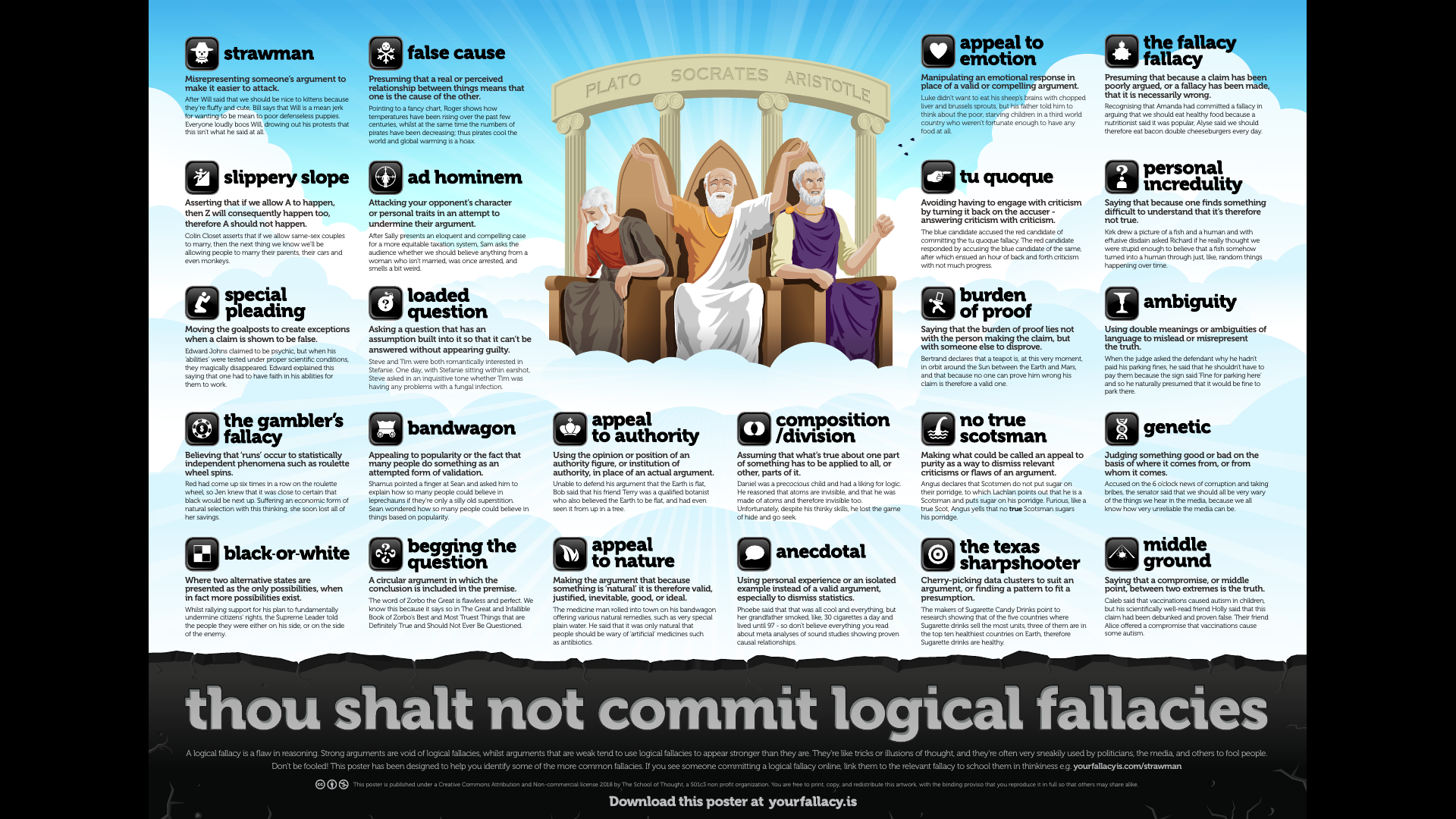
There are hundreds of named fallacies, but you only need to know a handful to spot the vast majority of flawed arguments. Let's take a quick tour of the most common ones.
19 Common Fallacies, Explained.
This video by Jared Henderson, '19 Common Fallacies, Explained,' offers a rapid-fire but clear overview of many key fallacies. It's an excellent way to quickly familiarize yourself with the concepts.
Watch the segments covering the following fallacies. I've grouped them to make them easier to remember: Attacking the Person: Ad Hominem (00:47 - 01:18) Misrepresenting the Argument: Straw Man (01:18 - 01:48) Faulty Assumptions: False Dilemma (02:15 - 02:47), Circular Argument (03:09 - 03:47), and No True Scotsman (05:52 - 06:26) Confusing Correlation and Causation: Post Hoc Ergo Propter Hoc (04:26 - 04:58) Don't worry about memorizing all 19; focus on understanding the logic behind these key examples.
Let's consolidate what you've just seen. Here are some of the most critical fallacies to have in your mental toolkit:
-
Ad Hominem: (Latin for "to the person") Attacking the person making the argument instead of the argument itself.
- Example: "You can't trust Professor Smith's economic model; he's a terrible public speaker." (His speaking ability is irrelevant to the validity of his model).
-
Straw Man: Misrepresenting or exaggerating an opponent's argument to make it easier to attack.
- Example: Person A: "I think we should invest more in public transit." Person B: "So you want to ban all cars and force everyone onto crowded buses? That's ridiculous."
-
False Dilemma (or False Dichotomy): Presenting two options as the only possibilities, when in fact more options exist.
- Example: "Either we cut social programs, or we'll have to deal with a massive national debt." (This ignores other possibilities, like raising taxes or cutting spending elsewhere).
-
Circular Argument (Begging the Question): An argument where the conclusion is already assumed in one of the premises.
- Example: "Freedom of speech is important because people should be able to speak freely." (The premise and conclusion are the same idea).
-
Post Hoc Ergo Propter Hoc: (Latin for "after this, therefore because of this") Assuming that because one event happened after another, the first event must have caused the second. This is a classic error you've likely covered in econometrics when distinguishing correlation from causation.
- Example: "Since the new CEO took over, profits have increased. Therefore, the new CEO is directly responsible for the increased profits." (This ignores other potential factors like market trends or previous investments).
-
Hasty Generalization: Drawing a broad conclusion based on a small or unrepresentative sample of evidence.
- Example: "I met two people from Country X, and they were both rude. Therefore, everyone from Country X is rude."
Test your understanding!
Identify the primary logical fallacy in each of the following statements:
- "My opponent argues for a carbon tax, but we can't listen to him. He was fined for littering last year."
- "Every time I wear my lucky socks to a game, my team wins. These socks must be the reason for our success."
- "We have to either approve the new highway project or accept that our city's traffic will be gridlocked forever."
- "The senator wants to reform the healthcare system. Clearly, he wants a complete government takeover of medicine and to abolish private insurance."
Show answer
- Ad Hominem: It attacks the opponent's character (littering) instead of addressing the merits of the carbon tax argument.
- Post Hoc Ergo Propter Hoc: It confuses correlation (wearing socks and winning) with causation.
- False Dilemma: It presents only two extreme options (approve the project or have gridlock forever), ignoring other potential solutions like improving public transport or optimizing existing roads.
- Straw Man: It misrepresents the senator's position ("reform") as a much more extreme one ("complete government takeover") to make it seem unreasonable.
3. Fallacies in the Wild: Political Discourse
Logical fallacies are everywhere, but they are especially common in political discourse, where the goal is often persuasion at any cost. Your interest in geopolitics makes this a fertile ground for applying your new skills.
The following resource is an undergraduate thesis that analyzes the use of fallacies in American political debates on several contentious issues. It provides excellent real-world examples.
The Logical Fallacies in Political Discourse - CrossWorks
This paper, 'The Logical Fallacies in Political Discourse,' analyzes real arguments from politicians and commentators. Let's look at a few examples to see how these fallacies are deployed in practice.
Read the analysis of Ben Shapiro's response to a question about Planned Parenthood in the section '1st: “Ben Shapiro Destroys the Abortion debate (Compilation)”' (page 20). Focus on the explanation of the half-truth fallacy. Note how this is a more subtle form of misrepresentation than a straw man.
The half-truth fallacy is powerful because it uses a true piece of information but omits other relevant facts to create a misleading impression. In the example, stating that Planned Parenthood performs abortions is true, but ignoring the fact that this constitutes only a small percentage of their total services is deliberately misleading.
Now let's look at a more complex example where multiple fallacies are packed into a single argument.
The Logical Fallacies in Political Discourse - CrossWorks
The paper also analyzes a viral tweet from author Patrick S. Tomlinson. This is a fantastic case study in how a seemingly clever argument can be riddled with logical errors.
Read the section '3rd: “Patrick S. Tomlinson on Twitter: a question for the pro-life group,”' which starts on page 22. Pay close attention to how the author breaks down the argument to identify the false dilemma, hasty generalization, ad populum, circular reasoning, and ad hominem fallacies.
This example shows that a single argument can be flawed in multiple ways. Being able to dissect it piece by piece, as the paper does, is a hallmark of a skilled debater.
4. The Nuances of Fallacy Spotting
Identifying fallacies is a skill that requires judgment. Not every appeal to authority is fallacious, and not every emotional argument is irrelevant. The context matters. Furthermore, simply naming a fallacy doesn't automatically win you the debate.
Every Single Logical Fallacy Explained
The video 'Every Single Logical Fallacy Explained' offers a more advanced, philosophical take. It moves beyond simple definitions to discuss how the rules and context of an argument determine whether something is truly fallacious.
Please watch two key sections from this video: Contextual Fallacies (21:50 - 29:36): This part explains why arguments like an 'appeal to pity' or an 'ad hominem' aren't always fallacious. The context and the specific conclusion being argued for are critical. Beyond Logic and Fallacies (29:36 - 36:52): This section introduces the 'fallacy fallacy' and advocates for a more curious, truth-seeking approach to debate rather than just calling out errors. This is crucial for maintaining intellectual honesty.
The most important takeaway here is the Fallacy Fallacy: assuming that a conclusion is false just because the argument made for it was fallacious.
- Example: Person A makes a terrible, fallacious argument for why the sky is blue. Person B says, "Your argument is a fallacy, therefore the sky is not blue."
Person B is wrong. A bad argument can be made for a true conclusion. As a skilled debater, your job is not just to point out the flaw but to explain why it's flawed and then, ideally, address the conclusion with a better argument. This approach is more intellectually robust and far more charismatic than simply shouting fallacy names.
Conclusion
Today, you've moved from constructing sound arguments to deconstructing unsound ones. You've learned that a logical fallacy is an error in reasoning that undermines an argument's validity, and you've been introduced to a toolkit of common fallacies to watch out for.
Key Takeaways:
- Logical fallacies are errors or tricks of reasoning that make an argument unsound.
- Common fallacies include Ad Hominem (attacking the person), Straw Man (misrepresenting the argument), False Dilemma (limiting options), and Post Hoc (confusing correlation with causation).
- Real-world arguments, especially in politics, are filled with these fallacies.
- Identifying a fallacy isn't just about naming it; it's about understanding the context and not falling for the Fallacy Fallacy—a bad argument doesn't automatically mean a false conclusion.
By learning to spot these errors, you make yourself a more formidable debater and a more discerning consumer of information, bringing you closer to your goal of being a sharp, convincing, and charismatic communicator.
Preview of the Next Lesson:
Now that you can build a sound argument and identify a fallacious one, we will combine these skills. In the next lesson, you will learn to apply the Toulmin model (Claim, Data, Warrant) to deconstruct and build arguments. The Toulmin model is a practical framework that will help you systematically analyze the components of any argument, including evaluating the "warrant" that connects the data to the claim—a place where fallacies often hide.