Hello! Welcome to the fifth lesson in our module on Active Listening and Empathetic Response.
In our last lesson, we focused on the power of asking clarifying and open-ended questions to build conversational depth. But to ask a truly insightful question, you must first fully hear and process what the other person is saying. This requires more than just staying silent; it demands managing your own internal world.
This brings us to today's crucial learning outcome: to identify and mitigate common listening barriers, such as premature judgment or response planning. You've mentioned that social interactions can be taxing, and a key reason for this is the immense mental energy consumed by these internal barriers. By learning to recognize and lower them, you will not only connect more effectively with others but also make listening a less draining and more rewarding experience, directly supporting your goal of better energy management in social settings.
1. Identifying the "Noise in Your Head"
Effective listening is often derailed not by external noise, but by internal "noise"—the thoughts, plans, and judgments that occupy our minds while someone else is speaking. To begin, let's get a clear overview of the most common internal barriers that prevent us from being fully present.
Barriers to Effective Listening Skills Top 6
This video, 'Barriers to Effective Listening Skills Top 6' by communication coach Alexander Lyon, provides an excellent and concise survey of the most common obstacles you'll face. It will give us a solid framework for our lesson.
Please watch from 00:31 to 07:27. As you watch, pay special attention to the distinction between external distractions and internal barriers like 'preoccupation' and the 'rebuttal tendency.'
As the video illustrates, numerous barriers can get in our way. Let's categorize them to make them easier to remember:
-
Internal Distractions: This is when your mind is simply elsewhere.
- Preoccupation: You're still thinking about a previous conversation or what you need to do later. Your mind hasn't "arrived" at the current interaction.
- Mental Drift: The speaker says a word that triggers an unrelated personal memory or thought, and your attention follows that new thread.
- Internal Monologue: You're caught up in your own insecurities or anxieties, such as worrying about how you appear or what the other person thinks of you.
-
Premature Cognitive Commitments: This is when your brain jumps ahead and "commits" to a path before the speaker has finished. This is a major category that includes the two barriers central to our lesson.
- The Rebuttal Tendency (Response Planning): Instead of listening to understand, you're using your mental energy to formulate your counter-argument or what you'll say next.
- Premature Judgment: You quickly categorize the speaker's message as right/wrong, good/bad, or smart/stupid, and this evaluation colors your ability to hear the rest of what they're saying.
- Premature Problem-Solving: You immediately start thinking of solutions and advice, which can prevent you from fully understanding the emotional landscape of the problem.
-
Focus and Engagement Issues:
- Boredom/Lack of Interest: You mentally check out because you don't find the topic engaging.
- Getting Lost in Details: You focus so intently on minor factual points that you miss the speaker's main message or "the big picture."
Now, let's take a deeper look at the two most impactful barriers: response planning and premature judgment.
2. The Rebuttal Tendency: Listening to Reply
As author Stephen Covey famously said, "Most people do not listen with the intent to understand; they listen with the intent to reply." This is the essence of the rebuttal tendency. It's the habit of using the other person's talking time to prepare your own speech.
This tendency is often driven by anxiety—the pressure to seem intelligent, have a clever comeback, or "win" the conversation. However, it's counterproductive. When you're planning your response, you're not truly listening, which can cause you to miss crucial information and appear disconnected.
7 Ways To Improve Your Active Listening Skills
The Cleveland Clinic's article '7 Ways To Improve Your Active Listening Skills' offers a clear, practical take on this specific barrier. It helps frame it not as a personal failing, but as a common habit we can unlearn.
Please read section #4, titled 'Don’t focus on your response.' Pay attention to the idea that letting go of this pressure shows you are a 'learner' and 'vulnerable'—qualities that build trust.
Mitigating the Rebuttal Tendency
Overcoming this habit requires a conscious shift in both mindset and behavior.
- Commit to the Pause: The most powerful behavioral change is to stop trying to eliminate the gap between their turn and yours. Make a conscious decision to pause for two to three seconds after the other person finishes speaking. This short buffer gives you time to formulate a response after you've fully heard them, and it signals to them that you've taken the time to absorb their words.
- Shift Your Goal from "Replying" to "Understanding": Before you respond, ask yourself: "Do I fully understand what they just said and how they feel about it?" If the answer is no, your next utterance should be a clarifying or open-ended question (from our last lesson), not a statement of your own.
- Let Go of the Pressure: As the Cleveland Clinic article suggests, give yourself permission not to have a brilliant response. Your primary role as a listener is not to be a dazzling debater but a trusted confidant. True charisma comes from making the other person feel heard, not from the cleverness of your immediate reply.
3. Premature Judgment: The Internal Critic
The second major barrier is judgment. This occurs when you mentally evaluate and label the speaker or their message while they are still talking. This is more than just disagreeing; it's the internal act of criticizing, diagnosing, or dismissing what is being said.
This barrier is particularly insidious because it feels productive—as though you are critically analyzing information. In reality, it closes your mind. Once you've slapped a label like "naive," "wrong," or "unrealistic" onto an idea, you stop being curious about the experiences and reasoning that led the person to that conclusion.
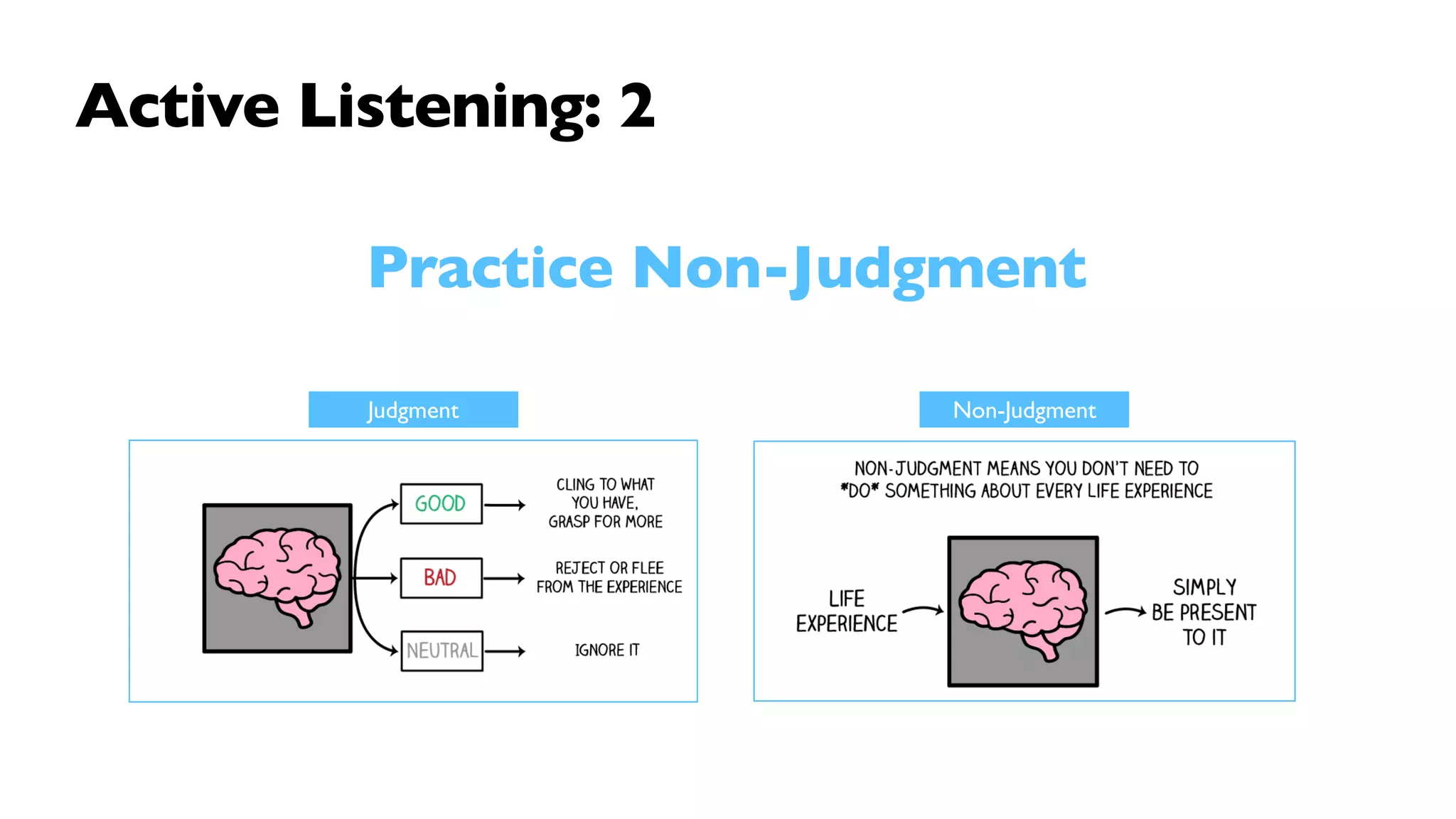
As you can see, non-judgment is about receiving information without the immediate need to classify it. It's a state of open curiosity.
How to Practice Active Listening: 16 Examples & Techniques
To understand the psychology behind this barrier and how to overcome it, let's turn to an article from PositivePsychology.com. It directly links judgment to the principles of effective, empathetic communication developed by psychologist Carl Rogers.
Please read the section 'Possible Barriers & Psychology Tips to Overcome Them.' Focus on how judgment, suggesting solutions, and avoiding the topic all function as barriers that make the speaker feel unheard.
Mitigating Premature Judgment
Like the rebuttal tendency, overcoming judgment is an internal practice of self-awareness.
- Notice, Don't Inhibit: You cannot stop judgmental thoughts from arising—they are a natural part of how our brains process the world. The goal is not to suppress them, but simply to notice them. When you catch yourself thinking, "That's a terrible idea," acknowledge the thought and then gently redirect your focus back to the speaker with the question: "I wonder why they see it that way?"
- Adopt Unconditional Positive Regard: This concept from Carl Rogers is a game-changer. It means you separate the person from their opinion. You can accept and respect the person's right to their feelings and perspective, even if you fundamentally disagree with their conclusion. It's an attitude of, "I value you as a person, and I am open to understanding your experience, regardless of whether I agree with it."
- Cultivate Active Curiosity: When you feel a judgment arising, use it as a trigger to become more curious. If someone says something you find boring, ask yourself, "What is it about this topic that animates them?" If they say something you think is wrong, ask, "What experiences have they had that led them to this belief?" Curiosity is the natural antidote to judgment.
Test your understanding!
Imagine a friend tells you, "I've decided to quit my stable job in economics to become a full-time artist. I know it's a huge risk, but it's what I've always dreamed of doing."
Your initial, gut reaction is that this is a financially reckless decision.
- What are the two main listening barriers you're likely to experience immediately?
- Describe one specific action you could take to mitigate each of those barriers in the moment.
Show answer
-
Likely Barriers:
- Premature Judgment: Your mind will immediately label the decision as "bad," "risky," or "foolish" based on your own knowledge of economics and career stability.
- The Rebuttal Tendency / Premature Problem-Solving: You will feel a strong urge to immediately point out the flaws in their plan, list the financial risks, or offer "better" solutions, like keeping their job and doing art on the side.
-
Mitigation Strategies:
- To Mitigate Judgment: Acknowledge your internal thought ("This seems risky") but then consciously adopt a stance of curiosity. You could ask a deep, open-ended question like, "What does this dream of being a full-time artist mean to you?" This shifts your focus from judging the decision to understanding the value behind it.
- To Mitigate the Rebuttal Tendency: Physically bite your tongue (if you have to!) and commit to a pause. Then, instead of offering your opinion, use a clarifying or reflective statement to show you're listening. For example: "Wow, it sounds like this is something you've been thinking about for a long time." This validates their feeling and invites them to say more, giving you more information before you even think about responding with your own views.
Conclusion
Mastering your internal environment is just as important as mastering the external techniques of active listening. By recognizing and actively working to lower your internal barriers, you create the mental space required for true connection.
Key Takeaways:
- Common listening barriers are often internal, such as preoccupation, the rebuttal tendency (response planning), and premature judgment.
- The rebuttal tendency is listening with the intent to reply. Mitigate it by committing to a pause and shifting your goal from replying to understanding.
- Premature judgment is evaluating a speaker's message before you fully understand it. Mitigate it by noticing your judgments without acting on them and actively cultivating curiosity about the other person's perspective.
- Overcoming these barriers is a key skill for social energy management, as it reduces the cognitive load of a conversation, making listening less of a chore and more of a discovery.
In our previous lessons, we've covered reflecting, questioning, and now, clearing away internal noise. You are building a complete toolkit for focused, empathetic listening. In our next lesson, we will use this clear mental space to practice a more advanced skill: listening for the underlying values, beliefs, and assumptions in a person's speech. This is where active listening transforms into profound understanding.