Hello! Welcome to the final lesson of our module on Active Listening and Empathetic Response.
In our last lesson, we ventured into the deeper layers of communication, learning how to listen for the underlying values, beliefs, and assumptions that drive a person's speech. You now have a framework for understanding not just what people say, but who they are.
Today, we'll address a crucial next step. What do you do with all that valuable insight? This lesson focuses on our learning outcome: to practice remembering key details from conversations to build rapport over time. If listening for values is like mining for gold, remembering those details is how you invest that gold into the relationship. This skill is fundamental for your goal of building deeper bonds, as it transforms you from a passive listener into someone who is actively and demonstrably invested in others.
Why Conversational Memory Matters
Forgetting a person's name, or a key detail they shared, sends an unintentional message: "You are not important to me." Conversely, remembering something specific—their child's name, a project they were worried about, a hobby they love—sends a powerful signal of care and respect. It makes people feel seen and valued.
As memory expert Jim Kwik puts it, "People do not care how much you know until they know how much you care." Remembering details is one of the most effective ways to show you care.
A Quick Look Under the Hood: How Memory Works
Given your interest in neuroscience, let's briefly look at a simple model of how memory operates. This will help you understand why the techniques we'll discuss are effective.
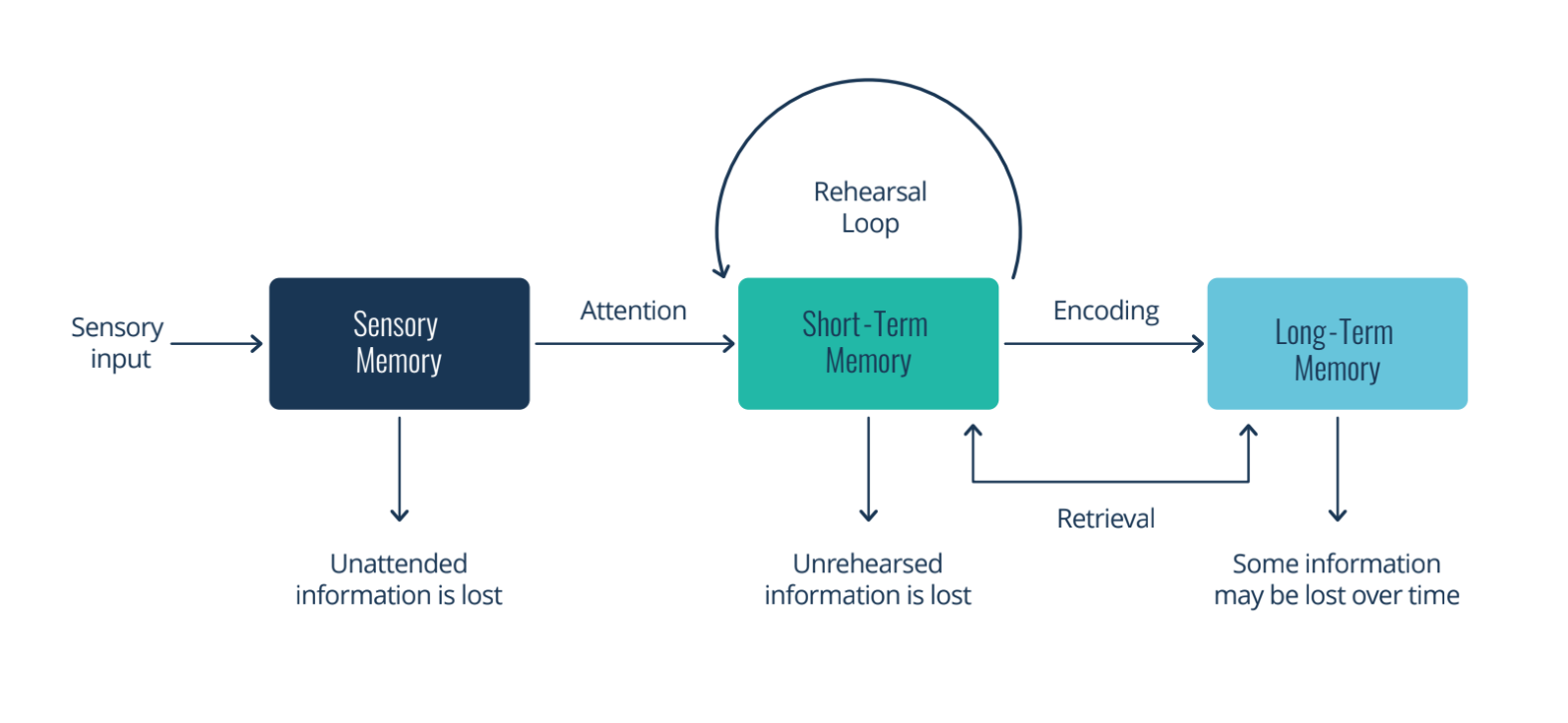
Look at the key "gates" in this process:
- Sensory Input to Short-Term Memory: The gate is Attention. If you are not paying attention, the information is lost almost instantly. This reinforces everything we've covered about active listening. As one expert notes, forgetting a name is often a listening problem, not a memory problem.
- Short-Term Memory to Long-Term Memory: The gate is Encoding. This is the process of actively working with information to make it "stick." Techniques like repetition, association, and visualization are all forms of encoding.
Our goal today is to give you practical encoding strategies to move important conversational details from your short-term "working memory" into your long-term memory, where they can be retrieved to build rapport.
Technique 1: The Foundation - Remembering Names
A person's name is the most important detail to remember. It's the label for all the other information you'll learn about them. A great framework for this is the SUAVE method.
To learn this method, let's turn to its creator, Jim Kwik.
How to Remember People's Names: Memorize Names INSTANTLY | Jim Kwik
In this video, 'How to Remember People's Names,' brain coach Jim Kwik breaks down a simple, five-step process for instantly improving your name recall. This is a foundational skill for any charismatic communicator.
Please watch from 03:49 to 11:31. This section covers the five letters of the SUAVE acronym. Pay attention to how each step actively engages your brain to encode the name.
To summarize the SUAVE method:
- S - Say it: Repeat the name immediately after you hear it. ("John, it's a pleasure to meet you.") This confirms you heard it correctly and creates a second auditory impression.
- U - Use it: Use the name intelligently once or twice during the conversation. This acts as repetition.
- A - Ask about it: If it's an unusual name, ask about its origin or spelling. This creates a deeper connection and story around the name.
- V - Visualize it: Create a strong, even absurd, mental picture associated with the name. (e.g., for "Mary," picture her getting married). Our brains are wired to remember images better than abstract words.
- E - End with it: Say the person's name when you part ways. ("It was great talking with you, John.") This provides one final, powerful repetition.
Technique 2: Remembering Conversational Details
Now, let's expand beyond names to remember the content of your conversations—the stories, goals, and the values we discussed in the last lesson. The key is to manage your working memory, which is the brain's temporary "whiteboard" during a conversation.
Let's explore some strategies to strengthen this process.
Working Memory: Strategies To Help You Remember What People Say in Conversations
The article 'Working Memory: Strategies To Help You Remember What People Say in Conversations' offers excellent, practical techniques that are both effective and socially discreet.
Please read the sections 'Why working memory matters in conversations,' 'Visualization: turn words into mental images,' and 'The echo strategy: listen, reflect, buy time.' These sections provide the theory and two powerful, in-the-moment techniques.
Let's break down the two core techniques from the article:
A. Visualization (Expanded)
Just as you visualize a name, you can create mental images for key concepts. When a colleague mentions they are stressed about a "project deadline," you might picture a calendar with a big red circle on it. If they talk about their "dream of opening a coffee shop," you could visualize them standing proudly behind a counter.
For a more structured approach, especially if someone is telling a story with multiple parts, you can use a powerful ancient technique called the Method of Loci.

To use this, you would take a familiar mental journey (e.g., your walk from your front door to your bedroom) and "place" key details of the conversation at different points along the way. For example, the person's name is at the front door, their job is in the hallway, and their main problem is in the living room. To recall the details, you simply "walk" the path in your mind. This may feel effortful at first, but with practice, it becomes a rapid and powerful internal filing system.
B. The Echo Strategy
The "echo" strategy is a dual-purpose tool that boosts both memory and rapport. It involves paraphrasing what the person said to confirm your understanding.
Example:
- Them: "I'm just swamped. The quarterly report is due Friday, and my son has his first soccer tournament on the same day."
- You (Echoing): "Wow, so you have the big report and your son's tournament all on Friday. It sounds like you're being pulled in two directions. Is that right?"
This does three things simultaneously:
- It forces you to actively process and summarize the information, which is a powerful form of encoding.
- It shows the other person you are listening intently and care about getting it right.
- It gives you a moment to think while confirming the key facts.
Technique 3: Externalizing Your Memory
Your working memory is finite. This is especially true when you find socializing taxing. Acknowledging this limit and using external tools is not a weakness; it's a smart strategy for energy management.
A. Strategic Note-Taking
In many contexts (especially professional ones), taking notes is perfectly acceptable. You can normalize it by saying, "That’s a really interesting point. I'm just going to jot that down so I don't forget."
In more casual settings, you can use "micro-notes." After a conversation, take 30 seconds to discretely type a few keywords into your phone's notes app (e.g., "Sarah - architect - loves hiking - brother in Toronto").
The most important part of note-taking happens after the conversation. Reviewing your notes within a few hours helps transfer the information to long-term memory.
B. The Follow-Up System
The ultimate goal of remembering is to build rapport over time. This happens when you use the information in a future interaction.
- Store Key Details: After a meaningful conversation, take a moment to add a brief note to the person's contact card on your phone or in a dedicated journal. For example: "Met at the conference. Is launching a new marketing campaign next month. Value: work-life balance."
- Set a Reminder: If they mentioned a significant upcoming event (a presentation, a trip, a deadline), you could even set a private reminder to ask them about it later.
- Review Before Reconnecting: Before your next meeting, take 15 seconds to review your notes.
Starting your next conversation with, "Hey Sarah, the last time we spoke you were getting ready for a big hiking trip. How was it?" is incredibly powerful. It demonstrates that you listened, you cared, and you remembered.
Test your understanding!
You meet a new person at a social event. They tell you their name is David, and during your conversation, they mention they are nervously preparing for their first marathon in three weeks, which they are running to raise money for a charity they care deeply about.
Describe a simple workflow using at least three different techniques from this lesson to remember these key details.
Show answer
Here is one possible workflow:
- Say it (SUAVE): When he introduces himself, you immediately say, "David, great to meet you."
- Visualize it (SUAVE/Visualization): You create a mental image of a famous David (like Michelangelo's statue) running a marathon, looking exhausted but determined. You see a calendar in the image with the number "3" circled.
- The Echo Strategy: You say, "A marathon in just three weeks? That's a huge undertaking, especially for a cause you're passionate about. That's really impressive." This both confirms the details and shows empathy.
- Micro-Note (Externalizing): After the conversation, you discretely add a note to your phone: "David - marathon in 3 weeks (charity)."
- End with it (SUAVE): When you leave, you say, "Good luck with the training, David!"
Conclusion
Remembering details from a conversation is not an innate gift; it is a learnable skill built on a foundation of attention and reinforced with simple, practical techniques. By treating the information people share with you as valuable, you make them feel valued.
Key Takeaways:
- Remembering names and details is a powerful way to show you care and build rapport.
- The process starts with attention (active listening) and requires active encoding (visualization, repetition, association) to move information to long-term memory.
- Use the SUAVE method (Say, Use, Ask, Visualize, End) as a reliable framework for remembering names.
- For conversational content, use visualization, the echo strategy, and strategic note-taking to manage your cognitive load and encode information effectively.
- The real power of this skill comes from creating a simple system to review and use these details in future conversations.
In our next module, we will shift from the internal skills of listening and remembering to the external mechanics of conversation. You have built a solid foundation. Now, we'll start putting it into action.
Preview of the next lesson: Our first lesson in Module 4, "Conversation Mechanics: Initiation and Flow," will be on how to use situational and observational openers to initiate conversations naturally. We'll cover how to confidently and smoothly start a conversation with anyone, anywhere.