Introduction
Welcome to Module 2. In our first module, we meticulously assembled the foundational building blocks for structured LLM interaction. We learned how to enforce schemas, call tools, manage conversational state, and stream responses in real-time. We now have a robust interface for communicating with an LLM.
This module, "Core Engine: The Asynchronous Agent Loop," shifts our focus from communication to autonomy. We will begin assembling those building blocks into systems that can act independently. This first lesson addresses a crucial architectural decision: how much control do we cede to the LLM? We will distinguish between three fundamental patterns—static chains, dynamic routers, and autonomous agents—by examining who, or what, owns the control flow.
Your expertise in distributed systems will be invaluable here, as we'll be discussing architectural patterns that echo concepts like deterministic versus non-deterministic execution and centralized versus decentralized coordination. Understanding this spectrum is the first step toward engineering the sophisticated, autonomous systems that are the goal of this course.
Let's begin with a high-level visual that contrasts the two ends of this spectrum.
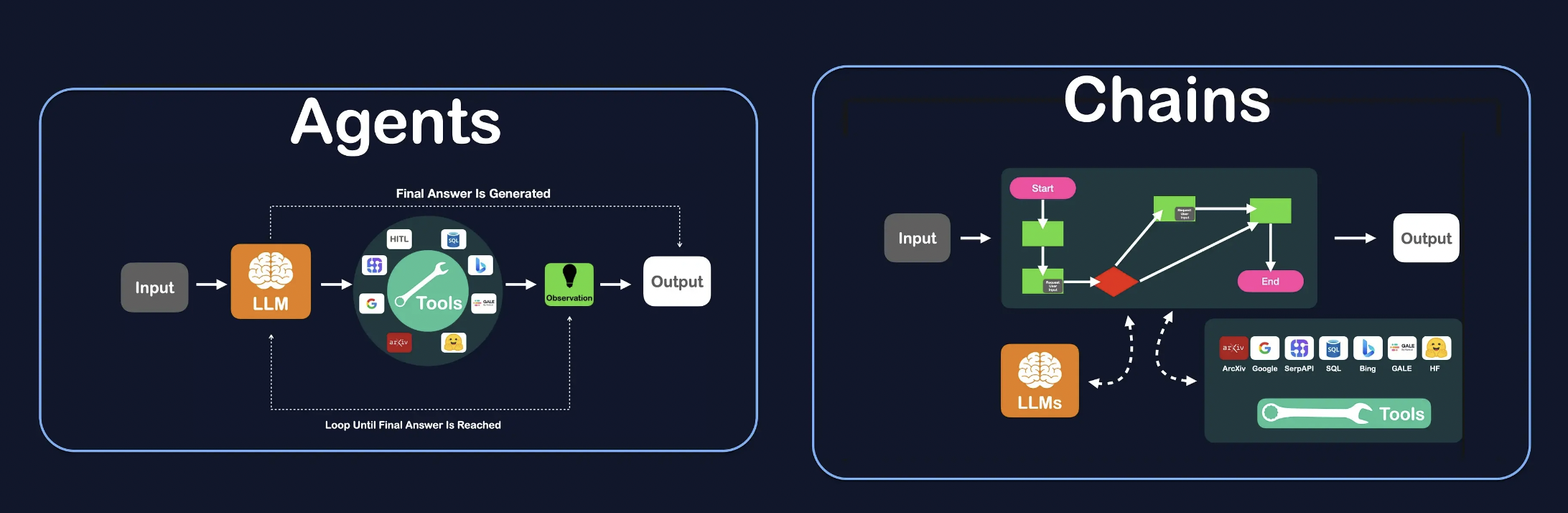
The Spectrum of Control Flow Ownership
At its core, an "agentic" system is any system that uses an LLM to help accomplish a task. However, this broad definition covers a wide range of architectures with vastly different capabilities and complexities. The most meaningful way to categorize them is by asking: Who decides what happens next? The answer places a system on a spectrum from fully deterministic to highly autonomous.
The following article provides a clear, developer-focused breakdown of these architectures.
Workflow Automation vs AI Agents: A Developer's Guide - DEV Community
This guide cuts through marketing terms to offer a practical, architectural distinction between different types of AI systems.
First, read the section The Three Architectures. It introduces the core concepts we will be discussing: workflow automation (static chains), AI-enhanced workflows (a subset of chains), and autonomous agents. Next, study the table in The Decision Matrix. This provides an excellent summary of the trade-offs between these patterns across key dimensions like predictability, cost, latency, and debugging, which are critical from a systems engineering perspective.
As the article highlights, the fundamental difference lies in whether the execution path is fixed at design time or determined at runtime. Let's examine each of these patterns in detail.
1. Static Chains: Developer-Owned Control Flow
A static chain is the simplest pattern. It is a sequence of steps where the control flow is hardcoded by the developer. Think of it as a script or a simple ETL pipeline: Step A runs, its output is passed to Step B, which runs, and so on. The LLM can be a component within one of these steps (e.g., to summarize text or classify an item), but it has no say over the sequence of the steps themselves.
The control flow is entirely owned by the developer and defined at design time.
Master ALL 20 Agentic AI Design Patterns [Complete Course]
This video provides a practical overview of common agentic design patterns. We'll start with the most basic one.
Watch the section on prompt chaining. The speaker describes it as an "assembly line" where each station performs a specific task and checks quality before passing it on. This is a perfect analogy for a static chain. Notice the emphasis on a predefined sequence of tasks.
The main advantages of this pattern are predictability, testability, and low cost. You can write unit tests for each step, and the behavior is deterministic. The downside is its rigidity; it cannot handle ambiguity or situations not explicitly coded for.
2. Dynamic Routers: Shared Control Flow
A dynamic router introduces a degree of runtime flexibility. In this pattern, the system uses an LLM to analyze an input and choose one of several predefined execution paths. The developer still defines the possible workflows, but the LLM decides which one to execute based on the specific request.
Here, control flow ownership is shared: the developer defines the "rails," and the LLM chooses which rail to follow.

The routing pattern is explained well in the same video on design patterns.
Master ALL 20 Agentic AI Design Patterns [Complete Course]
We will now look at the next step up in complexity from a simple chain.
Watch the segment on routing. The analogy of a "smart receptionist" who directs a request to the correct department captures the essence of this pattern. The router doesn't do the work itself; it directs the request to the correct predefined workflow.
This pattern is useful when you have multiple, distinct capabilities (e.g., handling a sales query vs. a technical support query) and need a way to triage incoming requests intelligently. It is more flexible than a static chain but is still limited to the paths you have explicitly created.
3. Autonomous Agents: LLM-Owned Control Flow
At the far end of the spectrum lies the autonomous agent. Here, the developer provides the LLM with a high-level goal, a set of available tools, and a reasoning framework. The agent then dynamically plans and executes a sequence of actions—thinking, using a tool, observing the result—in a loop until the goal is achieved.
In this model, the control flow is almost entirely owned by the LLM and is generated at runtime. The developer builds the environment and the loop mechanism, but the agent itself decides the step-by-step path. This is the observe-think-act loop that forms the heart of this module.
For a first-principles look at how such a system can be engineered for determinism and scale, we'll turn to a highly insightful article from Praetorian. It describes a shift from a "Thick Agent" (monolithic, complex) to a "Thin Agent / Fat Platform" architecture. This directly relates to managing control flow.
Deterministic AI Orchestration: A Platform Architecture ... - Praetorian
This article details a production-grade architecture for autonomous agents, focusing on how to manage complexity by strictly defining control flow ownership. Its focus on determinism and inverting control will align with your background in systems design.
Please read the following sections carefully: Start with The Solution: Inverting the Control Structure. This introduces the core idea of making agents stateless workers within a larger, deterministic platform. Now, read the section on The Orchestrator-Worker Pattern. This is the most critical part. Pay close attention to the Tool Restriction Boundary. The rule that an Orchestrator cannot execute work (e.g., write code) and a Worker cannot delegate tasks is a powerful, architectural enforcement of control flow separation. Finally, review the table under Coordinator vs. Executor Models. This table explicitly summarizes the separation of roles based on tool permissions, which is a direct implementation of differentiated control flow ownership.
The Praetorian architecture provides a masterclass in managing agentic systems. By forbidding a planning agent (Coordinator) from doing work and a working agent (Executor) from delegating, they architecturally enforce a separation of concerns. The high-level control flow (planning, delegation) is owned by the Orchestrator, while the low-level task execution is handled by ephemeral workers. This is a sophisticated and robust implementation of an LLM-owned control flow system.
Architectural Lens: Orchestration vs. Choreography
When you scale from a single autonomous agent to a system of multiple agents collaborating on a task, you encounter a classic distributed systems problem: coordination. The patterns for solving this will be very familiar to you. A fantastic talk by Sandipan Bhaumik frames this challenge in terms you'll recognize.
From Chaos to Choreography: Multi-Agent Orchestration Patterns That Actually Work — Sandipan Bhaumik
This video frames multi-agent design as a distributed systems challenge and introduces the two primary coordination patterns.
Watch the introduction to the two patterns, choreography or orchestration. Next, watch the explanation of choreography, which is event-driven and decentralized. Finally, watch the explanation of orchestration, which is centralized and controlled.
This brings our discussion full circle:
- Orchestration: This pattern aligns with the Praetorian model. A central component (the "Orchestrator") explicitly directs the control flow, calling specialized agents to perform tasks. It offers high predictability and easy debugging.
- Choreography: In this model, agents are more autonomous. They react to events on a shared message bus without a central controller. Control flow is emergent and decentralized. This can be more scalable and flexible but is significantly harder to debug and observe.
Choosing between these is a critical architectural decision, balancing autonomy against predictability and control.
Conclusion
In this lesson, we have dissected the term "agent" into a spectrum of architectures defined by control flow ownership. This distinction is not academic; it has profound implications for a system's capability, complexity, cost, and reliability.
Your key takeaways are:
- Static Chains (Developer-Owned Control): A fixed sequence of steps defined at design time. They are predictable and reliable but rigid.
- Dynamic Routers (Shared Control): An LLM chooses from a set of predefined paths. This offers more flexibility than chains but is still constrained to developer-defined workflows.
- Autonomous Agents (LLM-Owned Control): An LLM dynamically plans and executes actions in a loop to achieve a goal. This offers maximum flexibility and power but introduces significant complexity and non-determinism.
- Architectural Enforcement: Sophisticated systems, like the one described by Praetorian, enforce control flow ownership through architectural constraints, such as restricting the tools available to different types of agents (e.g., planners vs. executors).
- Multi-Agent Coordination: At scale, coordinating multiple agents becomes a distributed systems problem, where you must choose between centralized Orchestration and decentralized Choreography.
We have now established a clear conceptual framework for what an autonomous agent is and how it differs from simpler patterns. With this understanding, we are ready to begin building one.
In our next lesson, we will implement the core engine of an autonomous agent from first principles: the asynchronous observe-think-act loop. This is where we will write the code that brings the concept of LLM-owned control flow to life.