Introduction
In our previous lesson, we established the deterministic foundation of our agent testing strategy, focusing on unit and integration tests with mocked dependencies. This provides a crucial safety net, ensuring the individual components and their immediate connections work as expected. However, it deliberately sidesteps the inherent non-determinism and complex emergent behaviors of the complete agentic system.
This lesson confronts that complexity head-on. We will move up the testing pyramid from "Deterministic Foundations" to "Probabilistic Performance." Our goal is to answer the question: "How well does our agent perform on realistic tasks?" To do this, we need a standardized battlefield—a consistent set of challenges to measure our agent against. Therefore, this lesson will guide you through how to design an evaluation dataset of representative tasks to benchmark agent performance. You will learn the anatomy of an agent evaluation, principles for designing high-quality tasks, and a practical process for collecting and structuring your first evaluation suite. This forms the essential prerequisite for quantifying and improving your agent's quality over time.
Why Agent Evaluation is a Different Engineering Challenge
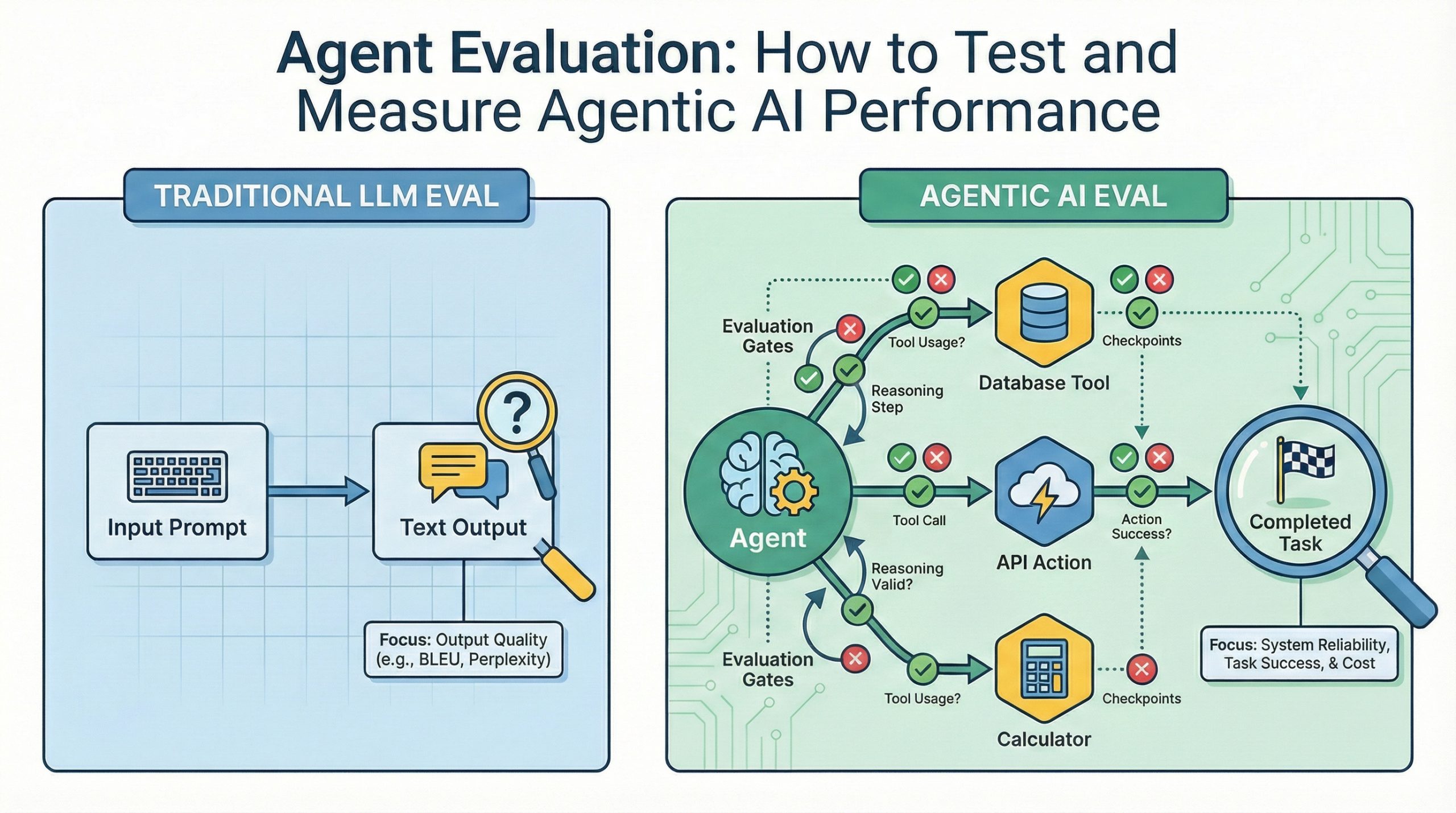
In traditional software testing, you verify that a given input produces a known, correct output. LLM-based agents break this paradigm. An agent's "output" is not a single response but a trajectory—a sequence of thoughts, tool calls, and observations. An agent might arrive at the correct final answer through a dangerously inefficient or incorrect path, or it might find a creative, valid solution you never anticipated.
This distinction is fundamental. As the diagram below illustrates, traditional LLM evaluation often focuses on the quality of a single text output. Agentic evaluation, however, must assess the entire multi-step workflow, including reasoning, tool use, and the final outcome in the environment.
This complexity requires a more sophisticated approach to evaluation, grounded in a well-defined set of concepts.
Agent Evaluation and Benchmarking for Measuring What Matters - Engineering Notes
This article from Muthu's Engineering Notes provides an excellent conceptual introduction.
Read the introductory section, "Concept Introduction," focusing on both the Simple Explanation and the more detailed breakdown of how agent evaluation differs from standard model evaluation. This will frame our thinking for the rest of the lesson.
The Anatomy of an Agent Evaluation Suite
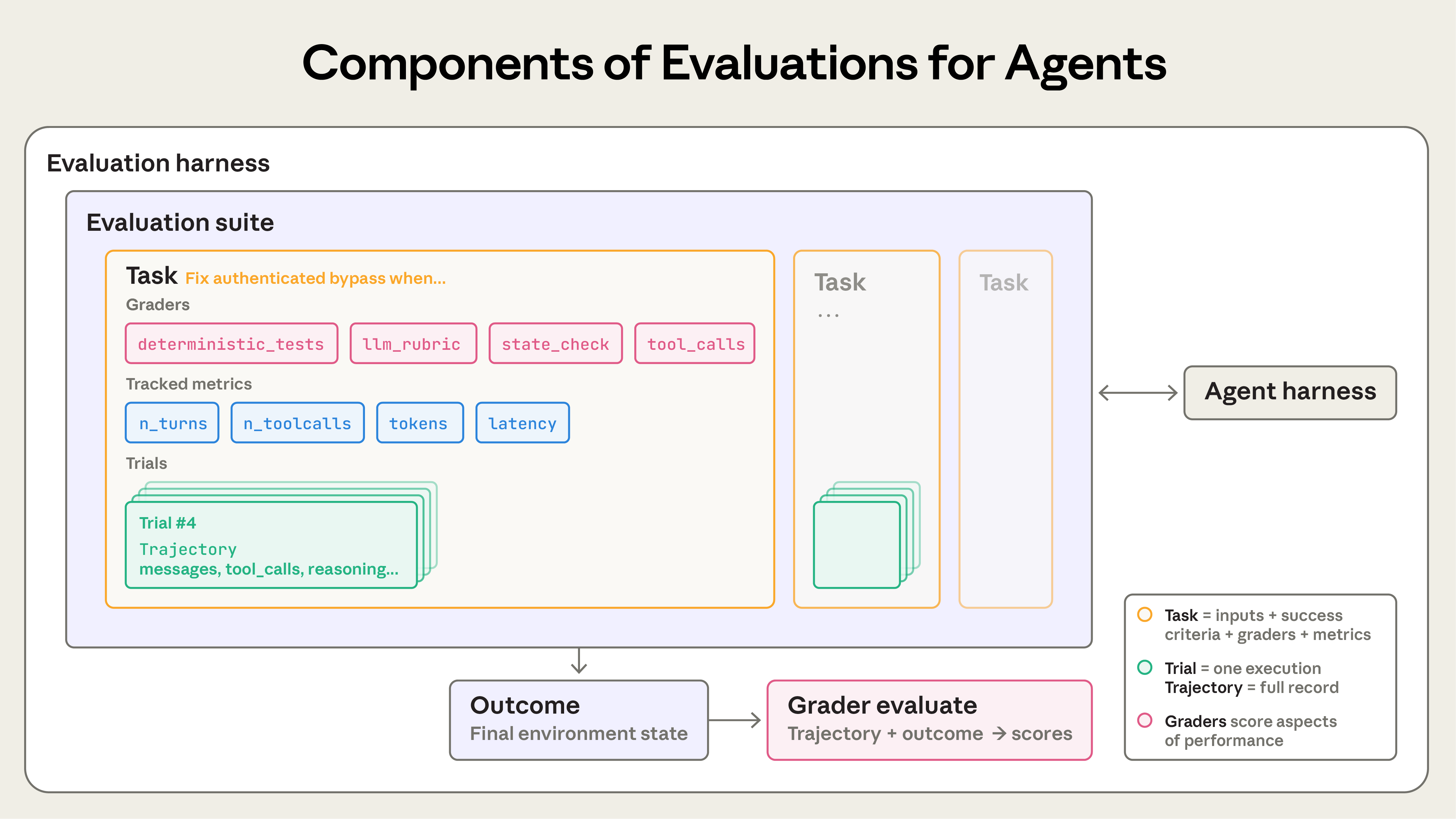
To systematically design a dataset, we first need a shared vocabulary. The components of an agent evaluation are analogous to a scientific experiment, designed for rigor and reproducibility.
Let's define these components, drawing on industry best practices.
Demystifying evals for AI agents
This article from Anthropic provides a clear and practical breakdown of agent evaluation terminology.
Please read the section "The structure of an evaluation". Focus on internalizing the definitions for: task, trial, grader, transcript (or trace/trajectory), outcome, evaluation harness, and evaluation suite.
To summarize these crucial terms:
- Task (or Test Case): A single problem for the agent to solve, with defined inputs and success criteria. Example: "Cancel order #12345 and confirm the refund amount."
- Trial: A single attempt by the agent to complete a task. Due to non-determinism, you will run multiple trials per task.
- Transcript (or Trajectory): The complete, replayable record of a trial, including all messages, reasoning steps, and tool calls. This is the core piece of data we analyze.
- Outcome: The final state of the environment after a trial (e.g., a database record was updated, an email was sent). This is distinct from the agent's final message.
- Grader: A piece of logic that scores the agent's performance on a task. A task can have multiple graders.
- Evaluation Suite: A collection of tasks designed to measure a specific agent capability. This is our "evaluation dataset."
- Evaluation Harness: The infrastructure that runs the evaluation suite, orchestrates the trials, records the transcripts, and applies the graders.
Our focus in this lesson is on designing the Evaluation Suite.
Designing High-Quality Tasks
The quality of your evaluation is determined by the quality of your tasks. A good evaluation suite should be representative of the real-world problems your agent will face and designed to produce a clear, unambiguous signal about its performance.
Capability vs. Regression Evals
First, it's essential to distinguish between two types of evaluation suites:
- Capability ("Quality") Evals: These suites are designed to answer, "What can our agent do well?" They should contain challenging tasks that are at the edge of the agent's current abilities. The pass rate will initially be low, and your goal is to "hill-climb" this score through improvements to your agent's prompts, tools, or reasoning logic.
- Regression Evals: These suites answer, "Does our agent still handle all the tasks it used to?" They consist of tasks that the agent has already mastered. The pass rate should be close to 100%. A drop in this score is a critical signal that a recent change has caused a regression, much like a failing unit test in a CI/CD pipeline.
Initially, you will focus on building a capability suite. As your agent improves and consistently passes certain tasks, those tasks can "graduate" into your regression suite.
A Roadmap for Collecting Tasks
Creating your first evaluation suite doesn't require hundreds of examples. You can start with a small, high-quality set of 20-50 tasks. The key is to start early and be systematic.
Demystifying evals for AI agents
This section of the Anthropic article provides a practical, step-by-step guide for creating your first dataset.
Read the subsection "Collect tasks for the initial eval dataset" in its entirety. Pay close attention to the three key steps: Start with what you already test manually: Your initial tasks should come from your own development process, user-reported bugs, and common use cases. Write unambiguous tasks with reference solutions: Ensure each task is clear and solvable, and that success is verifiable. Build balanced problem sets: Test for both when a behavior should occur and when it should not.
What Should a Task Definition Include?
Drawing from your engineering background, you can think of a task definition as an advanced test case specification. It needs to be precise and machine-readable. A common practice is to define tasks in a structured format like YAML or JSON.
Based on the examples in the Anthropic article, a robust task definition should include:
idanddesc: A unique identifier and a clear, human-readable description of the problem.inputs: The initial prompt or data given to the agent.graders: A list of conditions that must be met for the task to be considered successful. This is the heart of the task definition. Graders can be:- Deterministic Tests: Running a unit test against code the agent wrote.
- State Checks: Verifying a specific change in the environment (e.g.,
tickets.status == 'resolved'). - Tool Call Verification: Checking that specific tools were (or were not) called with the correct parameters.
- Transcript Constraints: Asserting something about the agent's path, like
max_turns: 10. - LLM Rubrics: Using another powerful LLM to judge the quality of the output against a detailed rubric (we'll cover this more in the next lesson).
tracked_metrics: A list of metrics to record for each trial, even if they don't determine pass/fail (e.g., latency, token count, cost).
The goal is to create tasks where success is automatically and objectively verifiable by the evaluation harness.
From Theory to Practice: A Workflow for Building Your Dataset
Now, let's outline a concrete workflow for building your initial dataset, aligning human expertise with a scalable process. The core idea is to start with a small, curated set of examples and have a human expert (you, initially) provide the "gold standard" judgment.
This excellent video from Dave Ebbelaar demonstrates a simple but powerful process using a spreadsheet, which serves as a perfect starting point before building a more complex evaluation harness.
Why Most AI Projects Fail and How to Fix It
This video, "How to Systematically Setup LLM Evals," outlines a practical, iterative approach.
Watch the section explaining the process for creating aligned evaluators. Then, focus on the detailed walkthrough of the spreadsheet-based workflow from "here's the the actual process". Pay close attention to these columns: Input: The initial user request (the task prompt). Model Response: The final output from the agent. Model Critique & Outcome: An automated evaluation from a "judge" LLM. (We'll build this next lesson). Human Critique & Outcome: The ground truth provided by a human expert. Agreement: A check to see if the human and model agree. This process of collecting input/output pairs and having a human annotate them is the fundamental act of creating a labeled evaluation dataset.
The process described in the video is the cornerstone of building a reliable evaluation suite. Let's adapt it for our agentic system:
- Step 1: Curate Initial Tasks. Based on the roadmap from Anthropic, gather 20-30 representative task prompts. These can be simple strings initially (e.g., "A customer wants to know the status of their order #XYZ and is asking for a discount because it's late.").
- Step 2: Run the Agent & Record Transcripts. For each task prompt, run your agent. Instead of just saving the final response, you must save the entire transcript: the initial prompt, every thought from the LLM, every tool call with its parameters, every tool output, and the final response. This full trace is your raw data.
- Step 3: Human Annotation (The Ground Truth). For each recorded transcript, you act as the domain expert. You will create the "golden" evaluation. This involves:
- Defining the Outcome: Was the task ultimately successful? (e.g., "Yes, the order status was correctly retrieved and a 10% discount was applied.").
- Writing a Rationale: Justify your verdict. ("The agent correctly identified the order but failed to recognize the customer's frustration and did not use the
apply_discounttool. Therefore, it failed the task."). - Checking Key Steps: Did it use the right tools? Did it follow the correct path?
This annotated dataset of (task_prompt, full_transcript, human_verdict, human_rationale) is your initial evaluation suite. It is the ground truth against which you will benchmark all future versions of your agent.
Conclusion
In this lesson, we have laid the conceptual and practical groundwork for robust agent evaluation. We've moved beyond simple, deterministic tests to embrace the challenge of measuring performance on complex, multi-step tasks.
Key Takeaways:
- Agent evaluation is trajectory-focused: We must assess the entire sequence of reasoning and actions, not just the final output.
- An evaluation suite is a structured collection of tasks: Each task has defined inputs and verifiable success criteria, often expressed as a set of "graders."
- Good tasks are unambiguous, representative, and balanced: They should reflect real-world usage, be clear to interpret, and test for both positive and negative behaviors.
- Start building your dataset early: Source initial tasks from manual checks, bug reports, and user-facing examples. You don't need a huge dataset to get started.
- Human annotation is the source of ground truth: The process of running your agent on tasks and having an expert label the outcomes creates the benchmark dataset you will use to measure all future progress.
Preview of the Next Lesson:
Now that we understand how to design and collect a dataset of evaluation tasks, our next step is to automate the grading process. In the next lesson, we will define and calculate key metrics for agent quality, including task completion rate and accuracy. We will explore how to implement the "graders" we've discussed, including deterministic checks and the powerful "LLM-as-a-judge" pattern, allowing us to scale our evaluation efforts far beyond manual review. We will also begin implementing the structured logging necessary to capture these rich execution traces automatically.