Introduction
Welcome to the first lesson of our module on Agent Reliability and Recovery Patterns. In the previous module, we successfully orchestrated complex, parallel workflows with multiple agents. However, as we build systems that rely on network communication with external services like LLM APIs and tools, we must confront a fundamental reality of distributed computing: transient failures are inevitable. A network connection might hiccup, an API might be temporarily overloaded, or a service might momentarily go down for a restart.
This lesson directly addresses this challenge. Our goal is to implement retry strategies with exponential backoff and jitter for transient LLM and tool API failures. You will learn to distinguish between failures that are temporary and those that are permanent, and then implement a robust, industry-standard pattern to handle the former. Your background in distributed systems provides a strong foundation here, as we will be applying core principles of resilient system design to the specific context of agentic workflows.
1. Understanding Transient Failures and the "Thundering Herd"
Not all errors are created equal. A 401 Unauthorized error from an API is permanent; retrying with the same invalid credentials will never succeed. However, a 429 Rate Limit Exceeded or a 503 Service Unavailable error is often transient—a temporary condition that will likely resolve on its own. The simplest response to a transient error is to wait a moment and try again.
However, a naive retry strategy can be dangerous. If many clients all experience a failure at the same time and all decide to retry after the same fixed delay, they will hit the recovering service in a synchronized wave, potentially knocking it over again. This is known as the "thundering herd" problem.
The following video provides an excellent deep dive into this problem space, setting the stage for the patterns we'll implement.
Retries & Exponential Backoff - Deep Dive
This video, "Retries & Exponential Backoff - Deep Dive" from the glich.stream channel, clearly explains the need for retries in a distributed system and the pitfalls of simple implementations.
Please watch the following segments: The Problem: First, watch from which goes offline to understand the context of service failures and the first layer of defense: timeouts. Naive Retries: Next, watch from we want to implement retries. This section introduces a simple retry logic with a constant delay and explains precisely why it leads to the "thundering herd" problem, overwhelming a recovering service. Exponential Backoff: Finally, watch from we're going to try a more complicated implementation. This introduces the core concept of exponential backoff, where the delay between retries increases exponentially. Note the formula and the resulting plot that visualizes the increasing delay.
As the video demonstrates, exponential backoff is a significant improvement. By systematically increasing the wait time between attempts, clients "back off" and give the struggling service more time to recover. However, this still doesn't fully solve the problem. If all clients start their backoff calculations at the same time, their retry attempts will still be correlated, creating smaller, but still potentially harmful, synchronized spikes of traffic.
2. The Refinement: Adding Jitter
The key to breaking these correlated spikes is to introduce a small amount of randomness into the wait times. This randomness is called jitter. By adding jitter, we ensure that even if thousands of clients start their retry logic simultaneously, their actual retry attempts will be spread out more evenly over time, smoothing the load on the downstream service.

The following article from the AWS Architecture Blog is the canonical source on this topic. It masterfully explains why jitter is so critical and compares a few different strategies for implementing it.
Exponential Backoff And Jitter | AWS Architecture Blog
This post by Marc Brooker provides the foundational argument and data for using jitter with exponential backoff.
Please read the sections Adding Backoff and Adding Jitter. As you read, focus on: The visualization in the first section showing how pure exponential backoff still leads to "clusters of calls." The dramatic improvement in the call time series after jitter is added. The comparison of different jitter algorithms ("Full Jitter", "Equal Jitter", "Decorrelated Jitter") and the conclusion that even a simple implementation provides a huge return.
The data presented in the article makes a compelling case. Adding jitter significantly reduces the total work done by the system and decreases the time to completion compared to un-jittered backoff.
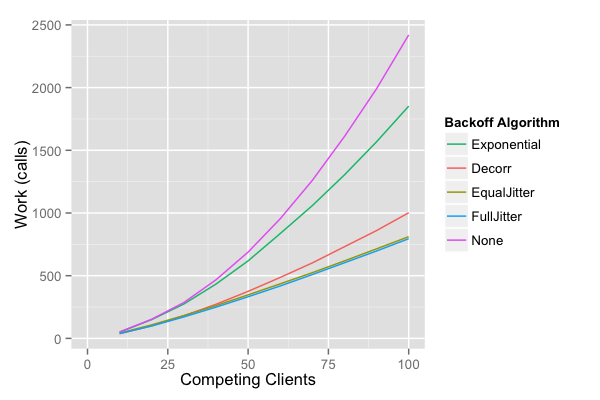
3. A First-Principles Blueprint for Implementation
With a solid grasp of the "why," let's design a blueprint for a robust implementation. A production-grade retry mechanism isn't just a simple loop; it's a configurable policy. The following technical specification for a unified LLM client provides an excellent, first-principles model for us to follow.
attractor/unified-llm-spec.md at main - GitHub
This document outlines the design for robust error handling in an LLM client library. It provides a clear, structured approach to building a retry mechanism.
Please read the following sections to understand the components of a comprehensive retry strategy: Error Classification: Start with section Retryability Classification. This is the most crucial step: you must distinguish between retryable errors (like RateLimitError or ServerError) and non-retryable ones (AuthenticationError, InvalidRequestError). Retrying a non-retryable error is just a waste of resources. Retry Policy: Next, read section Retry Policy. This defines the configurable parameters of our strategy, such as max_retries, base_delay, max_delay, and the backoff_multiplier. It also provides a concrete formula for calculating the delay with jitter, which we can directly translate into code. Handling API Feedback: Finally, review the short subsection on the Retry-After Header. When an API returns a 429 status code, it often includes this header to tell you exactly how long to wait. A robust client should respect this signal.
This specification gives us a complete checklist for our implementation:
- Identify which errors are transient and retryable.
- Define a configurable policy with max attempts, initial delay, a backoff factor, and a max delay cap.
- Calculate the delay for each attempt using the formula:
delay = min(max_delay, base_delay * (backoff_multiplier ** attempt)). - Apply jitter to the calculated delay:
final_delay = delay * random(min_jitter_factor, max_jitter_factor). - Honor the
Retry-Afterheader when provided.
4. From Blueprint to Code: A Python Implementation
Now, let's translate this blueprint into clean, reusable Python code. A decorator is a particularly elegant pattern for this, allowing us to add retry logic to any function—like one that calls an LLM or an external tool—without cluttering the function's core logic.
The following video provides a practical, step-by-step guide to building such a decorator.
Retry Pattern: The Secret to Resilient Python Code
ArjanCodes' video "Retry Pattern: The Secret to Resilient Python Code" is a fantastic walkthrough of implementing this pattern cleanly in Python.
As you watch, focus on the evolution of the code: Exponential Backoff: Start at back to the video. This section modifies a basic retry function to include exponential backoff. Notice how the sleep_time is calculated using a backoff factor and the current attempt number, directly implementing the formula we saw in the spec. Decorator Refactoring: Continue from you can clean things up. Here, the logic is refactored into a decorator. Pay close attention to the final example where this exact decorator is applied to a function that calls an LLM to get structured JSON output—a perfect use case for our agentic systems.
The video also touches on a crucial point: you should only retry operations that are idempotent. An idempotent operation is one that can be performed multiple times without changing the result beyond the initial application. Reading data is idempotent; creating a new user account is not (unless the system is specifically designed to handle duplicate creation requests). All LLM generation calls and most tool calls that query information are safely idempotent. For tool calls that have side-effects (e.g., sending an email, charging a credit card), you will need more advanced patterns, which we will cover later in this module.
Conclusion
In this lesson, we have engineered a critical component for any production-grade agentic system: a resilient client for external service calls. By understanding and implementing retry logic with exponential backoff and jitter, you can build agents that gracefully handle the inevitable transient failures of distributed environments.
Key Takeaways:
- Differentiate Failures: The first step to reliability is classifying errors as either transient (retryable) or permanent (non-retryable).
- Exponential Backoff: To avoid overwhelming a recovering service, the delay between retry attempts should increase exponentially.
- Jitter is Essential: To prevent correlated waves of retries from multiple clients (the "thundering herd"), a random jitter must be added to the backoff delay.
- Implement as a Policy: A robust retry mechanism is not hardcoded but is a configurable policy with parameters for max retries, delays, and backoff factors.
- Decorators are Elegant: In Python, decorators provide a clean, reusable way to apply retry logic to functions that perform network I/O.
Preview of the Next Lesson:
Retries are perfect for transient faults. But what if a service is down for an extended period? Continuously retrying a dead service wastes resources and can cause cascading failures in your own system. To prevent this, we need a pattern that can detect a hard-down dependency and temporarily stop calling it. In our next lesson, we will implement the Circuit Breaker pattern to provide this next level of resilience.