Introduction
In our last lesson, we built a crucial safety feature: the human-in-the-loop (HITL) approval gate. We designed an interrupt-checkpoint-resume architecture to pause an agent's execution before it performs a predefined high-stakes action, awaiting a simple "approve" or "reject" from an operator. This is excellent for managing known risks.
However, the most subtle failures in agentic systems often arise not from predictable high-stakes actions, but from ambiguity and uncertainty. What happens when the agent isn't confident in its plan, encounters contradictory information, or gets stuck in a loop? A simple yes/no approval gate isn't sufficient here. The agent doesn't need permission; it needs guidance.
This brings us to today's topic: designing a sophisticated escalation policy. Our goal is to create a system that can intelligently route tasks to human operators based on dynamic risk levels and confidence scores. We'll move beyond the binary logic of approval gates to a more nuanced model where the agent can effectively say, "I'm not sure how to proceed, please advise." This is a fundamental step toward building truly collaborative human-AI systems that are both autonomous and reliable.
From Binary Approval to Nuanced Escalation
First, it's essential to distinguish the HITL patterns we're dealing with. The approval gate we built previously is for a specific scenario. Escalation serves a different purpose.
Human-in-the-Loop Patterns: Approval, Input, and Escalation Workflows - Just Understanding Data
This article provides a clean taxonomy of HITL interactions. It will help us frame the distinction between what we've already built and what we're building today.
Read the introductory section, including the diagram, which defines the three main types of human interaction. Focus on the definitions and characteristics of Approval versus Escalation.
As the article clarifies:
- Approval is when the agent knows what it wants to do and asks for permission. It's a proactive check for a high-risk action.
- Escalation is when the agent is stuck or uncertain. It has encountered a situation it cannot resolve autonomously and needs help. It's a reactive request for guidance.
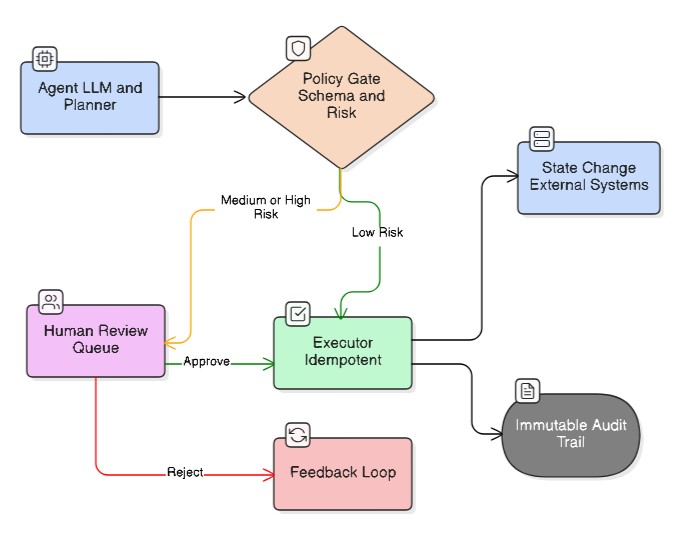
The architecture we're designing is visualized perfectly in the following flowchart. Last lesson, we built the pathway for a statically defined "high risk" action. Today, we're building the intelligent "Policy Gate" itself, which dynamically assesses risk to decide whether to execute automatically or route to the "Human Review Queue".
The Signal Stack: When to Escalate
How does the "Policy Gate" decide when a situation is risky or uncertain enough to warrant escalation? Relying on a single signal, like a model's self-reported confidence score, is notoriously unreliable. A more robust approach, common in production systems, is to use a "Signal Stack"—a combination of deterministic rules and model-based heuristics.
The Escalation Protocol: Building Agent-to-Human Handoffs That Don't Lose State
This article from Tian Pan offers an advanced, engineering-centric view on escalation. It critiques naive approaches and proposes a more resilient strategy.
Please read the section The Signal Stack. It details a multi-layered approach to triggering escalations, which will form the basis of our policy.
The article outlines three primary types of signals we can combine into a comprehensive escalation policy:
-
Task-Level Signals: These are deterministic, rule-based checks based on the agent's actions and the data it observes. They are the most reliable signals.
- An agent trying to process a refund for an amount exceeding a defined threshold (
amount > $1000). - An agent receiving conflicting information from two different tool calls (e.g., one API says the user's subscription is active, another says it's cancelled).
- The presence of compliance-flagged keywords in the agent's proposed response.
- An agent trying to process a refund for an amount exceeding a defined threshold (
-
Behavioral Signals: These signals monitor the agent's execution pattern for signs of struggle, even if each individual step seems confident.
- Looping: The agent calls the same tool with the same arguments multiple times.
- Scope Creep: The agent starts performing tasks that deviate significantly from the user's original request.
- High Complexity: The execution chain becomes excessively long, decreasing the cumulative probability of success.
-
LLM-Based Signals: These are derived from the model's output itself. While not perfectly reliable on their own, they are a valuable part of the stack.
- Low Confidence: The model's log probabilities for its generated response are low.
- Ensemble Disagreement: Running the same prompt through two different models (or the same model with different settings) yields conflicting plans or results.
By combining these signals, we can build a policy that is far more robust than a simple confidence threshold.
Measuring LLM Confidence with Log Probs
To implement the LLM-based signal, we need a practical way to quantify the model's "confidence." The most direct method is using log probabilities (logprobs). When an LLM generates text, it's essentially predicting the next token at each step. For each prediction, it calculates a probability distribution over all possible next tokens. logprobs give us access to the logarithm of the probability of the token that was actually chosen.
A high probability (a logprob close to 0) for a chosen token suggests the model was very certain. A low probability (a highly negative logprob) suggests it was uncertain and had many other plausible options.
The following video provides a clear, practical guide on how to access and use logprobs with the OpenAI API.
How to Measure LLM Confidence: Logprobs & Structured Output
This video from NeuralNine demonstrates how to retrieve and interpret log probabilities from an LLM response, both for simple text and for structured JSON output.
First, watch the section explaining the basics of logprobs. This covers how to enable them in the API call and interpret the results for a simple text response. Pay attention to how the confidence changes between a factual question and a subjective one. Next, watch the demonstration of how to aggregate these scores for structured output. This is directly applicable to our agents, which use structured tool calls and plans. The use of a helper library to map probabilities to specific fields in a Pydantic model is a powerful technique.
Let's translate this into a concrete function. Assuming we get a response object from the OpenAI client that includes logprobs for a structured output (like a tool call), we can calculate the average confidence for that output.
The average linear probability (by converting from log space) gives a good intuitive measure of confidence. We can compute the average of the e^(logprob) values for all tokens in the generated output.
import math

def calculate_average_confidence(logprobs_content: list) -> float:
    """
    Calculates the average probability (confidence) from a list of logprob objects.

    Args:
        logprobs_content: The 'content' list from the logprobs object in an OpenAI response.
                          Each item contains token info including 'logprob'.

    Returns:
        The average linear probability (0.0 to 1.0) across all tokens.
    """
    if not logprobs_content:
        return 0.0


    # Convert each log probability to a linear probability and sum them up
    total_probability = sum(math.exp(token_info.logprob) for token_info in logprobs_content)


    # Return the average
    return total_probability / len(logprobs_content)


# --- Example Usage (conceptual) ---
# Assuming 'response' is an object from an OpenAI API call with logprobs=True


# logprobs = response.choices[0].logprobs.content
# confidence = calculate_average_confidence(logprobs)


# print(f"Average confidence for the response: {confidence:.2%}")
This calculate_average_confidence function becomes a key component of our escalation policy.
Designing the Escalation and Routing Architecture
Now we can assemble these pieces into a coherent policy and architecture. Our PolicyGate will be a function that takes the current agent state and the latest LLM response, applies the Signal Stack, and returns a risk level.
from typing import Dict, Any, List


# Let's assume we have a simple state tracker for behavior
class BehaviorTracker:
    def __init__(self):
        self.call_history = []

    def record_call(self, tool_call: Dict[str, Any]):
        self.call_history.append(str(tool_call)) # Simplified representation

    def detect_loop(self, window=3) -> bool:
        if len(self.call_history) < window:
            return False


        # A simple loop detection: last `window` calls are identical
        last_n_calls = self.call_history[-window:]
        return len(set(last_n_calls)) == 1

def escalation_policy_gate(
    llm_response_with_logprobs: Any, # Mocking the OpenAI response object
    behavior_tracker: BehaviorTracker,
    task_context: Dict[str, Any]
) -> Dict[str, Any]:
    """
    Evaluates a situation based on the Signal Stack and determines if escalation is needed.
    """
    tool_calls = llm_response_with_logprobs.message.tool_calls


    # 1. Behavioral Signals
    if tool_calls:
        behavior_tracker.record_call(tool_calls[0])
        if behavior_tracker.detect_loop():
            return {"risk_level": "HIGH", "reason": "Repetitive action detected (potential loop)."}


    # 2. Task-Level Signals (Example)
    if tool_calls and tool_calls[0].function.name == 'process_refund':
        import json
        args = json.loads(tool_calls[0].function.arguments)
        if args.get('amount', 0) > 500:
            return {"risk_level": "HIGH", "reason": f"High-value refund (${args['amount']}) requires review."}


    # 3. LLM-Based Signals
    logprobs_content = llm_response_with_logprobs.logprobs.content
    confidence = calculate_average_confidence(logprobs_content)

    if confidence < 0.75: # Example threshold
        return {"risk_level": "MEDIUM", "reason": f"Low LLM confidence ({confidence:.2%})."}


    # Default: No escalation needed
    return {"risk_level": "LOW", "reason": "All checks passed."}
With this policy gate, we can now design the routing logic. In your experience with distributed systems, you've worked with message queues and event buses. We can apply the same architectural thinking here.
Think of our agent tasks as messages.
- Approval Gate (Last Lesson): This was like a simple, dedicated
Queue. If aprocess_refundaction appeared, it went to thehuman_approval_queue. - Escalation Routing (Today): This is more like an
Event Bus. Theescalation_policy_gateacts as a content-based router. It publishes a "task requires review" event to the bus. The event has properties likerisk_levelandtask_type. Different human teams can then subscribe to events that match their expertise.risk_level: 'MEDIUM'might go to a Tier-1 support queue.risk_level: 'HIGH'andtask_type: 'financial'might go directly to a senior finance team.reason: 'potential loop'might create a high-priority ticket for the engineering team.
This architecture decouples the agent's core logic from the human oversight workflow, making the system modular and scalable.
Structuring the Handoff
Finally, when a task is escalated, how do we present it to the human operator? Simply dumping the raw message history is inefficient and error-prone. The handoff must be a structured "decision brief."
The Escalation Protocol: Building Agent-to-Human Handoffs That Don't Lose State
Let's return to "The Escalation Protocol" to understand how to design the data payload for the handoff and the path for resuming execution.
First, read the section What to Hand Off. It outlines the three essential layers of a well-designed handoff payload. Next, review The Return Path. This covers the critical mechanics of how the agent re-integrates the human's feedback and resumes its work.
The key is to structure the handoff payload with:
- Action History: A summary of what the agent has already done and why.
- Current Context: The minimum information needed for a decision. What is the goal? What is the ambiguity?
- Structured Problem Statement: The explicit question the human needs to answer.
A very clean, first-principles way to implement this is to define an escalate_to_human tool that the agent can call. The schema for this tool is the structured handoff payload.
# In your tool definition file

def escalate_to_human(
    reason_for_escalation: str,
    summary_of_actions_taken: List[str],
    current_plan: Dict[str, Any],
    specific_question: str
) -> str:
    """
    Pauses execution and escalates the task to a human operator for review and guidance.
    Use this tool when you are uncertain how to proceed, have encountered conflicting information,
    or believe the current plan is no longer viable.
    """


    # This function's implementation would trigger the interrupt-checkpoint-resume
    # logic, similar to our approval gate, but with a richer state.
    print("--- 🚨 TASK ESCALATED TO HUMAN OPERATOR ---")
    print(f"Reason: {reason_for_escalation}")
    print(f"Question: {specific_question}")


    # ... save checkpoint with status 'pending_escalation'
    return "Task has been paused and escalated. Awaiting human guidance."
By making escalation an explicit tool, we force the agent to structure its uncertainty, which dramatically improves the quality of the handoff. The agent's reasoning process for calling this tool becomes the content of the escalation itself.
Conclusion
In this lesson, we have significantly upgraded our agent's safety and reliability framework. We moved from simple binary approval gates to a sophisticated, dynamic escalation policy. This allows our agent to handle uncertainty gracefully by routing ambiguous or high-risk situations to the appropriate human experts for guidance.
Key Takeaways:
- Escalation vs. Approval: Escalation is for handling uncertainty and failure ("I'm stuck"), whereas approval is for seeking permission for known high-stakes actions ("May I proceed?").
- The Signal Stack: A robust escalation policy combines task-level rules, behavioral monitoring, and LLM-based confidence scores to decide when to escalate.
- Measuring Confidence: Log probabilities (
logprobs) provide a concrete, quantifiable measure of an LLM's certainty in its output, forming a key input to our policy. - Event-Driven Routing: Architecting the escalation system like an event bus, where tasks are routed based on properties like
risk_level, creates a scalable and modular design. - Structured Handoffs: The payload sent to the human operator must be a well-structured "decision brief," not a raw data dump, to enable efficient and accurate review. Modeling escalation as a tool call is an effective way to achieve this.
Preview of the Next Lesson:
We've now built mechanisms for both preventative approval and reactive escalation. The final piece of our core safety toolkit involves proactive resource management. In the next lesson, we will implement budget and cost controls that cap token usage and API costs per agent task, ensuring our agents operate not only safely but also economically.