Hello! Welcome to the final lesson of your course on medallic art.
In our previous lesson, we explored how to prepare a digital 3D model in Blender for fabrication, bringing your design to the brink of physical existence. We've now completed the entire journey from concept, through design and modeling, to the creation of a raw metal object. All that remains is to give that object its final voice and character.
Today, we will focus on the last, crucial stage of the process: selecting appropriate patination and surface finishing techniques for a cast or struck medal to enhance its aesthetic qualities. This is where the medal transforms from a simple metal disc into a finished work of art. Given your extensive experience with sculpture and metal casting, you'll find many of these concepts familiar. Our focus will be on their specific application to the unique scale and function of the medal.
1. The Language of the Surface: What is Patina?
Before we dive into techniques, let's establish a clear understanding of what "patina" means in this context. It's more than just color; it's the entire character of the metal's surface.
Guidelines for the Technical Examination of Bronze Sculpture | Patina
To start with a formal definition, let's turn to this excellent resource from the Getty Conservation Institute. It clearly distinguishes between the different types of surface alterations that fall under the umbrella of 'patina.'
Please read the introductory section titled '1 What is patina?'. Focus on the distinction it makes between a chemical transformation of the metal (like corrosion) and applied organic coatings (like wax or paint).
As the reading clarifies, a patina can be:
- A chemical transformation: An induced corrosion layer (e.g., oxides, sulfides) that becomes part of the metal's surface.
- An applied coating: A layer of another material (wax, lacquer, oil, paint) that sits on top of the surface.
In medallic art, the primary goals of these finishes are both aesthetic and protective. Aesthetically, the finish is used to create contrast, enhance the legibility of the low relief, and evoke a certain mood. Protectively, it seals the metal from uncontrolled corrosion, fingerprints, and environmental damage.
The range of possible finishes is vast, creating a palette for the artist to work with.

2. Core Finishing Techniques for Medals
While the chemical possibilities are nearly endless, medal finishing generally revolves around a central principle: creating contrast to accentuate the relief. Let's explore the most common techniques used to achieve this.
A. The "Antique" Finish
This is a widely used two-step process common in both industrial production and artist studios. The principle is simple:
- Darken: The entire medal is chemically treated to give it a dark, uniform color (usually black or dark brown).
- Relieve: The high points of the relief are then polished or buffed, removing the dark layer and revealing the bright metal underneath. The dark patina remains in the recessed areas, creating artificial shadows that make the design "pop."
Let's see two variations of this process. First, an industrial approach using electroplating, and second, a hands-on studio method using common chemicals.
How to Make Zinc Die Casting Antique Medals?
This video shows the mass production of zinc medals. It provides a clear look at how the 'antique' finish is achieved on an industrial scale.
Please watch from 03:40 to 05:45. Observe the process of electroplating the medals first with copper, then with a black finish. Pay close attention to the final hand-polishing step, where the black finish is buffed off the raised surfaces to create the 'antique' look before the final lacquer is applied.
The studio equivalent of this process often uses a chemical solution instead of electroplating. One of the most common is liver of sulfur (potassium polysulfide).
Copper Patinas - How To Patina Copper Metal - Five Recipes - Verdigris, Liver of Sulphur, Vinegar
Now, let's watch a more hands-on demonstration. This video from 'The Crafsman' shows how to use liver of sulfur to create a dark patina on copper, which is then highlighted. The process is directly applicable to bronze medals.
Please watch the section from 04:49 to 08:21. Notice how quickly the liver of sulfur darkens the metal. The key takeaway is the process of using fine sandpaper or a polishing pad to 'relieve' the high points, creating the exact same kind of contrast seen in the industrial video.
B. The "French Finish"
For traditionally produced fine art medals, the most revered technique is the "French finish." It is a more refined version of the antiquing process.
Medal Making Technology In 1935
The blog post 'Medal Making Technology In 1935' gives a perfect, concise description of this classic process. This was the standard for high-quality art medals for much of the 20th century.
Please read the short section titled 'How a medal is finished.' It outlines the key steps: sandblasting, chemical darkening, relieving with a pumice slurry, and lacquering.
The key differences that define the French finish are:
- Surface Preparation: The process starts with sandblasting (or bead blasting) the raw medal. This imparts a fine, matte texture to the entire surface, which mutes the metallic glare and allows the patina to take more evenly.
- Relieving: Instead of dry sanding, the highlighting is done with a wet slurry of fine pumice powder, often on a buffing wheel. This gives a softer, more subtle transition between the dark and light areas compared to dry abrasives.
This method produces the signature satin, two-toned finish that is considered the hallmark of a classic art medal.
C. Hot Patinas and Color
As you know from your sculpture work, applying chemicals to heated metal can produce a rich range of translucent colors (browns, reds, blacks). This process is very much an art form in itself, requiring skill and control.
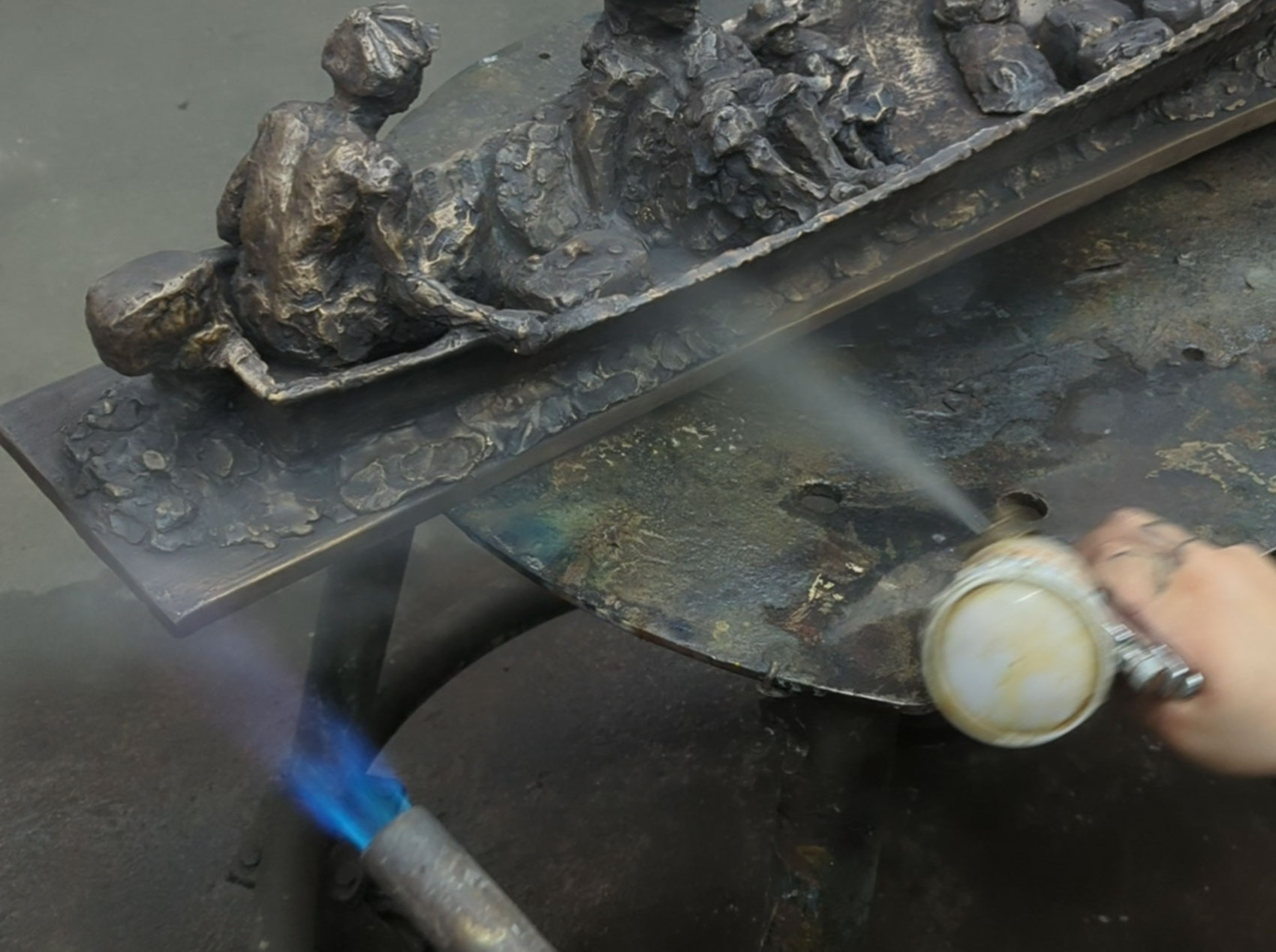
This technique is also used for medals, although less commonly than the French finish. It allows for more painterly effects but can sometimes obscure the fine details of a low-relief if the color is too opaque or dark. Often, a hot patina is applied and then selectively relieved on the high points, combining the techniques.
Conclusion and Course Wrap-up
We've reached the end of our journey. Today, you've learned how the final finish is not merely a coating, but an essential artistic choice that completes the medal's narrative.
Key Takeaways:
- Patination serves to both protect the medal and aesthetically enhance its relief.
- The most common techniques, like the "antique" and "French" finishes, rely on creating contrast by darkening the entire piece and then "relieving" the high points.
- The process typically involves surface preparation (e.g., sandblasting), chemical darkening, relieving (polishing), and finally sealing with wax or lacquer.
- The choice of finish should be a deliberate decision that supports the medal's subject matter and design.
Over the past eight lessons, you have surveyed the entire world of medallic art—from its history and design conventions to the practicalities of digital modeling and physical production. You have analyzed composition for the tondo format, integrated lettering, translated 2D concepts into 3D relief, and explored the paths to creating both cast and struck medals.
You now possess a comprehensive framework for creating your own medals, combining your deep knowledge of sculpture and design with the specific techniques and traditions of this unique art form.
Congratulations on completing the course. I wish you the very best in all your future medallic creations.