Introduction
In our last lesson, we established a powerful strategy for your final fitting room tryout, framing it as an optimal stopping problem. Using the rule of thumb, we determined that for 15 lingerie pieces, you should scout approximately the first 6 to set a benchmark before making a selection. This gave us a solid, mathematically-grounded plan.
However, given your background in operations research, you know that approximations, while useful, can sometimes be refined for small, critical scenarios. This lesson is dedicated to that refinement. We will move from the approximation to an exact calculation to solve the numerical problem of your fitting room selection. You will determine the precise optimal number of lingerie pieces to scout for and calculate the exact probabilities of success, ensuring your final decision-making process is not just good, but truly optimal.
Beyond Approximation: Calculating Exact Probabilities
The rule is derived by approximating a discrete sum with a continuous integral, an approach that becomes more accurate as the number of options () grows large. For a smaller, manageable number like your 15 curated lingerie pieces, we can calculate the exact probability of success for any given number of scouted items, .
The formula for this exact probability, , is:
Let's break this down in the context of your photoshoot:
- : This is the probability that the best piece in the first items (the current benchmark) is within the scouting set of items. For us to succeed, this must be true.
- : This sums the probabilities of success for each possible position where the overall best piece might be located. The term is the chance that we correctly select the best piece at position , which requires that the best of the preceding pieces was in our scouting set.
Your expertise in econometrics and decision theory will make the structure of this expected value calculation feel familiar. We are essentially weighting the probability of success at each step by the probability of reaching that step without having made a premature selection.
Numerical Exercise: Pinpointing the Optimal Strategy
In the previous lesson, our approximation led us to scout pieces. Now, let's test this result by calculating the exact probabilities for scouting and pieces to see which strategy truly maximizes our chance of success.
Your Task:
For your total of lingerie pieces, calculate the exact success probability for:
- k = 5 (scouting the first 5 pieces)
- k = 6 (scouting the first 6 pieces)
Use the formula above and compare the results to determine the truly optimal number of pieces to have the model try on for your "explore" phase.
Solution and Analysis
Let's perform the calculations.
1. For k = 5:
The formula is .
The sum is:
So, the probability of success is:
2. For k = 6:
The formula is .
The sum is the same as before, but without the first term ():
So, the probability of success is:
Conclusion:
Our exact calculation reveals a subtle but important insight: scouting 5 pieces yields a higher probability of success (38.94%) than scouting 6 pieces (38.73%). Our initial approximation of rounding up to 6 was not, in fact, the optimal integer choice. For your specific scenario, the best strategy is to take the floor of .
This highlights a key point in applying mathematical models: while general rules are powerful, for low-stakes and repeatable decisions, approximations are fine. For a high-stakes, one-shot decision like your photoshoot, the small effort of an exact calculation is worthwhile to gain that extra edge.
The Theory Behind the Integer Choice
This finding—that the closest integer to isn't always optimal—is a well-documented nuance of the Secretary Problem. The trade-off between exploring too little and exploring too much creates a probability function with a distinct peak.
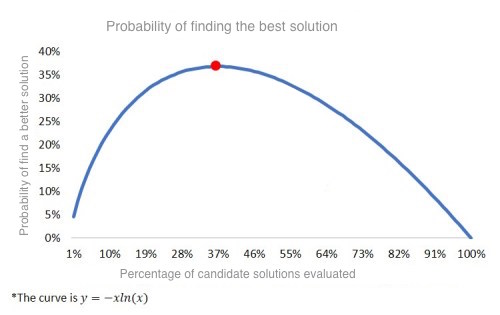
For a deeper dive into the mathematics, the following resources are excellent.
[PDF] The Secretary Problem - University of Luxembourg
This research paper provides the rigorous mathematics behind our calculations. You don't need to follow the full derivation, but focus on two key parts.
First, read section 3.1, "Finding an explicit formula," particularly the part that introduces the formula we just used. Then, skip to section 3.4, "The optimal integer," which discusses exactly the issue we just discovered: that the optimal scouting number r is not always the closest integer to n/e.
Why is this number everywhere?
This Veritasium video offers a brilliant and intuitive derivation of the continuous probability function P(S) = (S/N) * ln(N/S), which is the approximation of the formula we used.
Watch the segment from the calculation to see how the discrete sum elegantly transforms into an integral and how calculus reveals that the maximum probability is achieved at the 1/e point.
Your Refined Fitting Room Strategy
Armed with this more precise insight, we can now state your final, optimized strategy for the 15 lingerie pieces.
-
The "Explore" Phase (k=5):
Have the model try on the first 5 pieces in their random sequence. For example:- Piece 1: A black lace balconette bra and thong set.
- Piece 2: A red satin chemise.
- Piece 3: A white mesh bodysuit.
- Piece 4: A vintage-style garter belt with stockings.
- Piece 5: A minimalist plunge bra and high-leg brief set.
Reject all five of these, but mentally identify the one that has the most promise (e.g., the red chemise). This is your new, rigorously established benchmark.
-
The "Select" Phase (Pieces 6-15):
Continue the tryouts starting with the 6th piece. You will now select the very first piece that you judge to be superior to the benchmark (the red chemise). Once you make this selection, the process ends. -
The Contingency:
If you evaluate pieces 6 through 14 and none of them surpass your benchmark, you are committed to selecting the final piece, number 15.
By following this refined strategy, you are maximizing your probability of selecting the single best lingerie piece for the photoshoot at approximately 39%.
Conclusion
This lesson completes your journey through the statistical toolkit for your lingerie design project. We began with cleaning data and ended with a truly optimized strategy for making your final, high-stakes creative decision.
Key Takeaways:
- The optimal stopping rule provides a robust approximation for the ideal scouting period () in a sequential choice problem.
- For critical decisions with a small number of options (), it is practical and beneficial to calculate the exact success probabilities using the discrete sum formula to find the true optimal .
- For your specific case of lingerie pieces, the optimal strategy is to scout items, which yields a success probability of nearly 39%, slightly outperforming the initial estimate of .
You have now mastered techniques spanning the entire project lifecycle: from exploratory analysis and trend identification with correlation and PCA, to predictive modeling with regression, to avoiding fallacies with causal inference, and finally, to making optimal selections with experimental design and stopping rules. You are fully equipped to execute your project with a level of analytical rigor that elevates your creative process. Congratulations on completing the course