Hello! Welcome to the final lesson in our module on understanding data.
In our previous lessons, we've covered the practical aspects of data: its quality, volume, and variety. You saw a powerful example of what happens when data lacks variety with the story of Amazon's biased recruiting tool. That example is the perfect entry point for today's topic, which moves from the practical to the critical.
Our learning outcome for this lesson is to identify ethical and privacy risks when working with business data. For the managers in your workshop, this is arguably one of the most important topics. A failure to understand these risks can lead to flawed decision-making, legal penalties, and significant damage to a company's reputation. Your role is to equip them with the awareness to ask the right questions and lead responsibly in the age of AI.
The Landscape of AI Risks
When we talk about "ethics" in a business context, we're really talking about a set of risks and responsibilities. An AI system is a powerful tool, but like any tool, it can be misused or have unintended negative consequences. For a manager, understanding the landscape of these risks is the first step toward mitigating them.
This infographic provides an excellent high-level summary of the key areas of concern.

We will focus on three of the most critical risks for managers dealing with data:
- Algorithmic Bias and Discrimination
- Data Privacy and Security
- Lack of Transparency (The "Black Box" Problem)
1. Algorithmic Bias: When Data Teaches the Wrong Lessons
We've already touched on this, but it deserves a deeper look. Algorithmic bias occurs when an AI system's outputs create or reinforce unfair outcomes, such as discriminating against a particular group. As you learned, this bias often originates from the data used to train the system.
To help you explain this concept to your audience, the following article provides a very clear, business-focused breakdown.
5 Ethical Considerations of AI in Business - HBS Online
The article '5 Ethical Considerations of AI in Business' from HBS Online clearly explains algorithmic bias in a way that is perfect for a non-technical audience. It uses a relatable hiring example.
Please read the section titled '2. Algorithmic Bias'. Pay close attention to how it defines the issue and the concrete steps it suggests for addressing it, like using diverse data sets and regular audits.
The key takeaway is that AI systems have no inherent sense of fairness. They simply learn patterns from data. If the historical data reflects societal biases (e.g., fewer women in executive roles), the AI will learn that bias as a rule and apply it to future decisions.
For a slightly different perspective on why this happens, consider this short video clip. It frames the issue as the AI not sharing our human values.
The three big ethical concerns with artificial intelligence
In this clip from 'The three big ethical concerns with artificial intelligence', the speaker explains that the risk isn't that AI is malicious, but that it does exactly what we tell it to, sometimes in unexpected and harmful ways—like adopting bias from data.
Watch from 01:16 to 02:27. Focus on the idea that bias is an 'unexpected and kind of bad' consequence of an AI trying to fulfill its objective without understanding the human context of fairness.
2. Data Privacy and Security: Protecting Your Most Valuable Asset
Every manager understands the importance of protecting sensitive company and customer information. AI adds new layers to this challenge because AI models are trained on vast amounts of data, creating a rich target for attack and a high potential for accidental leaks.
The following resources discuss the intertwined nature of data privacy and cybersecurity in the context of AI.
5 Ethical Considerations of AI in Business - HBS Online
Let's return to the HBS Online article. It has excellent sections on cybersecurity and privacy that frame the issues from a manager's perspective.
Read the sections '3. Cybersecurity' and '4. Privacy'. Note the practical advice about not keeping data you don't need—this is a simple but powerful message for your workshop audience.
To give you a deeper understanding of the types of attacks that can happen, the next video from IBM Technology provides a clear, though more technical, overview of threats like data poisoning and exfiltration. Knowing these terms isn't essential for your audience, but it will strengthen your own expertise as the instructor.
How to Secure AI Business Models
This video, 'How to Secure AI Business Models', details the specific ways data used for AI can be attacked. This will help you understand the 'how' behind the cybersecurity risks mentioned in the previous article.
Watch from 01:33 to 04:12. The speaker discusses threats to the data itself, such as data poisoning, exfiltration, and leakage, and introduces countermeasures like data classification and access controls.
The core message for your workshop participants is that using data for AI increases their responsibility. They must know what data they have, why they have it, who can access it, and how it is protected. A crucial part of this is handling Personally Identifiable Information (PII)—such as names, addresses, and contact details—with extreme care, as there are often legal obligations to keep it secure.
3. Transparency and Explainability: The "Black Box" Problem
One of the biggest challenges with some advanced AI models is that they are "black boxes." They can produce a highly accurate prediction or decision, but it can be difficult or impossible to understand why they arrived at that conclusion. This is a major problem in a business setting. How can a manager trust and act on a recommendation if they can't understand its reasoning?
This article explains the importance of transparency and the risks of these "black box" systems.
Ethics in AI: Why It Matters - Harvard Professional Development
The article 'Ethics in AI: Why It Matters' from Harvard Professional Development offers a great explanation of the need for transparency and the concept of 'explainability'.
Read the section titled 'AI Modeling Transparency and Explainability'. It makes a compelling case for why businesses need to understand the 'why' behind AI decisions to ensure fairness and maintain trust.
For a manager, if an AI denies a customer's loan application, recommends firing an employee, or flags a supplier as high-risk, the manager needs to be able to ask "Why?". Without a clear answer, the business is exposed to legal challenges, reinforcing biases, and making critical errors.
Test your understanding!
A logistics company uses an AI model to predict which delivery routes are most likely to experience delays. The model is 95% accurate. One day, it flags a route that has historically been very reliable as "high-risk." The manager responsible for dispatching drivers is confused but can't see why the AI made this prediction.
Based on the concepts we've discussed, what are the primary ethical/business risks here?
Show answer
The primary risks are:
- Lack of Transparency (The "Black Box" Problem): The manager cannot trust or validate the AI's recommendation. Acting on it without understanding could mean unnecessarily re-routing drivers, wasting time and fuel. Ignoring it could mean facing the predicted delay. This erodes trust in the system.
- Potential for Bias or Flawed Data: The AI might be acting on a hidden, incorrect pattern. For example, perhaps the training data was corrupted, or it learned a spurious correlation (e.g., a driver's name is similar to one who often has delays). Without explainability, there's no way to check.
- Accountability: If the manager follows the AI's advice and it turns out to be a mistake, who is accountable? The manager? The AI developer? The lack of transparency makes accountability difficult to assign.
A Framework for Responsible AI: The Manager's Role
Understanding these risks is not about stopping innovation; it's about guiding it responsibly. As a leader, a manager's role is to foster an environment of awareness and accountability. This is often referred to as AI Governance.
Governance involves creating policies and processes to ensure that AI is used fairly, transparently, and securely. It connects directly to the evolving legal landscape, like the EU's AI Act, which classifies AI systems by risk level.
The following infographic provides a positive framework, outlining the principles of an ethical AI system. You can present this to your workshop as the "goal" to strive for.
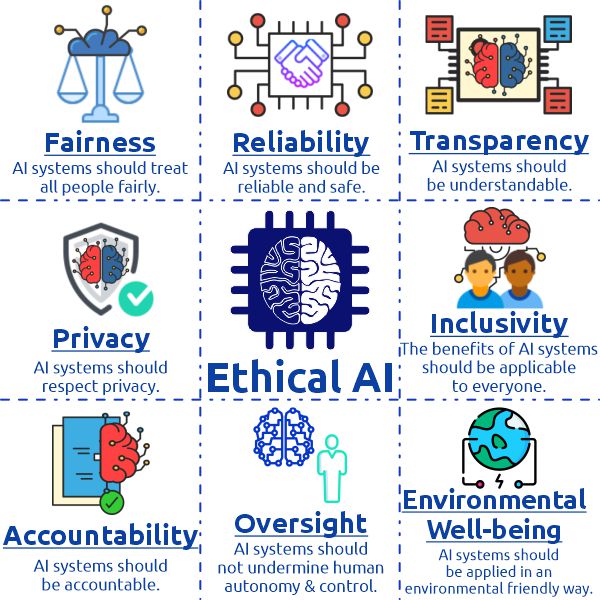
Your message to managers should be: You don't need to be an AI expert, but you need to be a responsible leader. This means:
- Asking "Why?": Challenge your teams on what data is being used, how bias is being tested, and whether AI decisions can be explained.
- Prioritizing Privacy: Champion the principle of "data minimization"—only collecting and storing what is absolutely necessary.
- Demanding Governance: Ensure there are clear lines of accountability and oversight for any AI system being deployed.
Conclusion
This lesson concludes our module on understanding data. We have moved from the technical (types, quality, volume, variety) to the socio-technical and ethical. You are now prepared to teach your audience of managers how to identify the critical risks of bias, privacy violations, and lack of transparency that come with using data in AI.
Key Takeaways for Your Workshop:
- AI ethics in business is about managing risk: legal, reputational, and financial.
- The three key risks to watch for are Bias from data, Privacy/Security breaches, and the "Black Box" problem of non-transparent models.
- A manager's job is not to build the AI, but to govern its use by asking critical questions guided by principles like fairness, transparency, and accountability.
Preview of the Next Module:
Having established a strong foundation in what data is, why its quality matters, and the ethical framework for its use, we are ready to get hands-on. In the next module, you will learn the first practical steps in a data workflow using the tools for your workshop. We'll start by opening Excel and learning how to import data into Power Query, the first step toward transforming raw data into valuable insights.