Introduction
Welcome to the final lesson in our Financial Management module. In our previous lesson, you learned about cash flow management—the critical process of tracking and forecasting the actual money moving in and out of your business. We emphasized that a business can be profitable but still fail if it runs out of cash, especially in retail where you pay for inventory upfront.
Today, we'll zoom in on the "profit" side of the equation. This lesson focuses on the Profit and Loss (P&L) statement, also known as an Income Statement. This is one of the most important financial reports you'll use. It tells the story of your store's financial performance over a specific period, such as a month, a quarter, or a year.
By the end of this lesson, you will be able to read a P&L statement, understand what each line item means, and, most importantly, interpret the data to make smarter decisions for your beauty mini-market.
1. What is a P&L Statement?
At its core, a Profit and Loss statement follows a simple formula: Revenue - Expenses = Profit (or Loss). It provides a clear summary of how much money you made and how much money you spent to earn it.
Unlike the cash flow forecast, which predicts your future bank balance, the P&L looks back at a past period to assess profitability. Let's start with a short video that gives a great overview of the P&L structure from a retailer's perspective.
P&L Management Basics | Retail Dogma
The video 'P&L Management Basics' from Retail Dogma explains what a P&L statement is and walks through its essential components in a retail context.
Please watch from the beginning until 03:03. Pay attention to the top-to-bottom flow, starting from Total Sales and ending with Profit.
As the video explained, the P&L is a structured report that subtracts various costs from your revenue in stages. This multi-step process gives you deeper insights than just looking at the final profit number.
2. Deconstructing the P&L: A Line-by-Line Guide
To truly understand your store's performance, you need to be comfortable reading each section of the P&L. Let's break down a typical retail P&L statement from top to bottom.
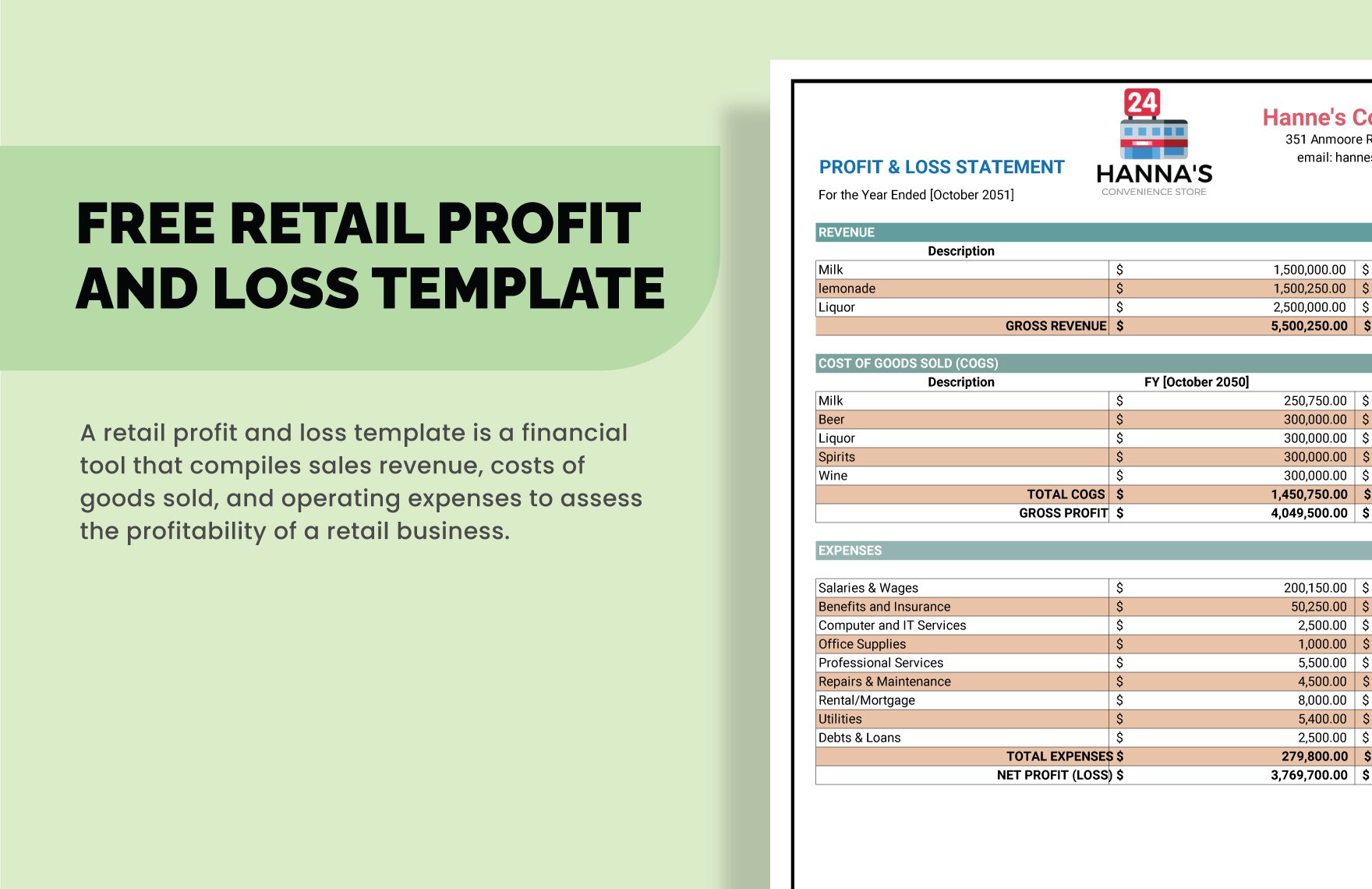
We will now go through each of these key sections in more detail.
Profit and Loss Statement Example
The article 'Profit and Loss Statement: What is it, Template & Analysis' by Bench.co provides excellent, clear definitions for each line item. We'll use its example of a small retail business to guide our walkthrough.
Please read the section titled 'Profit and loss statement example', which goes from 'Sales revenue' down to 'Net profit'. Focus on understanding the definition of each term.
Let's summarize those key components in the context of your beauty mini-market:
-
Sales Revenue (The "Top Line"): This is the total amount of money generated from selling your beauty products during the period. It's the sum of all your sales before any costs are deducted.
-
Cost of Goods Sold (COGS): This is the direct cost of the inventory you sold. For your store, it includes the wholesale price you paid for the skincare, makeup, and other products that customers purchased. It only includes the cost of products that were actually sold.
-
Gross Profit: This is calculated as
Sales Revenue - COGS. This number is crucial because it tells you how profitable your products are on their own, before accounting for your operational overhead.- A related, and very important, metric is Gross Margin, which is Gross Profit expressed as a percentage:
(Gross Profit / Sales Revenue) * 100. A 40% gross margin means that for every $100 in sales, you have $40 left over to pay for your operating costs and to generate a profit.
- A related, and very important, metric is Gross Margin, which is Gross Profit expressed as a percentage:
-
Operating Expenses (OpEx): These are the costs required to run the store, which are not directly tied to the products sold. They are often called "overheads" and include:
- Rent for your store location
- Employee salaries and wages
- Utilities (electricity, water, internet)
- Marketing and advertising costs
- POS system subscription fees
- Bank and credit card processing fees
-
Operating Profit (or EBITDA): This is your
Gross Profit - Operating Expenses. It shows the profitability of your core business operations. It's a strong indicator of your store's day-to-day financial health and efficiency. (EBITDA stands for Earnings Before Interest, Taxes, Depreciation, and Amortization). -
Net Profit (The "Bottom Line"): This is the final profit after all expenses, including interest on loans and taxes, have been deducted from your revenue. This is the ultimate measure of profitability and is the money that you can either reinvest in the business or take as personal income.
3. From Reading to Interpreting: Making Strategic Decisions
Understanding the P&L is only half the battle. Its real power comes from using it to analyze your business and make informed decisions.
One of the most effective ways to analyze a P&L is to create a "Common Size" P&L statement. This format shows each line item as a percentage of total sales revenue. This makes it incredibly easy to see where your money is going and to compare your performance over different periods (e.g., this month vs. last month, or this quarter vs. the same quarter last year).
What is a common size profit and loss statement? & How to analyze a profit and loss statement
Let's return to the Bench.co article to see what a common size P&L looks like and how to begin your analysis.
First, read the short section 'What is a common size profit and loss statement?'. Then, read 'How to analyze a profit and loss statement'. This will give you a practical checklist for interpretation.
Now, let's see how this analysis can be applied specifically to a beauty business like yours.
Case studies: how to use P&L in a salon
The article 'Mastering beauty salon finances with a P&L statement' by EasyWeek provides several case studies showing how beauty businesses used P&L analysis to improve their profitability.
Please read the section 'Case studies: how to use P&L in a salon'. As you read, think about how you could apply similar thinking to your own beauty mini-market.
As these examples show, by regularly reviewing your P&L, you can answer critical business questions:
- Is my gross margin high enough? If your COGS are too high (e.g., above 60% of revenue), you might need to find new suppliers or adjust your pricing.
- Are my operating expenses under control? If your rent or marketing costs are eating up too much of your gross profit, you'll need to find ways to reduce them. For example, the case study showed a business realizing its marketing spend was ineffective and reallocating it.
- Which products are most profitable? By analyzing sales and COGS data for different product categories, you can focus on stocking and promoting high-margin items.
- Is my business growing healthily? By comparing P&L statements over time, you can see if your revenue is increasing and if your profit margins are improving or declining.
Conclusion
Congratulations on completing the Financial Management module! You now have a foundational understanding of the three most important financial tools for your new business.
Key Takeaways:
- The P&L Statement measures your store's profitability over a period by subtracting all expenses from your revenue.
- The key sections are Revenue, COGS, Gross Profit, Operating Expenses, and Net Profit (the "bottom line").
- Analyzing your P&L is not just an accounting exercise; it's a strategic tool. It helps you identify opportunities to increase revenue, control costs, and improve overall profitability.
- Using a "Common Size" P&L (with percentages) is a powerful way to track trends and benchmark your performance over time.
You began this module by learning how to calculate your Break-Even Point—your primary sales target. Then you learned to manage your day-to-day survival with a Cash Flow Forecast. Finally, with the P&L Statement, you now know how to measure and analyze your performance. Together, these three tools provide a 360-degree view of your store's financial health.
Preview of the Next Module:
With your financial planning foundation in place, we will move on to the operational side of your business. The next module, Staffing, Customer Service, and Daily Operations, will cover how to hire the right people, create an exceptional in-store experience, and set up the daily procedures that will make your beauty mini-market run smoothly and professionally.