Hello! In our last lesson, we focused on asking questions using do/does and Wh-words. You now have the skills to form many different types of simple sentences and questions.
Today, we will take the final and most important step in our "English Sentence Foundations" module. We will learn how to ensure every sentence you write is grammatically complete and correct. Specifically, we will focus on two very common errors for new writers: sentence fragments (不完整的句子) and run-on sentences (连续句子).
Learning to spot and fix these errors is essential. For your IELTS test, correct sentence structure is a basic requirement. In your daily writing, it makes your messages clear and easy to understand.
What is a Complete Sentence?
Before we look at errors, let's review what makes a sentence complete. From our first lessons, we know a sentence needs a subject and a verb. But there is one more part: it must express a complete thought.
For example, "She waited" is a complete sentence.
- Subject: She
- Verb: waited
- Complete thought: We understand the main idea.
The resource below gives a clear definition of a complete sentence.
Fragments and Run-ons – The Writing Center
This handout from the University of North Carolina Writing Center clearly explains the three essential parts of a complete sentence.
Please read the section titled "The basics." Focus on the three components of a complete sentence: the definition.
Part 1: Sentence Fragments (不完整的句子)
A sentence fragment is an incomplete sentence. It's like a piece of a sentence that is missing something. This can happen in three main ways:
- It is missing a subject (who or what is doing the action).
- It is missing a verb (the action).
- It has a subject and a verb, but it does not express a complete thought.
This video gives excellent, clear examples for each type of fragment and shows how to fix them.
Sentence Fragments & How to Fix Them | How to Write Complete Sentences | English Writing Essentials
This video from Sparkle English breaks down sentence fragments into simple categories, making them easy to understand and correct.
First, watch the introduction to understand the definition of a fragment. Next, see examples of fragments without a subject. Then, look at examples of fragments without a verb. Finally, focus on the most common type: dependent clauses that are fragments. Watch from this section to see how to fix them by joining them to a complete sentence.
As the video explained, the most common fragments are incomplete thoughts that often start with words like because, if, when, or although.
- Fragment: Because I was tired. (The reader asks, "...so what happened?")
- Complete Sentence: I went to bed early because I was tired.
To fix this type of fragment, you must connect it to a complete sentence (an independent clause).
Part 2: Run-on Sentences (连续句子)
A run-on sentence is the opposite of a fragment. Instead of having too little information, it has too much. A run-on sentence joins two or more complete sentences together without the correct punctuation or connecting word.
- Run-on: I am a student I go to school every day.
This is incorrect because "I am a student" and "I go to school every day" are two separate, complete thoughts. They cannot be "run together" like this.
A very common type of run-on is called a comma splice, where a comma is incorrectly used to join two complete sentences.
- Comma Splice (Incorrect): I am a student, I go to school every day.
A comma alone is not strong enough to connect two complete sentences. The video below explains this common mistake.
SENTENCES, FRAGMENTS, & RUN-ONS | English Lesson
This video from Kevin Spaans gives a very direct explanation of run-on sentences and the comma splice error.
Please watch the section that defines a run-on sentence. Pay close attention to the warning about using only a comma to separate two complete sentences.
How to Fix Run-on Sentences
There are several easy ways to fix a run-on sentence. The simplest methods are best for a beginner.
-
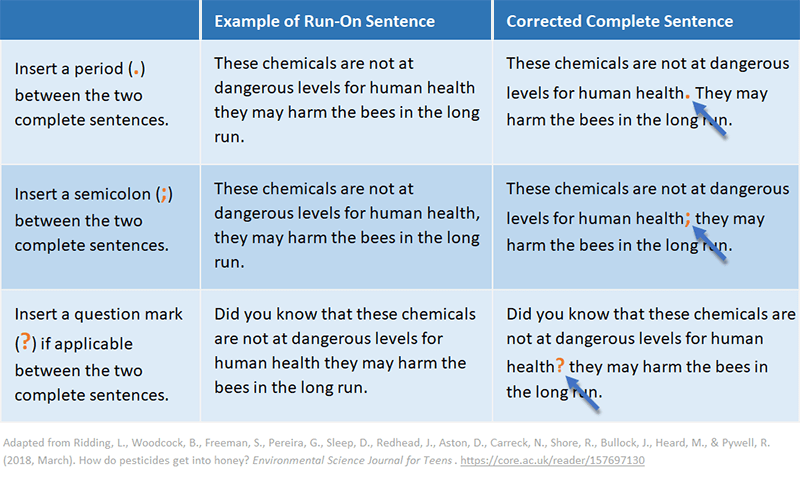
Use a period (.) to create two separate sentences. This is always a safe and correct choice.
- I am a student. I go to school every day.
-
Use a semicolon (;) to connect two very closely related thoughts. A semicolon is stronger than a comma but weaker than a period.
- I am a student; I go to school every day.
-
Use a comma (,) plus a connecting word (like and, but, so).
- She likes tea, but he likes coffee.
The image below provides a great visual summary of some of these correction methods.
Practice
Now let's practice identifying these different structures. For each example below, decide if it is a complete sentence, a fragment, or a run-on.
- Because I studied for the test.
- My brother works in a bank he is a manager.
- The sun is shining.
- Wrote an email to my friend.
- She is very smart, she always gets good grades.
Answers:
- Fragment. It's an incomplete thought. (Correct: I passed the exam because I studied for the test.)
- Run-on. It's two complete sentences joined incorrectly. (Correct: My brother works in a bank. He is a manager.)
- Complete Sentence. It has a subject, a verb, and a complete thought.
- Fragment. It's missing a subject. (Correct: I wrote an email to my friend.)
- Run-on (Comma Splice). Two complete sentences are joined only by a comma. (Correct: She is very smart, so she always gets good grades. OR She is very smart. She always gets good grades.)
Key Takeaways
- A complete sentence must have a subject, a verb, and express a complete thought.
- A sentence fragment is an incomplete sentence. To fix it, add the missing part (subject or verb) or join it to a complete sentence.
- A run-on sentence combines two or more complete sentences incorrectly. To fix it, separate the sentences with a period (
.), a semicolon (;), or a comma plus a connecting word (and,but,so). - In formal writing and for tests like IELTS, always use complete sentences. In very informal writing like text messages, fragments are sometimes used (e.g., "See you soon!").
This lesson concludes our first module on the foundations of English sentences. You have learned how to build sentences, ask questions, and now, how to make sure they are grammatically complete.
In our next lesson, we will begin Module 2, "Core Grammar for Writing: Tenses," starting with how to use the simple present tense to describe facts and routines.