Hello! Welcome back to our Hindi sessions.
In the last lesson, you learned to use frequency adverbs to add detail to your sentences, saying things like Main kabhi-kabhi action filmein dekhti hoon (I sometimes watch action films). This was a great step in describing your own habits.
Today, we're going to take that same grammar—the habitual present tense—and use it for a new, exciting purpose: talking about the general plot or themes of your favorite types of movies. Instead of just talking about what you do, you'll learn to describe what typically happens in a film. This is a core skill for your goal of discussing movies with a live audience.
By the end of this lesson, you'll be able to move from describing your media habits to narrating the basic storyline of different movie genres.
1. The Vocabulary of Film
Before we can talk about movie plots, we need a shared vocabulary. Many English film terms are used directly in conversational Hindi, which is great news!
Here's a mind map to get us started with some common genres and film-related words.
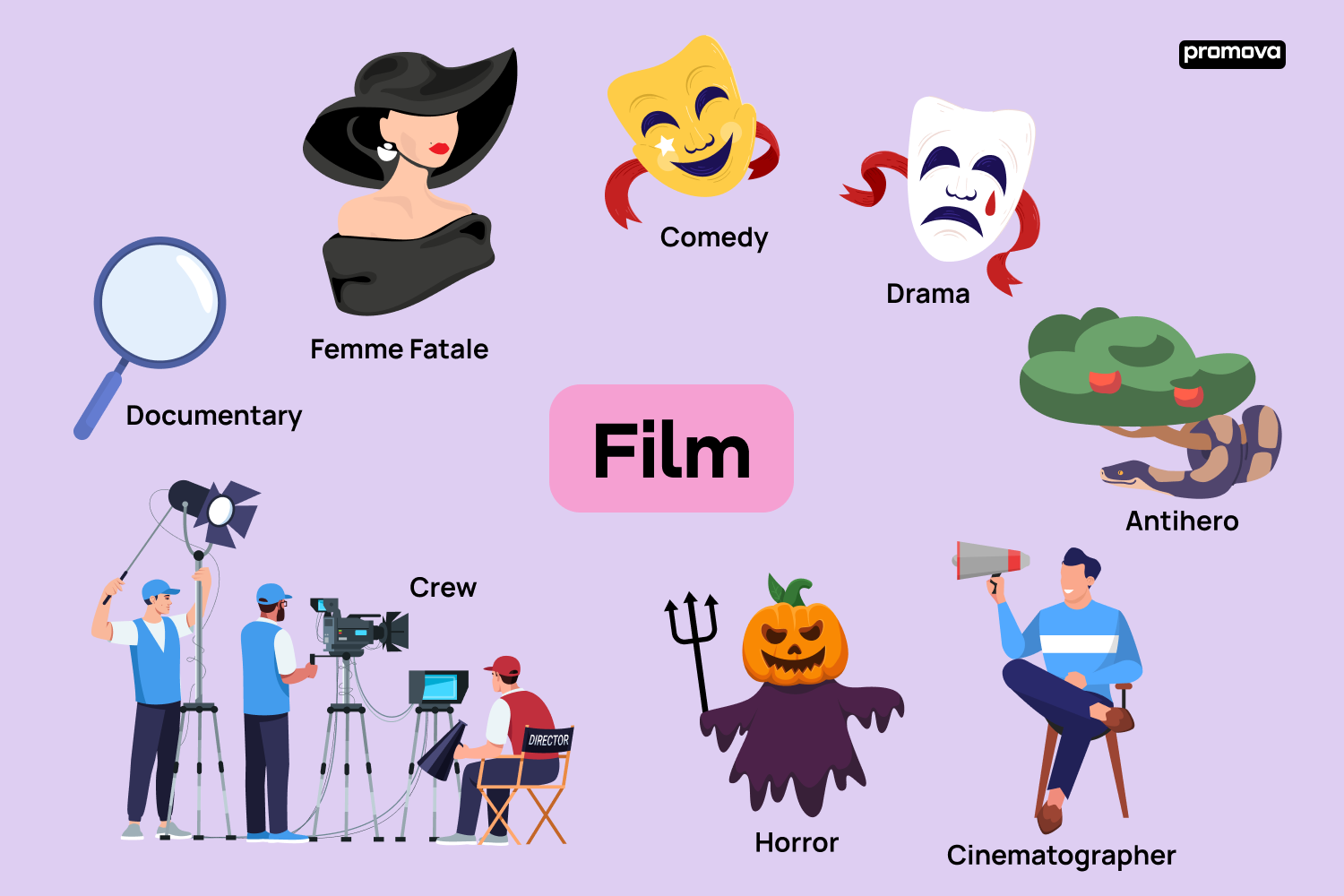
Let's focus on a few key terms. The Hindi words are often very similar to the English ones.
- Action film:
action film(एक्शन फिल्म) - Comedy:
comedy(कॉमेडी) - Romantic film:
romantic film(रोमांटिक फिल्म) - Drama:
drama(ड्रामा)
And here are some essential nouns for describing any plot:
- Hero:
hero(हीरो) - Heroine:
heroine(हिरोइन) - Villain:
villain(विलेन) - Love:
pyaar(प्यार) - Fight:
ladai(लड़ाई) - Song:
gaana(गाना)
Keep these words in mind as we move on to building sentences.
2. Describing a General Plot
In previous lessons, you used the habitual present tense to talk about your own routine, using main ... -ti hoon (I do...).
Main filmein dekhti hoon.(I watch films.)
Now, we'll use the same tense to describe a general truth or what usually happens in a story. For this, we'll use the third-person forms:
... -ta hai(for masculine subjects)... -ti hai(for feminine subjects)
The key is to start your sentence by setting the context, for example, "In romantic films..." (Romantic filmon mein...).
Here’s the structure:[Genre] filmon mein, + Subject + (Object) + Verb + -ta hai / -ti hai
Let's see it in action:
-
In action films, the hero fights.
Action filmon mein, hero ladta hai.- (Genre:
Action filmon mein,Subject:hero[masc.], Verb:ladta hai)
-
In romantic films, the heroine sings songs.
Romantic filmon mein, heroine gaane gaati hai.- (Genre:
Romantic filmon mein,Subject:heroine[fem.], Object:gaane, Verb:gaati hai)
-
In these movies, a lot happens.
In filmon mein, bahut kuch hota hai.- (Context:
In filmon mein,Subject:bahut kuch[masc. default], Verb:hota hai)
This structure is your key to summarizing any genre.
Test your understanding!
Using the vocabulary we just learned, how would you say: "In comedy films, the hero does comedy."?
Show answer
Comedy filmon mein, hero comedy karta hai.
3. Analyzing Real Movie Plots
Now let's see how these descriptions look in the real world. You have a strong ability to understand written Hindi, so we'll use that to our advantage. The following article contains short plot summaries of popular Bollywood films. Reading them will help you see how stories are told.
Top Indian Movie List for Your Hindi Learning
Let's read some movie summaries from the HindiPod101 article 'Top Indian Movie List for Your Hindi Learning'. This will give you a feel for how plots are described in a natural way.
Please read the short plot summaries for the following three movies: Bhaag Milkha Bhaag: Find this under the 'Inspirational Movies' section. Notice how it describes his journey and challenges. A Wednesday: Look for this under 'Movies on Sensitive Issues'. See how it sets up the central conflict: 'What happens when a common man takes things into his own hands?'. English Vinglish: Find this under 'Entertainment with a Message'. Pay attention to how it describes the main character, Shashi, and her central problem. As you read, focus on identifying the main character and the central action or theme of the story.
Let's break down a sentence from one of those summaries to see our grammar at work.
The summary for English Vinglish says: "The film depicts the life of a housewife, Shashi..."
In Hindi, this could be phrased:Yeh film Shashi naam ki ek housewife ki life dikhati hai.
(This film shows the life of a housewife named Shashi.)
Notice the verb: dikhati hai (shows). It's the habitual present, describing what the film does.
Another example, for the movie Akele Hum Akele Tum: "The movie portrays the hardships of a desperate father..."Yeh film ek desperate pita ki mushkilein dikhati hai.
(This film shows the difficulties of a desperate father.)
Again, we see dikhati hai used to describe the film's theme.
4. Practice Describing a Theme
Now it's your turn to practice. Let's use an image that has a plot summary built into it.

Based on the Hindi text in this image, we can describe the theme of this movie using the structure we learned.
- The Subject: The husband (
pati). - The Action: Harasses his wife (
apni patni ko pareshan karta hai).
So, a simple plot summary would be:Is film mein, pati apni patni ko pareshan karta hai.
(In this film, the husband harasses his wife.)
This is exactly the kind of simple, clear summary you can use when introducing a movie to your audience.
Conclusion
Excellent work today! You've made a significant leap from personal narration to storytelling. This is a fundamental skill for discussing movies, series, and even song storylines.
Key Takeaways:
- You've expanded your vocabulary with key movie genres and plot elements like
hero,heroine,pyaar, andladai. - You learned to use the third-person habitual present (
-ta hai / -ti hai) to describe the general plot of a movie, not just personal habits. - The key sentence structure for this is:
[Genre] filmon mein, [Subject] [Action]. - You can now describe what typically happens in different genres, for example,
Action filmon mein, hero ladta hai.
Preview of the Next Lesson:
Now that you can objectively describe what happens in a movie, the next step is to share your personal feelings about it. In our next lesson, we will learn how to express likes and dislikes. You'll learn how to use phrases like mujhe pasand hai (I like) to say whether you enjoyed a film, a song, or a character's performance. This will add a whole new layer of personal expression to your conversations.