Hello! Welcome back.
In our last lesson, you learned the mechanics of the simple future tense, which is essential for talking about plans and intentions. You practiced conjugating verbs like karnā (to do) and dekhnā (to watch) to say what you or others "will do."
Today, we'll put that knowledge to work in a way that's directly tied to your goal of discussing movies. This lesson focuses on the learning outcome: Predict what might happen next in a movie or series. You'll learn the phrases and structures needed to speculate on plot developments, a key skill for engaging with an audience during a live stream.
1. The Language of Prediction
When we predict something, we're not stating a fact; we're expressing an opinion or a possibility about the future. In Hindi, there are two simple and extremely common ways to frame a prediction.
A. Expressing a feeling or thought: Mujhe lagtā hai ki...
This phrase translates to "I think that..." or "It seems to me that...". It's the perfect way to introduce your opinion about what will happen. The structure is:
Mujhe lagtā hai ki + [Your prediction in the simple future tense]
- Example:
Mujhe lagtā hai ki hero jītegā.(I think that the hero will win.)
Notice that the sentence after ki (that) is a complete, standard future tense sentence.
B. Expressing a possibility: Shāyad...
This word means "maybe" or "perhaps." It's a great way to show you're speculating. You simply place it at the beginning of the sentence.
- Example:
Shāyad villain hār jāegā.(Maybe the villain will lose.)- Note:
hār jānāis a compound verb often used for "to lose."
- Note:
These two phrases, mujhe lagtā hai ki and shāyad, will be the foundation for almost all your predictions.
2. Predicting a Scene: A Practical Exercise
Let's use these new tools. As discussed in the academic article "The Popular Culture of Bollywood in Teaching Hindi," a great way to practice is to look at a scene and predict the outcome.
Take a look at the image below.
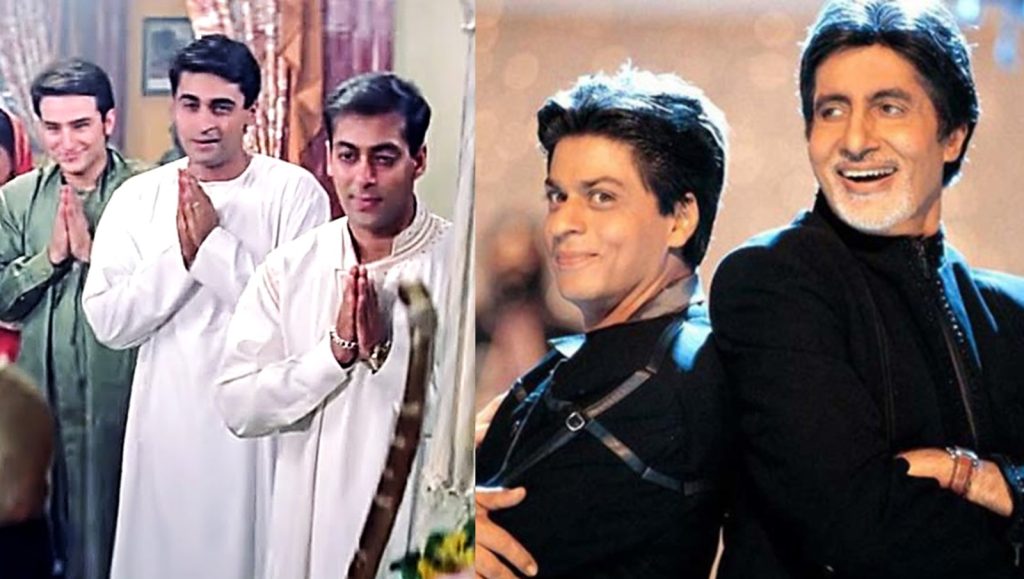
Let's focus on the scene on the left, featuring actors who look like they are from a family drama (like Hum Saath-Saath Hain).
Scenario: Imagine these are three brothers. The brother in the middle has just returned home after being away for ten years. The other two brothers look surprised and emotional. What will happen next?
Here are a few possible predictions using the structures we just learned:
-
Prediction: Maybe they will hug him.
- Hindi:
Shāyad ve use gale lagāeṅge. - Breakdown:
Shāyad(Maybe)ve(they)use(to him)gale lagāeṅge(will hug - future tense ofgale lagānā, agreeing withve)
- Hindi:
-
Prediction: I think their mother will be very happy.
- Hindi:
Mujhe lagtā hai ki unkī mām̐ bahut khush hoṅgī. - Breakdown:
Mujhe lagtā hai ki(I think that)unkī mām̐(their mother)bahut khush(very happy)hoṅgī(will be - future tense ofhonā, agreeing withmām̐, which is feminine)
- Hindi:
Test your understanding!
Now, look at the scene on the right, with Shah Rukh Khan and Amitabh Bachchan. Let's imagine this is a father (Amitabh) and son (Shah Rukh) who had a big argument and haven't spoken in years. They have just met unexpectedly.
Using mujhe lagtā hai ki or shāyad, how would you predict: "Maybe the son will say sorry."
- Son:
beṭā - To say sorry:
sorry bolnāormāfī māṅgnā
Show answer
Shāyad beṭā sorry bolegā.
ORShāyad beṭā māfī māṅgegā.
- Structure:
Shāyad+ Subject (beṭā) + Verb (bolegā/māṅgegā). - Verb: The verb root is
bol-ormāṅg-. The future tense ending for a singular masculine subject (beṭā, he) is-egā.
You could also say: Mujhe lagtā hai ki beṭā sorry bolegā. (I think that the son will say sorry.)
3. Narrating a Future Sequence
Your live stream commentary won't be just one sentence. You'll likely predict a short sequence of events. You can connect sentences using simple words like phir (then/after that) and uske bād (after that).
Let's try to build a mini-narrative for a classic Bollywood trope.
Scenario: The hero and heroine are running away to get married. Suddenly, the heroine's angry father and his goons stop their car. What will happen next?
Let's build a 3-step prediction.
-
First, the hero will fight the goons.
Pahale, hero guṇḍoṅ se laṛegā.Pahale(First),guṇḍoṅ se(with the goons),laṛegā(will fight).
-
Then, he will defeat the father.
Phir, vah pitā ko harāegā.Phir(Then),vah(he),pitā ko(to the father),harāegā(will defeat).
-
After that, maybe they will get married.
Uske bād, shāyad ve shādī kareṅge.Uske bād(After that),shāyad(maybe),ve(they),shādī kareṅge(will do marriage/will get married).
Putting it all together, you get a short, coherent prediction:
Pahale, hero guṇḍoṅ se laṛegā. Phir, vah pitā ko harāegā. Uske bād, shāyad ve shādī kareṅge.
This is exactly the kind of running commentary you could provide during a live stream when a tense scene begins.
Conclusion
Excellent work today! You've taken the grammatical rule of the future tense and turned it into a powerful tool for communication and commentary, which is central to your goal.
Key Takeaways:
- To make a prediction, you can start your sentence with
Mujhe lagtā hai ki...(I think that...) orShāyad...(Maybe...). - The actual prediction is a standard sentence in the simple future tense, with the verb ending agreeing with the subject (e.g.,
hero jītegā,ve shādī kareṅge). - You can string predictions together using words like
pahale(first),phir(then), anduske bād(after that) to narrate a potential sequence of events.
Preview of the Next Lesson:
Your predictions are good, but we can make them even more specific. What if you want to say, "If the hero defeats the father, then they will get married"? In the next lesson, we will learn how to form these powerful "if/then" conditional sentences using agar and toh, adding another layer of sophistication to your Hindi commentary.