Hello! In our last module, we explored the incredible theoretical power of quantum algorithms like Shor's, which can solve certain problems exponentially faster than any known classical method. We concluded by noting that designing an algorithm on paper is one thing, but building a machine to run it is a monumental engineering challenge.
Welcome to our final module, where we bridge that gap between theory and reality. Today's lesson kicks off this exploration by looking at the very foundation of a quantum computer: the physical qubit. You'll learn about the main ways scientists and engineers are currently building qubits, focusing on two leading technologies: superconducting circuits and trapped ions. This topic should resonate well with your background in electronics and electrical engineering, as we'll be discussing concepts like circuits, resonance, and electromagnetic fields.
Our goal is to understand how these technologies work at a high level and to appreciate the different engineering trade-offs each one presents.
1. What Makes a Good Qubit?
Before diving into specific technologies, let's consider what we need from any physical system to call it a qubit. While there's a formal list of criteria (known as the DiVincenzo criteria), the essential requirements are:
- Two-Level System: It must have two distinct and controllable quantum states that we can label and .
- Initialization: We must be able to reliably set the qubit to a known starting state, typically .
- Control: We need to be able to perform universal quantum gates, rotating the qubit state to any point on the Bloch sphere (single-qubit gates) and creating entanglement between qubits (two-qubit gates).
- Measurement: We must be able to accurately measure the final state of the qubit.
- Coherence: The qubit must remain in its quantum state long enough to complete a computation before it "decoheres" and loses its information to the environment.
No single technology is perfect across all these criteria. The field is a story of clever engineering and trade-offs. Let's explore the two most mature approaches.
2. Superconducting Qubits: Engineering an Artificial Atom
One of the most advanced and well-funded approaches to building a quantum computer is based on superconducting circuits. Companies like Google and IBM have built their processors using this technology. The core idea is to create a macroscopic circuit that, when cooled to near absolute zero, behaves like a single quantum object—an "artificial atom."
For someone with your background, the best starting point is a familiar component: the LC circuit.
How to Turn Superconductors Into A Quantum Computer | Superconducting Qubits 1
The video "How to Turn Superconductors Into A Quantum Computer" from Lukas's Lab provides an excellent step-by-step explanation, starting from classical concepts.
Begin by watching the segment that connects a classical LC circuit to a simple harmonic oscillator. Next, understand why a simple quantum version of this circuit is not suitable for a qubit. Pay close attention to the discussion of equally spaced energy levels. This is the central problem that needs to be solved. Finally, see how replacing the linear inductor with a non-linear circuit element—the Josephson junction—solves this problem by creating unevenly spaced energy levels. This allows us to isolate the two lowest states to act as our qubit.
As the video explains, a standard LC circuit is a harmonic oscillator. If you make it quantum, you get a "ladder" of energy levels that are all equally spaced. If you try to excite the system from state to with a microwave pulse, that same pulse has the right energy to excite it from to , from to , and so on. You can't isolate just two levels.
The key innovation is the Josephson junction, which acts as a non-linear, dissipation-free inductor. By replacing the standard inductor with a Josephson junction, the circuit becomes an anharmonic oscillator. The energy gaps are no longer equal.
Left: A harmonic oscillator with equally spaced energy levels. Right: An anharmonic oscillator with non-equal spacing, allowing the transition to be addressed uniquely.
This allows us to use microwave pulses tuned to the specific frequency of the transition, without affecting any other energy levels. The most common type of qubit built this way is called the transmon, which is what you've just learned about.
Advantages and Disadvantages
Superconducting qubits have some significant engineering advantages but also major challenges.
Understanding the Quantum Computing Hardware Landscape
This article from The Quantum Insider provides a concise summary of the pros and cons of different qubit platforms.
Read the section on Superconducting Quantum Computers. Focus on the trade-offs mentioned: the benefits of speed and established fabrication techniques versus the challenges of cryogenic cooling and sensitivity to noise.
To summarize:
- Pros: They are essentially microchips, so we can leverage decades of experience from the semiconductor industry to fabricate and scale them. The gate operations are also very fast (nanoseconds).
- Cons: They are extremely sensitive to environmental noise (stray electric or magnetic fields, temperature fluctuations). This leads to shorter coherence times. To function at all, they must be kept in dilution refrigerators at temperatures colder than deep space (~15 millikelvin).
3. Trapped-Ion Qubits: Nature's Perfect Qubit
A completely different approach uses nature's own quantum systems: atoms. In this method, individual atoms are stripped of an electron to become positively charged ions. These ions are then suspended in a vacuum using electromagnetic fields. Each ion serves as a nearly perfect, identical qubit.
What is an Ion Trap Quantum Computer?
This short animation from Simon Benjamin's channel, "What is an Ion Trap Quantum Computer?", clearly illustrates the fundamental principles.
First, watch how an ion's internal energy levels are used to store the |0\rangle and |1\rangle states, and how lasers are used for control and readout. Then, see the physical components of the system, including the ion trap chip itself, the vacuum chamber, and the surrounding laser systems.
The key components here are:
- The Qubit: An ion, such as Ytterbium (Yb+), whose stable internal electronic energy states serve as and .
- The Trap: A chip with gold electrodes that generate oscillating electric fields to hold the ions in a precise line within an ultra-high vacuum chamber.
- Control/Readout: Carefully aimed lasers perform gate operations by driving transitions between the energy levels. Measurement is also done with lasers—if the ion is in state , it will absorb and re-emit laser light (fluoresce), which can be detected by a camera. If it's in state , it remains dark.
Advantages and Disadvantages
Trapped-ion systems present a different set of trade-offs compared to superconducting ones.
Understanding the Quantum Computing Hardware Landscape
Now, read the next section of the same article.
Read the section on Trapped-Ion Quantum Computers. Note the key advantages of stability and long coherence times, and the trade-offs in gate speed and scaling complexity.
- Pros: Because ions are identical and well-isolated in a vacuum, they are much less sensitive to noise. This gives them very long coherence times (seconds or even minutes!). They also tend to have higher gate fidelities (i.e., gates are more accurate).
- Cons: The gate operations, which involve physically moving ions and using lasers, are much slower (microseconds) than in superconducting systems. While trapping a few dozen ions is routine, scaling up to thousands or millions presents significant engineering hurdles.
4. Head-to-Head: A Comparison of Technologies
Let's directly compare these two leading contenders. They differ not only in their physical makeup but also in how qubits can interact with each other.
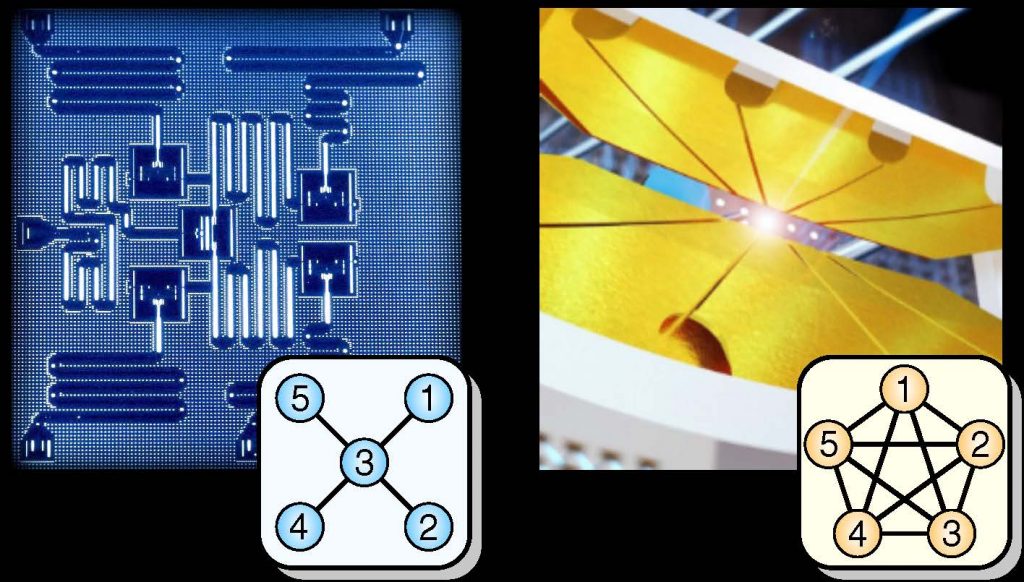
This difference in connectivity is critical. In many superconducting architectures, a qubit can only directly interact with its immediate neighbors on the chip. In a trapped-ion system, a single ion's motion can influence the entire chain, making it easier to perform a gate between any two qubits. This can significantly simplify the implementation of complex quantum algorithms.
The following chart summarizes the performance of several "qubit flavors".

As you can see, there is a clear trade-off: superconducting qubits are faster, but trapped ions are more stable and accurate. There is no clear "winner" yet, and both are areas of active research and development.
Finally, different qubits require vastly different operating environments.
Quantum Systems: A Beginners' Guide for Classical Engineers
This article is written specifically for engineers moving into the quantum space and provides excellent analogies.
Read the section titled Cryogenics & environment. This section clearly lays out the different physical needs of superconducting chips (extreme cold) versus trapped-ion chips (vacuum and shielding), framing them as the "power/thermal envelope" of the processor.
Conclusion
In this lesson, we moved from the abstract concept of a qubit to the concrete reality of its physical implementation. We've seen that building a qubit is a complex engineering task with no one-size-fits-all solution.
Key Takeaways:
- Superconducting qubits (like the Transmon) are "artificial atoms" built from microelectronic circuits. They are fast and leverage existing fabrication technology but are sensitive to noise and require extreme cryogenic cooling. Their operation is rooted in creating an anharmonic oscillator using a Josephson junction.
- Trapped-ion qubits use individual, charged atoms as nearly perfect, identical qubits. They are incredibly stable and have high fidelity but are controlled by lasers, leading to slower gate speeds.
- The choice of technology involves fundamental engineering trade-offs between speed, stability (coherence), fidelity, and scalability.
- The physical architecture also dictates practical properties like qubit connectivity, which impacts how algorithms are run on the hardware.
Preview of the Next Lesson:
We've repeatedly mentioned that a qubit's greatest enemy is "noise" and interaction with its environment. This phenomenon has a name: quantum decoherence. In our next lesson, we will dive into what decoherence is, why it's the central challenge for building quantum hardware, and how it causes quantum computations to fail.