Hello! Welcome to our next lesson.
In our last session, we successfully moved from theory to practice by building and verifying the quantum teleportation circuit in Qiskit. We saw firsthand that the protocol works, teleporting a quantum state from Alice to Bob with perfect fidelity in our simulation.
This brings us to a fascinating and crucial question. The teleportation protocol relies on entanglement, where Alice's measurement on her qubits seems to have an instantaneous effect on Bob's qubit, no matter how far apart they are. This naturally leads one to wonder: can this be used to send signals faster than light?
Today, we will address this question directly. Our goal is to explain why quantum teleportation does not enable faster-than-light communication. The short answer is that the protocol requires a classical communication step, which is limited by the speed of light. Throughout this lesson, we will unpack exactly why this classical step is indispensable, solidifying the distinction between non-local quantum correlations and the actual transfer of information.
The Paradox: Instant Collapse vs. Slow Information
At the heart of the confusion is the concept of wavefunction collapse. When Alice performs her Bell measurement, the combined state of the three qubits collapses instantly. This collapse affects Bob's qubit, changing it into one of four possible states depending on Alice's measurement outcome. This "spooky action at a distance" is real, but does it carry information?
Let's look at a diagram that clarifies the two different "channels" at play in the protocol.
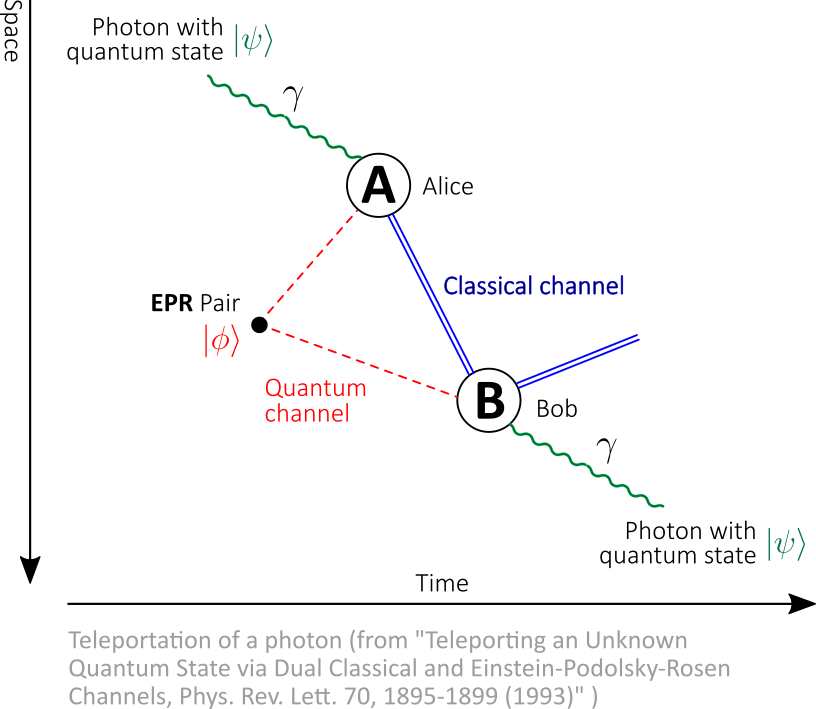
The key insight is that even though Bob's qubit changes instantly, the state it changes to is, from his perspective, completely random. He has no way of knowing what the original state was, or even that a teleportation has occurred, until he receives more information from Alice.
The following video from the Qiskit team explains this critical point clearly.
How Quantum Teleportation Really Works
This video from the Qiskit YouTube channel, "How Quantum Teleportation Really Works," directly addresses the FTL communication question.
First, watch the introduction which sets the stage, confirming that teleportation transmits information, not matter, and obeys the cosmic speed limit. Then, pay close attention to the core explanation. It highlights that the classical communication from Alice to Bob is the reason the protocol does not violate causality.
As the video explains, Bob is left with a qubit that is a "scrambled" version of the original state . Let's formalize this:
- If Alice measures
00, Bob's qubit is in the state . - If Alice measures
01, Bob's qubit is in the state . - If Alice measures
10, Bob's qubit is in the state . - If Alice measures
11, Bob's qubit is in the state .
Each of these outcomes occurs with a 25% probability. Without knowing which of the four outcomes occurred, Bob has a qubit that is in a random state. If he were to measure it, the result would be random and tell him nothing about . He absolutely needs the two classical bits from Alice to know which "unscrambling" operation (, , , or ) to apply.
Can't We Devise a Cleverer Scheme?
You might argue that a simple measurement isn't the only thing Bob could do. Perhaps there's a more advanced experiment he could perform on his single qubit to deduce what Alice did, without her needing to send a message. This is a common line of thinking, and it's a great question that gets to the heart of the no-signaling principle in quantum mechanics.
This principle states that no local measurement on one part of an entangled system can be used to transmit information to another, distant part of the system. Let's explore why this is true.
The following video does an excellent job of debunking common "loopholes" people propose to get around this limitation.
Why Can't You Use Quantum Mechanics To Communicate Faster Than Light?
This video from the Looking Glass Universe channel, "Why Can't You Use Quantum Mechanics To Communicate Faster Than Light?", explores why entanglement in general cannot be used for FTL communication.
First, watch the segment on a simple FTL scheme. Note why it fails: Alice cannot control her random measurement outcome. Next, consider the more "devious" plan involving interference. The key takeaway here is that you cannot locally (by only looking at your qubit) tell the difference between a qubit that is part of a superposition and one that has already been collapsed. Finally, watch the brief mathematical explanation. You don't need to follow every step of the math, but grasp the conclusion: the probabilities of Bob's measurement outcomes are exactly the same whether Alice has measured her entangled particle or not.
The video makes the essential point: local measurement statistics are unaffected by distant actions. No matter what measurement Alice performs on her qubit (or even if she does nothing at all), the probabilities for any outcome of any measurement Bob chooses to perform on his qubit remain unchanged. Because he can't see any statistical difference, he can't get any information.
This concept is also clearly explained in the following article.
Quantum entanglement doesn't allow faster-than-light communication
This article from Big Think by astrophysicist Ethan Siegel provides a clear, non-mathematical explanation for why entanglement can't be used for FTL communication.
Read the sections that describe a hypothetical FTL experiment and explain why it fails. Start from the text "On the surface, it might appear that information really is being communicated at speeds faster-than-light..." and continue to the end of the section that mentions the no-cloning theorem ("...is the nail-in-the-coffin of any workable scheme..."). Focus on the argument that "forcing" one particle into a specific state to send a signal breaks the entanglement, making the outcome on the other side completely random.
Tying It All Together: Two Channels are Required
We can now state with confidence why teleportation does not allow for FTL communication. The information required to reconstruct the original quantum state on Bob's side is split into two essential pieces:
- The Quantum Channel: The shared entangled pair allows for non-local correlations to be established. This is what enables the "spooky" part of the protocol, instantly mapping properties of onto Bob's qubit, albeit in a scrambled way.
- The Classical Channel: The two bits from Alice's measurement provide the "key" for Bob to unscramble his qubit and recover the original state. This information must be sent via conventional means (like a radio signal or an optical fiber), and is therefore limited by the speed of light.
Since Bob needs information from both channels to complete the protocol, the total time for the information transfer is bottlenecked by the slower of the two—the classical channel. This is analogous to Alice securely sending a locked box to Bob via an instant courier, but sending the key via regular mail. Bob has the box, but he can't access its contents until the key arrives. The information is not truly "received" until both parts are present.
Conclusion
In this lesson, we have confronted the apparent paradox of quantum teleportation and resolved it. While entanglement involves non-local effects, it cannot be used to transmit information on its own.
Key Takeaways:
- Quantum teleportation is a protocol to transmit a quantum state, not matter or energy.
- The protocol requires both a pre-shared entangled pair (a quantum channel) and classical communication.
- Alice's measurement instantly collapses the wavefunction, but from Bob's local perspective, his qubit is left in a completely random state. He cannot extract any information from it.
- Bob must wait for two classical bits from Alice, sent at or below the speed of light, which tell him how to "unscramble" his qubit to recover the original state.
- This reliance on a classical channel ensures that quantum teleportation respects causality and does not enable faster-than-light communication. This is a manifestation of the no-signaling principle.
Preview of the Next Lesson:
We've just analyzed a protocol that uses entanglement and classical bits to transmit a quantum bit. In the next lesson, we'll explore a fascinating counterpart called superdense coding. This protocol does the reverse: it uses a shared entangled pair to transmit two classical bits of information by sending only one qubit.