Hello! Welcome to the first lesson in our module on fundamental quantum protocols.
In our last lesson, we saw how to calculate the probabilities of measurement outcomes for multi-qubit systems, including the important case of "partial measurements" where we only measure a subset of the qubits. This concept is the final piece of the puzzle we need before we can explore some truly remarkable quantum applications.
Today, we'll dive into one of the most famous of these: the quantum teleportation protocol. Our goal is to describe the step-by-step process that allows the quantum state of a qubit to be transmitted from one location to another, without physically sending the qubit itself. We'll explore the roles of the two main participants, Alice and Bob, and uncover the three essential ingredients they need to make teleportation possible.
The Problem: Sending an Unknown Quantum State
Imagine an engineer, Alice, has a qubit in a specific but unknown quantum state, . She wants to transmit this exact state to her colleague, Bob, who is in a different location.
What can't she do?
- Physically send the qubit: This is what we want to avoid. The whole point is to transmit the information without transmitting the particle.
- Measure her qubit and tell Bob the result: As we've learned, measuring the qubit will collapse its state to either or . This measurement would destroy the original superposition and lose the information contained in the amplitudes and .
- Determine and and send them: A single measurement can't reveal the values of and . While you could prepare many identical copies and measure them to estimate the amplitudes, the No-Cloning Theorem (which we'll touch on later) forbids making an exact copy of an unknown quantum state.
So, how can Alice achieve this seemingly impossible task? The solution lies in a clever protocol that uses two quantum resources and one classical one.
The Three Ingredients for Teleportation
To teleport the state , Alice and Bob need three things:
- Alice's message qubit (): The qubit in the state that she wants to send.
- A shared entangled pair (): Alice and Bob must each possess one qubit from an entangled pair. Typically, this is a Bell state, like . Alice holds and Bob holds .
- A classical communication channel: A regular communication channel (like a phone or internet connection) for Alice to send two classical bits of information to Bob.
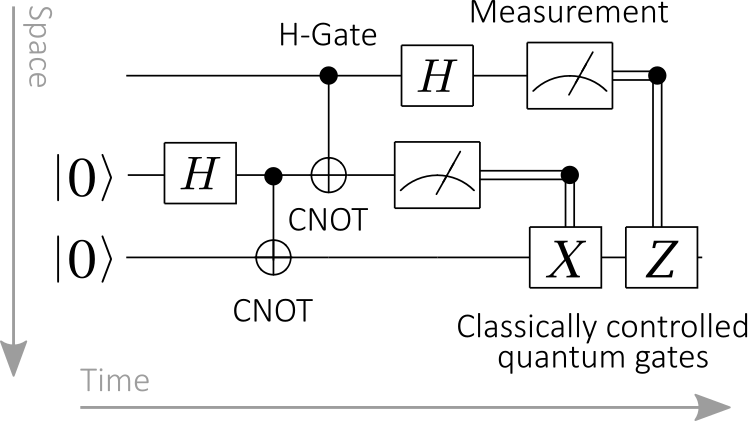
The entire process can be visualized using a quantum circuit diagram. We will spend the rest of this lesson breaking down exactly what happens in each part of this circuit.
The Teleportation Protocol: A Step-by-Step Guide
Let's follow the journey of Alice's quantum state. The Qiskit video below gives an excellent conceptual overview of the process. We will watch it in segments to analyze each step.
How Quantum Teleportation Really Works
This video from the Qiskit channel, "How Quantum Teleportation Really Works," provides a clear, high-level explanation of the protocol.
First, watch the introduction from the beginning to understand the context and the key components involved. Then, watch the detailed explanation of the protocol from this point. Pay close attention to the sequence of Alice's actions and the table of corrections Bob must perform.
As you saw in the video, the protocol unfolds in a precise sequence. Let's formalize those steps with reference to the circuit diagram.
Step 1: State Preparation
- Alice has her message qubit, , in the unknown state .
- An entangled Bell pair is shared between Alice () and Bob (). This is created by applying a Hadamard gate to and then a CNOT gate with as the control and as the target.
Step 2: Alice's Operations
Alice now performs two operations on her two qubits ( and ).
- She applies a CNOT gate with her message qubit () as the control and her half of the entangled pair () as the target.
- She then applies a Hadamard gate to her message qubit ().
These two operations have the effect of entangling her message qubit with the already-entangled pair, spreading the information of across all three qubits.
Step 3: Alice's Measurement & Classical Communication
This is where our last lesson becomes crucial. Alice performs a partial measurement on the 3-qubit system.
- Alice measures both of her qubits, and , in the computational basis. This measurement collapses her qubits into one of four possible classical outcomes:
00,01,10, or11. - Each outcome has an equal probability of occurring (), regardless of the original state .
- Alice then uses the classical channel to send these two bits of information to Bob.
This third step is the reason quantum teleportation does not allow for faster-than-light (FTL) communication. To see why, let's consult a short reading.
Does teleportation enable faster-than-light communication?
This excerpt from the "Quantum Country" essay on teleportation directly addresses the role of the classical channel.
Please read the short section titled "Does teleportation enable faster-than-light communication?". It explains that although Alice's measurement instantly affects Bob's qubit, Bob cannot extract the information of |\psi\rangle until he receives the classical bits from Alice.
Step 4: Bob's Corrections
Bob now has his qubit, , and two classical bits from Alice. The state of Bob's qubit is now one of four possibilities, directly related to Alice's measurement outcome. His final task is to apply the correct "fix-up" operation to recover the original state .
The correction rules are as follows:
| Alice's Measurement | Bob's Operation | Gate to Apply |
|---|---|---|
00 |
Do nothing | I (Identity) |
01 |
Apply an X gate | X (Bit-flip) |
10 |
Apply a Z gate | Z (Phase-flip) |
11 |
Apply X then Z | Z then X |
After Bob applies the specified gate(s), the state of his qubit, , is magically transformed into the exact state that Alice originally held.
At the same time, Alice's measurement has destroyed the original state in her lab. The information has been moved, not copied.
For the Curious: The Math Behind the Magic
You are not required to follow the mathematical derivation for this lesson, as our goal is descriptive. However, if you are interested in seeing why this protocol works, the following video provides a rigorous step-by-step derivation, tracking the state vector of the three-qubit system through each gate.
Quantum Teleportation of 1 Qubit - Quantum Circuit Diagram, Entanglement of Bell States
This video from Elucyda provides a detailed mathematical proof of the teleportation protocol.
This is an optional deep dive. If you're curious, watch the sections where the presenter analyzes the state of the system at each stage of the circuit and then shows how the final state leads directly to the four possible outcomes for Bob. This will connect the gates directly to the algebraic transformations you've seen before.
Conclusion
In this lesson, we have dissected the quantum teleportation protocol. You can now describe the process from start to finish, identifying the necessary components and the actions taken by both Alice and Bob.
Key Takeaways:
- Quantum teleportation transmits a quantum state from one location to another using shared entanglement and classical communication. It does not transmit matter.
- The three essential ingredients are a message qubit, a shared entangled pair, and a classical communication channel.
- The protocol consists of four main stages:
- Entanglement Sharing: Alice and Bob each take one qubit from an entangled Bell pair.
- Alice's Operations: Alice entangles her message qubit with her half of the Bell pair using CNOT and Hadamard gates.
- Measurement & Communication: Alice measures her two qubits and sends the two classical bits of the result to Bob. This step is limited by the speed of light.
- Bob's Correction: Bob uses the two classical bits to apply the correct recovery gates (X and/or Z) to his qubit.
- The original quantum state is destroyed at the source and perfectly reconstructed at the destination, in accordance with the no-cloning theorem.
Preview of the Next Lesson:
Now that you understand the theory and the step-by-step logic of the teleportation circuit, it's time to put it into practice. In the next lesson, we will implement and verify this entire quantum teleportation circuit in Qiskit, demonstrating that we can successfully "teleport" a qubit state in a simulation.