Hello! In our last lesson, we mastered API versioning, which is all about managing the contract at the "front door" of a service. Now, it's time to zoom out and look at the entire "floor plan" of our application. How do we arrange all our code and functionality? This brings us to one of the most fundamental decisions in system design.
Today, we'll kick off the microservices module by addressing the learning outcome: Compare monolithic vs. microservices architectures, analyzing their respective trade-offs. This is a classic, non-negotiable topic in any senior engineering or system design interview. Your ability to articulate the nuanced pros and cons of each, beyond a superficial definition, will demonstrate your architectural maturity.
1. Defining the Architectures: The Cake vs. The Cupcakes
Before we dive into the trade-offs, let's establish a clear, shared understanding of what these two architectural styles are. A common analogy is to think of a monolith as a single, large cake and microservices as a collection of individual cupcakes.
- Monolithic Architecture: The entire application is built as a single, cohesive unit. All the business logic for different domains (e.g., users, orders, payments) resides in one codebase, is packaged into a single deployment artifact (like a
.jarfile for a Spring Boot app), and runs as a single process. - Microservices Architecture: The application is broken down into a suite of small, independent services. Each service is responsible for a specific business capability, has its own codebase, and is deployed and runs independently. These services communicate with each other, typically over the network using APIs.
Moving from MONOLITHS to MICROSERVICES 🎂 → 🍰🍰🍰
For a quick visual introduction to these concepts, let's watch a short segment from Gaurav Sen's channel.
Watch the first 54 seconds of the video. Focus on how it visually contrasts a single monolithic codebase with multiple independent services.
2. The Core Trade-Offs: A Deep Dive
The choice between a monolith and microservices is not about which is "better," but which is more appropriate for a given context. The legendary software architect Martin Fowler has written extensively on this topic. His analysis provides an excellent framework for our discussion.
Let's read Martin Fowler's seminal article, 'Microservice Trade-Offs'. This will form the backbone of our analysis. It provides a balanced and deep look at the pros and cons.
Read the entire article. As you read, focus on understanding each of the three main benefits (Strong Module Boundaries, Independent Deployment, Technology Diversity) and the three main costs (Distribution, Eventual Consistency, Operational Complexity).
Now that you've read the article, let's synthesize those points into a structured comparison, adding practical interview-oriented insights from other resources.
The Monolith Advantage: Simplicity (at first)
For a new project or a small team, a monolith is often the right choice.
- Simpler Development: Everything is in one place. You can run and debug the entire application locally from your IDE. There are no complex network calls between services to worry about.
- Easier Deployment: You have only one thing to deploy. The initial operational overhead is very low.
- Straightforward Refactoring: Making changes across different functional areas is easier since it's all in the same codebase, often a simple method call away.
The Microservices Advantage: Scaling Gracefully
As an application and the organization building it grow, the simplicity of the monolith starts to break down, and the benefits of microservices become apparent.
| Trade-Off | Monolithic Architecture | Microservices Architecture |
|---|---|---|
| Deployment | Risky "big bang" deployments. A small change requires redeploying the entire application. A bug can halt the release pipeline for all teams. | Independent deployment. Teams can release their services independently and frequently, leading to faster feature delivery. |
| Scalability | Must scale the entire application, even if only one part is a bottleneck. Inefficient use of resources. | Granular scaling. You can scale only the services that need it, leading to more efficient, cost-effective infrastructure usage. |
| Reliability | Low fault isolation. An unhandled exception or a memory leak in one module can bring down the entire application. | High fault isolation. A failure in one non-critical service (e.g., recommendation service) shouldn't cascade and take down the entire system (e.g., payments). |
| Team Structure | Large teams on one codebase lead to coordination overhead and slower velocity. ("Stepping on each other's toes.") | Team autonomy. Aligns with Conway's Law. Small, independent teams can own services end-to-end, fostering ownership and speed. |
| Technology | Locked into a single tech stack chosen at the beginning. Difficult to adopt new frameworks or languages. | Technology diversity. Allows choosing the best tool for the job for each service (e.g., Python for a machine learning service, Java for a transaction service). |
Microservices Interview Questions 2025 - Senior & Mid Level - Part 1
To hear these trade-offs explained from a direct, interview-focused perspective, watch this video from 'theSeniorDev'. It covers many of the points we've just discussed.
Watch from 00:12 to 05:53. Pay close attention to the practical discussion of the pros and cons, especially the nuance around technology diversity (section starting at 04:11), which is a great point for a senior-level interview.
3. The "Microservice Premium": The Hidden Cost of Complexity
So far, microservices sound pretty great. But as Martin Fowler pointed out, they come with significant costs. This is often called the "Microservice Premium": the price you pay in complexity for the benefits of distribution.
-
Distributed System Complexity: You're no longer making simple in-process function calls. You're making network calls, which are slow and can fail. This introduces major challenges:
- Latency: A user request might chain through several services, and the total latency adds up.
- Data Consistency: Without single, overarching database transactions, you must manage eventual consistency, which is much harder to reason about.
- Debugging: A failure might be buried deep in a chain of service calls. You need sophisticated distributed tracing and centralized logging to figure out what went wrong. As
theSeniorDevvideo mentioned, debugging a cascade of seven microservices is a significant challenge.
-
Operational Complexity: Instead of managing one application, you might have to manage dozens or hundreds of services. This requires a mature DevOps culture and significant investment in automation for deployment, monitoring, and service discovery.
This trade-off is perfectly captured in the following graph based on Martin Fowler's work.
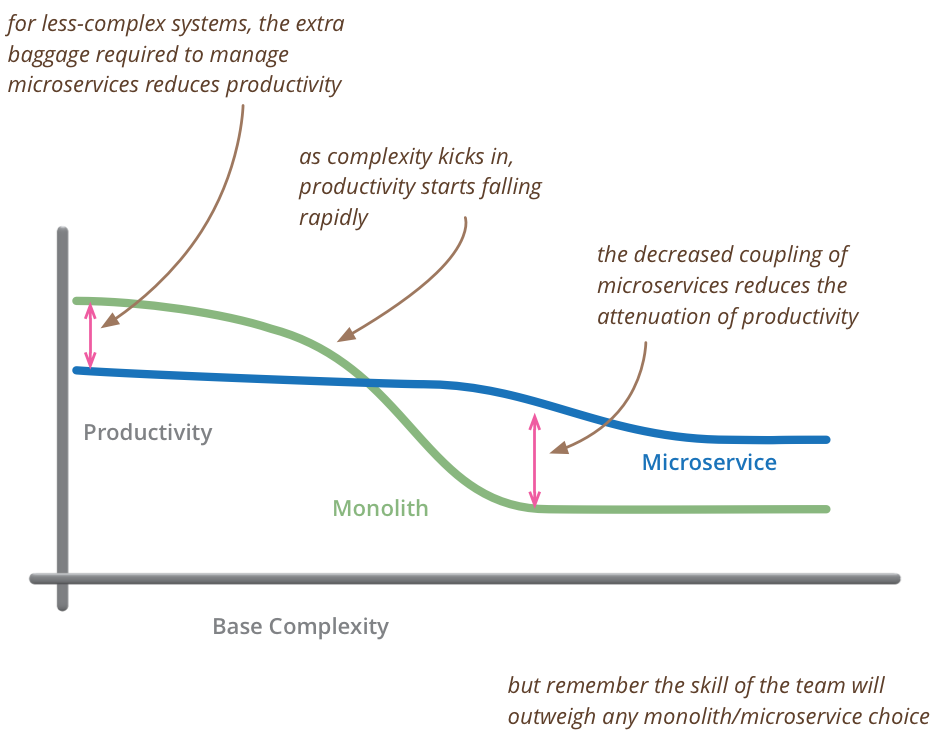
This graph leads to a critical strategic conclusion: Monolith First. For many projects, especially at startups or for new products, it makes sense to start with a well-structured monolith. You avoid paying the Microservice Premium upfront and can move quickly. As the system and the team grow, and you have a better understanding of the domain boundaries, you can then strategically break the monolith apart into microservices.
4. Making the Choice: An Interview Perspective
In an interview, you'll be judged on your ability to apply this knowledge to a hypothetical scenario. A great answer never says "microservices are better." It always starts with "It depends on the context..."
Test your understanding! (Interview Scenario)
An interviewer asks: "You are the founding engineer at a new startup building an online photo-sharing platform. Your initial features are user registration, photo uploads, and a simple activity feed. Should you start with a monolithic architecture or a microservices architecture? Justify your decision."
Show answer
A strong, senior-level answer would be:
"For this scenario, I would strongly advocate for starting with a well-structured monolithic architecture. Here's my reasoning, based on the trade-offs:
-
Time to Market: As a startup, our primary goal is to ship features quickly and validate our business idea. A monolith offers the fastest development velocity initially. The overhead of setting up a microservices infrastructure—CI/CD for dozens of services, service discovery, distributed tracing—would be a significant distraction and slow us down. This is the 'Microservice Premium' that we cannot afford to pay right now.
-
Team Size: As the founding engineer, I'll likely be working alone or with a very small team. The coordination overhead that microservices help solve doesn't exist yet. A single codebase is far more efficient for a small team.
-
Unknown Domain Boundaries: Right now, the boundaries between 'users', 'photos', and 'feeds' seem clear, but as the product evolves, these might change. For example, we might add albums, tags, or comments. Starting with a monolith allows these boundaries to evolve organically within the codebase. If we commit to microservices too early with the wrong boundaries, refactoring can be extremely expensive.
My strategy would be 'Monolith First'. I would focus on building the application with strong internal modularity, perhaps separating features into distinct Java packages with clear interfaces. This keeps the code organized and makes it much easier to carve out services later. Once the product gains traction, the team grows, and we start hitting the pain points of the monolith—such as slow deployments or contention between teams—we can then begin to strategically extract the most volatile or resource-intensive parts of the application into their own microservices."
Conclusion
You now have a robust mental model for comparing monolithic and microservices architectures. You understand that this isn't a technical decision alone; it's deeply intertwined with team structure, business goals, and organizational maturity.
Key Takeaways:
- Monoliths are simple to start with but become complex and slow to change as they grow.
- Microservices offer scalability, resilience, and team autonomy but come at the cost of significant operational and distributed systems complexity (the "Microservice Premium").
- The right choice is context-dependent. Key factors include system complexity, team size, time-to-market pressure, and existing operational capabilities.
- The "Monolith First" strategy is often a pragmatic approach, allowing you to move fast initially and evolve the architecture as the system's needs become clearer.
Preview of the Next Lesson:
We've established that microservices are inherently distributed systems. This means they are subject to the fundamental laws of distributed computing. In our next lesson, we will explore one of the most important of these laws: the CAP theorem. You'll learn what it is and its profound implications for how you design and reason about your distributed systems.