Hello! Welcome to your next lesson on microservice architectural principles.
In our last session, we compared synchronous and asynchronous communication for service-to-service interactions. We saw that while REST is simple for direct requests, messaging provides resilience and loose coupling. This distinction is key for internal communication.
Today, we shift our focus from how services talk to each other to how external clients (like web browsers or mobile apps) talk to the entire system. Allowing a client to directly call dozens of individual microservices is inefficient and insecure. This lesson will introduce the solution: the API Gateway pattern. Your goal is to explain its role in routing, aggregation, and handling cross-cutting concerns.
Mastering this pattern is non-negotiable for any system design interview, as it's the front door to almost every modern microservices architecture.
1. The Problem: Why Direct Client-to-Service Communication Fails
Imagine you're building an e-commerce mobile app. To load the main screen, the app needs to fetch user details, product recommendations, the shopping cart contents, and active promotions. If the client calls each microservice directly, you run into several major problems.
Api Gateway Pattern | System Design
This article from AlgoMaster provides an excellent summary of the issues with direct client-to-service communication.
Read the section titled 'The Problem: Direct Client-to-Service Communication'. Focus on the four main problems it outlines.
As the article highlights, the key problems are:
- Chattiness & High Latency: Multiple network round trips from a client, especially on a mobile network, lead to slow load times and high battery consumption.
- Tight Coupling: The client is tightly coupled to the internal service decomposition. If you refactor the
Order ServiceintoOrderandShippingservices, you have to update and redeploy all your client applications. - Duplicated Cross-Cutting Concerns: Each and every microservice would need to implement its own logic for authentication, rate limiting, logging, and CORS. This is redundant and error-prone.
- Protocol Mismatch: Your internal services might use efficient binary protocols like gRPC, but your external clients (browsers) speak REST/JSON over HTTP. A translation layer is needed.
The API Gateway pattern is designed to solve exactly these problems.
2. The API Gateway: A Single Front Door
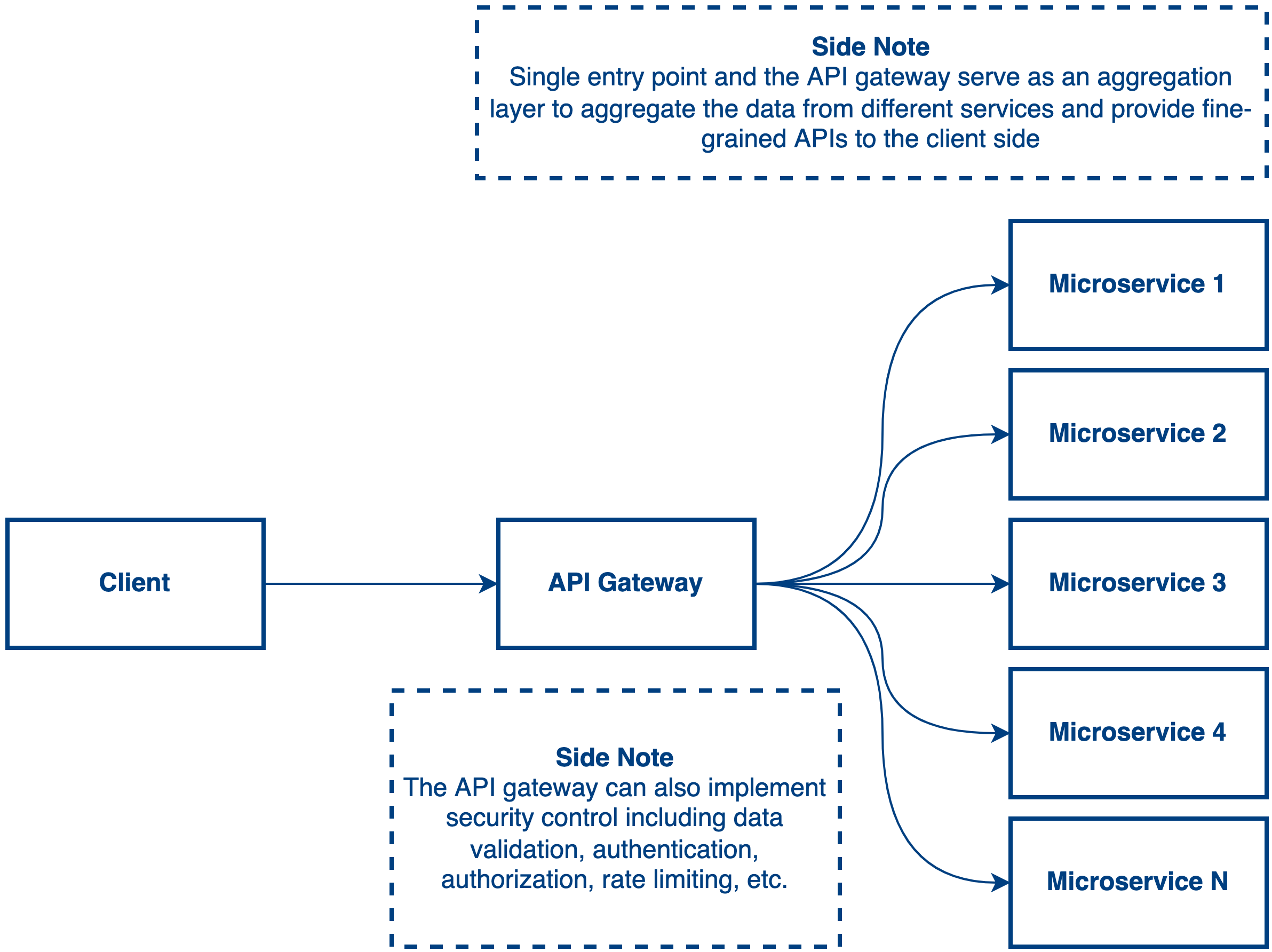
An API Gateway is a server that acts as a single entry point for all client requests. It sits on the edge of your system, abstracting the internal complexity of your microservices architecture. Let's break down its three primary responsibilities.
a) Request Routing
At its most basic, the gateway is a smart reverse proxy. It inspects incoming requests and routes them to the appropriate backend service.
API GATEWAY and Microservices Architecture | How API Gateway act as a Single Entry Point?
This video from 'Concept && Coding' clearly explains the routing function and, importantly, distinguishes an API Gateway from a simple load balancer.
Watch the section from 00:37 to 02:43. Pay close attention to the explanation that a load balancer distributes traffic among instances of a single service, while a gateway routes traffic to different services based on the request's content (e.g., the URL path).
Routing can be based on various criteria, such as the request path, HTTP method, or headers. With Spring Cloud Gateway, you define these rules, called predicates, in your configuration.
Spring Cloud Gateway: Resilience, Security, and Observability by Thomas Vitale @ Spring I/O 2022
For a practical look at how routing is configured in a Spring Boot application, this talk from Spring I/O is excellent. It demonstrates configuring a route using YAML.
Watch from 05:42 to 09:20. Notice how a 'route' is defined with a URI (the destination microservice) and a 'predicate' (the condition for activating the route, like Path=/books/**).
b) Request Aggregation (API Composition)
To solve the "chattiness" problem, a gateway can receive a single request from a client, make multiple calls to internal microservices, and then aggregate the results into a single, consolidated response.
For example, a request for /api/product-details/123 might trigger the gateway to:
- Call the
Product Serviceto get basic product info. - Call the
Inventory Serviceto get stock levels. - Call the
Review Serviceto get user ratings.
The gateway then combines these three responses into one JSON object and returns it to the client. This moves the complexity of orchestration from the client to the gateway.
API GATEWAY and Microservices Architecture | How API Gateway act as a Single Entry Point?
The 'Concept && Coding' video also has a great explanation of this 'API Composition' feature.
Watch from 02:43 to 05:43. The example of showing different details for a mobile client versus a desktop client is a classic use case for aggregation at the gateway.
c) Cross-Cutting Concerns
This is where the API Gateway truly shines. By centralizing common logic, it keeps your downstream microservices lean and focused on their business domain.

Here are the most common concerns handled by the gateway:
- Authentication & Authorization: The gateway can validate credentials (e.g., a JWT token) for every incoming request. If the token is valid, it can pass user information downstream via HTTP headers. This means your
Product Servicedoesn't need to contain any security code; it can simply trust that requests coming from the gateway are authenticated. - Rate Limiting & Throttling: To protect your services from being overwhelmed by too many requests (either from a malicious attack or a buggy client), the gateway can enforce limits, such as "100 requests per minute per user."
- Resilience Patterns: The gateway is the perfect place to implement patterns like Retries (with exponential backoff) and Circuit Breakers. If a downstream service is temporarily unavailable, the gateway can handle the failure gracefully without the client even knowing.
- Observability: The gateway is the ideal choke point to generate logs, metrics, and distributed traces for all incoming traffic, giving you a unified view of your system's behavior.
Spring Cloud Gateway: Resilience, Security, and Observability by Thomas Vitale @ Spring I/O 2022
The Spring I/O talk provides in-depth, practical demonstrations of implementing these cross-cutting concerns using Spring Cloud Gateway's filter mechanism.
This is a longer but highly valuable segment. Watch from 16:09 to 44:27. You don't need to memorize every line of code, but focus on understanding: Resilience (16:09 - 37:16): How filters are used to implement retries, rate limiting (using Redis for state), and circuit breakers (using Resilience4j). Security (37:16 - 44:27): How the gateway integrates with an identity provider (Keycloak) using OAuth2/OIDC to secure endpoints and propagate the authentication context downstream (the 'token relay' pattern). This demonstrates how powerful and central the gateway is in a production-grade architecture.
3. Key Design Considerations and Interview Questions
Introducing a gateway is powerful, but it also introduces new challenges. A senior-level interview will expect you to know the trade-offs.
Main Drawback: A Potential Single Point of Failure
Since all traffic flows through the gateway, its failure can bring down your entire application.
Test your understanding! (Interview Question)
An interviewer asks: "You've proposed using an API Gateway. What's the biggest risk you just introduced, and how would you design your system to mitigate it?"
Show answer
Answer:
"The biggest risk is that the API Gateway becomes a single point of failure (SPOF). If it goes down, no clients can access any of our microservices.
To mitigate this, I would design for high availability:
- Redundancy: We would never run just one instance of the gateway. We would deploy a cluster of multiple gateway instances.
- Load Balancing: We would place a load balancer (like an AWS ALB/NLB) in front of the gateway cluster to distribute incoming traffic across the healthy instances.
- Multi-AZ Deployment: To protect against the failure of an entire data center or availability zone (AZ), we would deploy our gateway instances across multiple AZs. The load balancer would then route traffic to instances in the available zones.
- Health Checks: The load balancer would continuously run health checks against the gateway instances. If an instance becomes unhealthy, the load balancer will automatically stop sending traffic to it.
- Global Resiliency (Advanced): For a globally distributed application, we would deploy gateway clusters in multiple geographic regions (e.g., us-east-1, eu-west-1). A DNS-based load balancer like AWS Route 53 would then route users to the closest healthy region, providing protection against a full regional outage."
API GATEWAY and Microservices Architecture | How API Gateway act as a Single Entry Point?
For a deep dive into achieving high availability, the 'Concept && Coding' video has an excellent, detailed walkthrough of a production-grade setup.
Watch the section from 13:01 to 22:36. This explains how you combine load balancers, multiple gateway instances, availability zones, regions, and DNS-based routing to eliminate the gateway as a single point of failure.
Other Considerations:
- Latency Overhead: The gateway adds an extra network hop. Keep gateway logic (filters) fast and efficient.
- Keep it "Thin": The gateway should handle routing and cross-cutting concerns, not business logic. Calculating an order total or validating a business rule does not belong in the gateway; it belongs in a domain service.
Conclusion
You now have a solid understanding of the API Gateway pattern, a foundational element of microservices architecture. It's the gatekeeper that simplifies client interactions, secures your system, and improves resilience.
Key Takeaways:
- An API Gateway is a single entry point for external clients, abstracting the internal microservice landscape.
- Its core roles are Routing (directing traffic), Aggregation (composing responses), and handling Cross-Cutting Concerns (like security, rate limiting, and resilience).
- In the Spring ecosystem, Spring Cloud Gateway is the standard tool, using predicates for routing rules and filters to implement cross-cutting concerns.
- While powerful, a gateway can be a single point of failure and must be deployed in a highly available, redundant configuration.
Preview of the Next Lesson:
We've now covered how services communicate (synchronously vs. asynchronously) and how clients access them (via an API Gateway). We're ready to tackle one of the most complex problems in distributed systems: maintaining data consistency across multiple services without using traditional distributed transactions. In the next lesson, we will explore the Saga pattern, a powerful technique for managing long-running, distributed business processes.