Hello! In our last lesson, we explored the CAP theorem, which provides a high-level framework for making trade-offs between consistency and availability in a distributed system. We learned that this choice is critical, but it doesn't tell us how to draw the lines between our microservices in the first place.
Today, we'll answer that "how". We will dive into Domain-Driven Design (DDD), a powerful methodology for designing complex software systems that directly informs microservice architecture. Your goal for this lesson is to learn how to apply core DDD principles, specifically Bounded Contexts and Aggregates, to define service boundaries. This is a fundamental skill for designing maintainable microservice systems and a frequent topic in senior-level system design interviews.
1. The Philosophy of Domain-Driven Design
At its core, Domain-Driven Design (DDD) is an approach to software development that centers on the business domain. It emphasizes collaboration between technical teams and business experts to create a shared understanding that is reflected directly in the code. This shared understanding is built upon a common vocabulary called the Ubiquitous Language.
DDD is broadly divided into two parts:
- Strategic Design: The "big picture" activity of decomposing a large, complex business domain into smaller, more manageable pieces. This is where we'll find the tools to define our service boundaries.
- Tactical Design: The "in-the-weeds" activity of modeling the objects (like Entities and Value Objects) within those smaller pieces.
Let's start with a video that introduces these core ideas.
Domain-Driven Design: The Last Explanation You'll Ever Need
This video from 'Software Developer Diaries' provides a great overview of DDD, starting with the strategic concepts that are most relevant for defining service boundaries.
Watch from the beginning to 07:01. Focus on understanding these key strategic concepts: Ubiquitous Language: The shared vocabulary. Event Storming: A collaborative technique to discover the domain. Subdomains (Core, Supporting, Generic): How the business domain is categorized.
As the video explained, the first step is to analyze the business domain and break it down into subdomains. This isn't a technical exercise; it's about understanding the business itself. For example, in an e-commerce company, you might identify:
- Core Subdomain: The "secret sauce" of the business, like a unique product recommendation engine.
- Supporting Subdomain: Necessary for business but not a competitive advantage, like order management.
- Generic Subdomain: A problem that's already solved and can be bought off-the-shelf, like identity management or payment processing.
This analysis is the foundation for the next crucial step: defining our software boundaries.
2. Bounded Contexts: Drawing the Lines
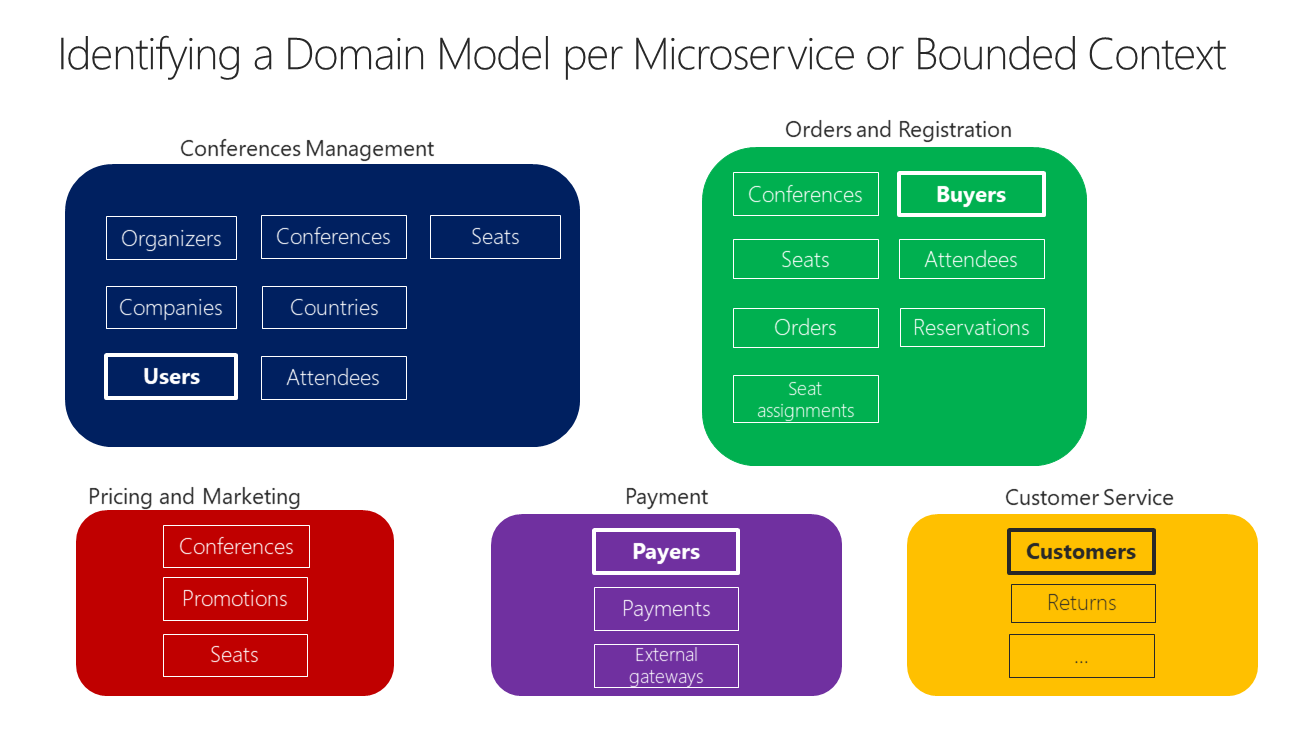
While subdomains represent the problem space (the business), Bounded Contexts represent the solution space (the software). A Bounded Context is a clear, explicit boundary within which a specific domain model is defined and consistent. Inside a Bounded Context, every term in the Ubiquitous Language has a precise, unambiguous meaning.
This is arguably the most important concept in DDD for microservice architecture. A Bounded Context provides the logical frame for a microservice.
To truly grasp this concept, let's watch a video dedicated to it.
Domain-Driven Design: Bounded Contexts Explained! 🚀
The channel 'ByteMonk' has an excellent video that explains why Bounded Contexts are necessary and how they work. It clarifies the relationship between subdomains and bounded contexts.
Watch the following segments: 00:00 - 03:51: This introduces the problem of ambiguous terms (like 'Student') and defines Bounded Context as the solution. 07:46 - 10:14: This is a crucial section that explicitly contrasts Subdomains (the business problem) with Bounded Contexts (the software solution). 10:14 - 11:23: This segment explains how Bounded Contexts translate into physical system boundaries and team ownership.
As the video highlights, the same term can mean different things in different contexts. A Product in the Catalog context might have a name, description, and images. But in the Shipping context, the same Product might only be represented by its weight, dimensions, and SKU. Forcing these two different models into one creates a bloated, confusing system—a "big ball of mud."
By defining separate Bounded Contexts for Catalog and Shipping, we allow each to have its own clean, simple model of a Product that is perfectly suited to its specific job.
3. From Bounded Contexts to Microservices
With a clear understanding of Bounded Contexts, the path to defining microservices becomes much clearer. The primary heuristic is: one Bounded Context per microservice.
This approach gives us services that are:
- Loosely coupled: The
Catalogservice can evolve its model without breaking theShippingservice. - Highly cohesive: Everything inside the
Catalogservice is related to managing catalogs. - Aligned with business capabilities: The services reflect the structure of the business domain.
Let's read a short article that formalizes this process.
Identify microservice boundaries
This Microsoft Azure documentation provides a pragmatic, step-by-step guide on how to derive microservices from a domain model. It also offers a checklist for validating your design.
Read the sections 'From domain model to microservices' and the validation criteria that follow it. Pay close attention to the suggested candidates for microservices and the checklist for a good design.
The article provides a great starting point, but in senior-level interviews, you'll need to show nuance. While "one microservice per Bounded Context" is a strong default, it's not a rigid rule. Non-functional requirements (like extreme scalability needs for one specific feature) or team structure might lead you to split a Bounded Context into multiple services, or combine very small contexts into a single service. The key is to start with the Bounded Context as your guide and justify any deviations.
4. Inside the Boundary: Aggregates as Consistency Guardians
We've defined our service boundaries using Bounded Contexts. Now we need to look inside a service. This brings us to DDD's Tactical Design patterns, and the most important one for us is the Aggregate.
An Aggregate is a cluster of domain objects (Entities and Value Objects) that can be treated as a single unit. It acts as a consistency boundary.
- Entity: An object with a distinct identity that changes over its lifecycle (e.g., an
Orderwith ID123). - Value Object: An immutable object defined by its attributes (e.g., a
Moneyobject with amount and currency, or anAddress). - Aggregate Root: A specific entity within the Aggregate that serves as the single entry point. All external interactions must go through the Aggregate Root.
The golden rule of Aggregates is: A single transaction should only ever create or modify a single Aggregate instance.
This rule is the key to maintaining data consistency within a microservice without resorting to complex, slow, and error-prone distributed transactions between microservices.

Let's revisit our first video to get a clear explanation of these tactical patterns.
Domain-Driven Design: The Last Explanation You'll Ever Need
This segment of the 'Software Developer Diaries' video explains the tactical patterns, focusing on Entities, Value Objects, and especially Aggregates.
Watch from 07:01 to 13:26. Focus on understanding: The difference between an Entity (has an ID) and a Value Object (is immutable, no ID). How an Aggregate groups these objects into a consistency boundary. Why Aggregates are tied to the concept of a database transaction.
So, putting it all together: A Bounded Context defines the boundary of your microservice. An Aggregate defines the boundary of a single transaction within that microservice.
Test your understanding! (Interview Scenario)
An interviewer says: "Let's design a simplified online food delivery platform like Uber Eats. Using Domain-Driven Design principles, what Bounded Contexts would you identify? For one of those contexts, what would be a primary Aggregate?"
Show answer
Here is a strong, structured answer:
"Great, I'll start with strategic design to identify the Bounded Contexts by analyzing the business domain.
Some potential Bounded Contexts would be:
- Restaurant Management: This context deals with restaurants onboarding, managing their menus, setting operating hours, and viewing their own analytics. The concept of a
MenuItemhere includes price, description, and photos. - Order Management: This is a core context that handles the entire lifecycle of a customer's order, from placement to completion. The model of an
Orderhere is rich, containing status, customer info, items, and total price. - Driver Management: This context focuses on delivery drivers: their profiles, availability, location tracking, and earnings. A
Driverhere has a vehicle type and a rating. - Customer Management: This context manages customer profiles, saved addresses, and payment methods. A
Customerhere is defined by their identity and preferences. - Billing & Payments: A generic context responsible for processing payments, issuing refunds, and generating invoices for restaurants.
Now, let's zoom into the Order Management context and identify a primary Aggregate.
The most important Aggregate would be the Order Aggregate.
- Aggregate Root: The
Orderentity itself would be the root. It would have a unique ID (orderId). Any changes to the order must go through thisOrderobject. - Entities within the Aggregate: It would contain a list of
OrderLineItementities. EachOrderLineItemhas its own identity within the order (e.g., you could update the quantity of one specific item). - Value Objects: The
Orderwould contain Value Objects like theDeliveryAddress(street, city, zip), and aMoneyobject for thetotalPrice. - Consistency Boundary: The entire
OrderAggregate represents the consistency boundary. For example, when a customer adds an item, the list ofOrderLineItems is modified and thetotalPriceis recalculated. This must happen atomically within a single transaction. You cannot just add a line item without updating the total, as that would leave the Aggregate in an inconsistent state. By defining theOrderas an Aggregate, we ensure that any operation, likeaddItem()orcancelOrder(), maintains the internal consistency of the entire order object."
Conclusion
Today, we've moved from the high-level trade-offs of distributed systems to a concrete methodology for designing them. Domain-Driven Design provides a powerful toolkit for decomposing a complex problem domain into a set of well-defined, business-aligned microservices.
Key Takeaways:
- DDD aligns software design with the business domain through a Ubiquitous Language.
- Bounded Contexts are the primary tool for strategic design. They define linguistic and model boundaries and are the best candidates for your microservice boundaries.
- Aggregates are the primary tool for tactical design. They define transactional consistency boundaries within a microservice, ensuring data integrity without needing distributed transactions.
- The workflow is to move from the business problem (subdomains) to the software solution (Bounded Contexts containing Aggregates), which then maps to an architecture (microservices).
Preview of the Next Lesson:
We've established that Bounded Contexts should guide our service boundaries. A natural consequence of this separation is that each microservice should own its own data. In our next lesson, we will explore this principle in detail by examining the database-per-service pattern and its data consistency challenges. This will directly build on today's concepts of Aggregates and consistency boundaries.