Hello! Welcome to your next lesson in the "Java Collections & Problem-Solving" module.
In our last session, we mastered the 'Two Sum' problem, leveraging a HashMap to achieve an elegant and efficient O(n) solution. We saw how the hash map's O(1) average-time lookup was the key to avoiding a slow O(n²) nested loop.
Today, we're tackling another extremely common interview problem: 'Top K Frequent Elements'. This problem is a fantastic follow-up because it requires you to combine the HashMap for frequency counting—a technique you're now familiar with—with another powerful data structure, the PriorityQueue, to efficiently track the "top" elements. Mastering this pattern is crucial for the mid-to-senior interviews you're preparing for, as it tests a deeper understanding of data structure trade-offs.
By the end of this lesson, you will be able to solve the 'Top K Frequent Elements' problem by effectively combining a HashMap and a PriorityQueue, and you'll be able to analyze its performance and discuss alternative solutions.
1. Understanding the Problem
The problem statement is as follows:
Given a non-empty array of integers
numsand an integerk, return thekmost frequent elements.
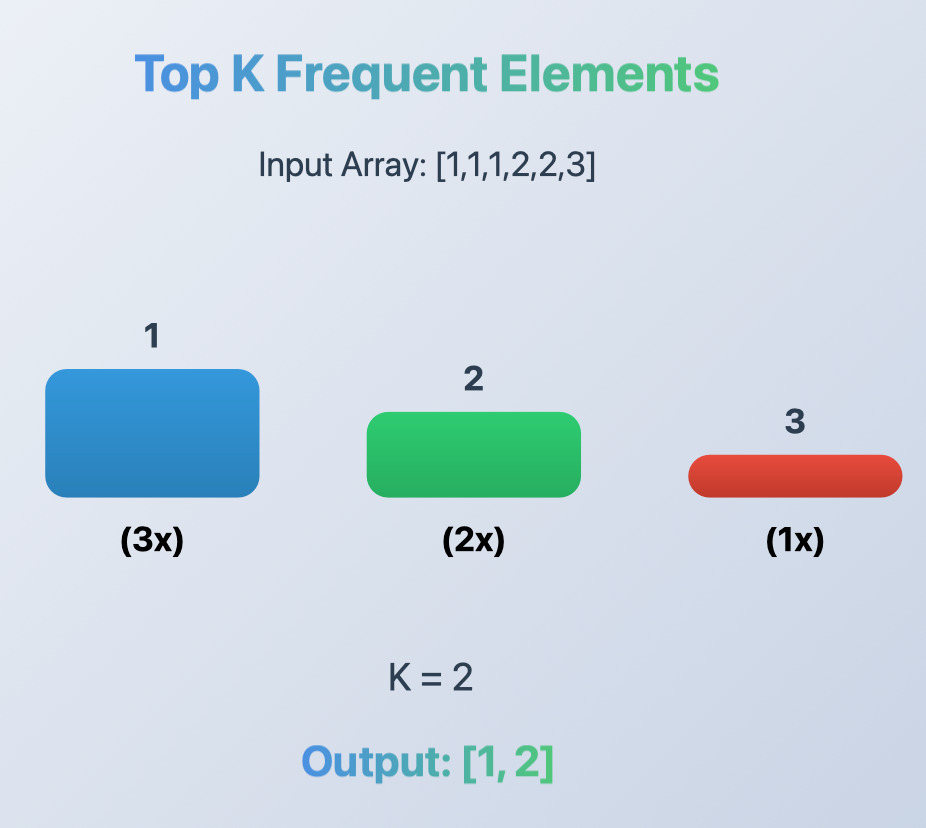
Let's look at a quick example to make this concrete.
In an interview, good clarifying questions would be:
- What should I do in case of a tie in frequencies? (The problem on platforms like LeetCode often guarantees a unique answer).
- Can
kbe larger than the number of unique elements? - What is the range of values in the array?
For today, we'll assume the answer set is unique.
2. The Two-Step Strategy
The most effective way to solve this problem is to break it into two distinct steps:
- Count Frequencies: First, determine how many times each number appears in the input array.
- Find the Top K: From the frequency counts, identify the
knumbers with the highest frequencies.
Let's tackle each step.
Step 1: Counting Frequencies with a HashMap
This first step should feel familiar after our last lesson. A HashMap<Integer, Integer> is the perfect tool to store each number and its corresponding frequency.
We can iterate through the input array nums and populate our map. For each number, we either initialize its count to 1 or increment its existing count.
// nums = [1, 1, 1, 2, 2, 3], k = 2

Map<Integer, Integer> frequencyMap = new HashMap<>();
for (int num : nums) {
    frequencyMap.put(num, frequencyMap.getOrDefault(num, 0) + 1);
}

// After the loop, frequencyMap will be:
// {1=3, 2=2, 3=1}
This step takes O(N) time, where N is the number of elements in the input array, and O(M) space, where M is the number of unique elements.
Step 2: Finding the Top K Elements with a PriorityQueue
Now we have our frequencies. The challenge is to find the top k from this map efficiently.
A naive approach would be to dump the map's entries into a list and sort it by frequency. This would work, but sorting takes O(M log M) time. Interviewers will often ask for a solution better than O(M log M).
This is where a heap comes in. A heap is a specialized tree-based data structure ideal for "Top K" problems. In Java, we use the PriorityQueue class, which is implemented as a heap.
To understand the core pattern, the following video gives an excellent high-level overview.
Top K Elements in 6 minutes | LeetCode Pattern
This short video from AlgoMasterIO introduces the 'Top K Elements' pattern. It explains why a heap is more efficient than sorting and how to apply it to our specific problem.
Watch the video from the beginning to 04:45. Pay close attention to: The comparison between sorting (O(N log N)) and the heap approach (O(N log K)). The clever use of a min-heap of size k to keep track of the top k largest elements. How this pattern is applied directly to the 'Top K Frequent Elements' problem.
The Min-Heap Trick
As the video explained, the most efficient way to solve this is using a min-heap of size k. Here’s why this seemingly counter-intuitive choice works so well:
- The heap will store the
kmost frequent elements seen so far. - Because it's a min-heap, the element at the top (the root) is the one with the lowest frequency among those
kelements. - When we process a new element from our frequency map, we compare its frequency to the root of the heap.
- If the new element's frequency is greater than the root's, it means the new element deserves to be in the top
k. We remove the root (the current "weakest" of the topk) and add the new element. - If the new element's frequency is less than or equal to the root's, we do nothing. It doesn't belong in the top
k.
- If the new element's frequency is greater than the root's, it means the new element deserves to be in the top
This way, the heap acts as a gatekeeper, always maintaining the k elements with the highest frequencies seen so far, and each check/update operation is a fast O(log k).
For a detailed walkthrough, the following text provides a great step-by-step guide.
347. Top K Frequent Elements - In-Depth Explanation
This article from Algo.monster provides a clear, written explanation of the two-step approach, complete with an example walkthrough.
Read the sections titled 'Intuition', 'Solution Approach', and 'Example Walkthrough'. This will solidify your understanding of how the frequency map and the min-heap work together.
3. Java Implementation
Now, let's put all the pieces together in a clean, interview-ready Java implementation.
import java.util.HashMap;
import java.util.Map;
import java.util.PriorityQueue;

class Solution {
    public int[] topKFrequent(int[] nums, int k) {
        // Step 1: Build a frequency map. O(N) time.
        Map<Integer, Integer> frequencyMap = new HashMap<>();
        for (int num : nums) {
            frequencyMap.put(num, frequencyMap.getOrDefault(num, 0) + 1);
        }

        // Step 2: Use a min-heap to find the top k frequent elements.
        // The PriorityQueue will store Map.Entry objects.
        // We use a lambda expression to define the comparator, so the heap is ordered
        // by the frequency (the entry's value). This makes it a min-heap.
        PriorityQueue<Map.Entry<Integer, Integer>> minHeap =
            new PriorityQueue<>((a, b) -> a.getValue() - b.getValue());
            // An equivalent way is: new PriorityQueue<>(Comparator.comparingInt(Map.Entry::getValue));

        // Iterate through the frequency map. O(M log k) time, where M is unique elements.
        for (Map.Entry<Integer, Integer> entry : frequencyMap.entrySet()) {
            minHeap.add(entry);
            // If the heap size exceeds k, remove the element with the smallest frequency.
            if (minHeap.size() > k) {
                minHeap.poll();
            }
        }

        // Step 3: Extract the results from the heap. O(k log k) time.
        int[] result = new int[k];
        for (int i = 0; i < k; i++) {
            // The problem statement says the order of the result doesn't matter.
            result[i] = minHeap.poll().getKey();
        }

        return result;
    }
}
Complexity Analysis:
- Time Complexity: O(N log k).
- Building the
HashMaptakes O(N). - Iterating through the M unique elements and performing heap operations takes O(M log k).
- Since M <= N, the dominant term is O(N log k). This is better than the O(N log N) sorting approach.
- Building the
- Space Complexity: O(M + k).
- O(M) for the
HashMapto store M unique elements. - O(k) for the
PriorityQueue.
- O(M) for the
Test your understanding!
In our Java code, the PriorityQueue is a min-heap. What would happen if you configured it as a max-heap instead (e.g., (a, b) -> b.getValue() - a.getValue())? How would the algorithm need to change, and would it still be as efficient?
Show answer
If you used a max-heap, the simple "add and poll if size > k" logic would not work correctly. It would keep the k least frequent elements.
To make a max-heap work, you would have to change the algorithm:
- Add all M unique elements from the frequency map into the max-heap. This would take O(M log M) time.
- Then,
poll()from the heapktimes to get thekelements with the highest frequencies. This would take O(k log M) time.
The overall time complexity would be O(M log M), and the space complexity would be O(M) to store all unique elements in the heap. This is less efficient than the O(M log k) time and O(k) space of our min-heap approach, especially when k is much smaller than M.
4. Interview Discussion: Going Further
In a senior-level interview, after presenting this optimal solution, a great candidate will be prepared to discuss alternatives and trade-offs.
A key follow-up you might encounter is about an even faster solution. While O(N log k) is excellent, there is a way to solve this in O(N) linear time.
This method is a variation of Bucket Sort.
- Count frequencies with a
HashMapas before (O(N)). - Create an array of lists (the "buckets"), where the index of the array represents a frequency.
buckets[i]will hold a list of all numbers that appeareditimes. The size of this array would benums.length + 1. - Iterate through your frequency map and place each number into the correct bucket based on its frequency (O(M)).
- Iterate backwards from the end of the buckets array (highest frequency) and collect numbers until you have
kelements (O(N) in the worst case).
This gives a total time complexity of O(N). The trade-off is space: the buckets array requires O(N) space, which might be more than the HashMap + PriorityQueue approach if the number of unique elements is low. Mentioning this demonstrates a deep command of algorithms.
Conclusion
You've now added another essential problem-solving pattern to your interview toolkit. You've seen how to combine two fundamental data structures, HashMap and PriorityQueue, to create an efficient and elegant solution.
Key Takeaways:
- The 'Top K' family of problems can often be broken down into counting and selecting.
- A
HashMapis the standard tool for efficient frequency counting. - A min-heap of size
kis the optimal data structure for finding the topklargest items from a stream or collection, offering an O(N log k) time complexity. - For interviews, be prepared to discuss the brute-force (sorting) approach, the optimal heap-based solution, and even linear-time alternatives like Bucket Sort, explaining the time/space trade-offs of each.
In our next lesson, we will pivot from problem-solving to a deep dive into the internal workings and performance characteristics of two fundamental collection types: ArrayList and LinkedList. Understanding these trade-offs is crucial for writing high-performance Java code.