Hello! Welcome to the next lesson in our Advanced Java Concurrency module.
In our last lesson, we dove into volatile, a low-level keyword for ensuring memory visibility between threads. We saw how it guarantees that updates to a variable are immediately propagated to main memory, but we also learned its critical limitation: it does not provide atomicity for compound operations.
Today, we'll build on these fundamentals by moving up a level of abstraction. Instead of managing visibility and locks manually, we'll use a high-level concurrency utility that handles all the coordination for us. Your learning outcome for this lesson is to implement the producer-consumer pattern using BlockingQueue. This is one of the most fundamental and widely used patterns in concurrent programming, and a frequent topic in senior developer interviews.
1. The Producer-Consumer Pattern
At its core, the producer-consumer pattern is a way to decouple the process that creates work (the producer) from the process that does the work (the consumer). They don't interact directly; instead, they communicate through a shared data structure, typically a queue.
- Producers create tasks or data and put them into the queue.
- Consumers take tasks or data from the queue and process them.
This model is incredibly powerful for building robust, scalable systems.
Producer Consumer Pattern - With Java Example
To start, let's get a clear understanding of the producer-consumer pattern and its benefits. This video by Jakob Jenkov explains the 'why' behind the pattern, connecting it to practical goals like improving performance and responsiveness.
Watch the video from the beginning until 10:31. Focus on these key advantages, which are highly relevant to system design: How it decouples task submission from execution. How it can be used to optimize CPU utilization by matching the number of consumer threads to available cores. How it improves responsiveness in applications (e.g., UI or server request handling) by offloading long-running tasks to background threads.
The main challenges in implementing this pattern are synchronization-related:
- If the queue is full, the producer must wait until space becomes available.
- If the queue is empty, the consumer must wait until a task is available.
- The queue itself must be thread-safe, so that multiple producers and consumers can access it concurrently without corrupting its state.
You could solve this with low-level primitives like wait()/notify() on a shared List, but this approach is verbose and notoriously error-prone. Fortunately, Java's java.util.concurrent package provides a perfect tool for the job.
2. The Solution: java.util.concurrent.BlockingQueue
A BlockingQueue is a thread-safe queue that automatically handles the waiting (blocking) for you. It's the standard, canonical way to implement the producer-consumer pattern in Java.
- When a producer calls
put(element)on a full queue, the thread will block until a consumer makes space. - When a consumer calls
take()on an empty queue, the thread will block until a producer adds an element.
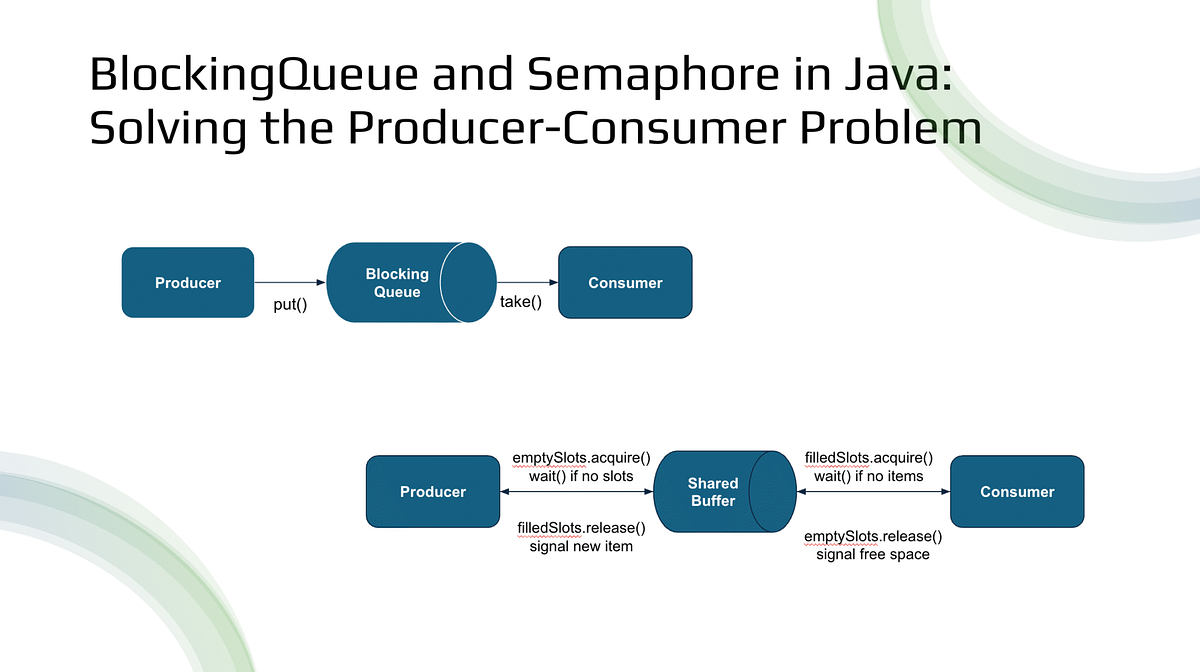
This built-in coordination abstracts away all the manual locking and signaling. The image below contrasts the simple BlockingQueue approach with a more complex, low-level implementation using semaphores. It clearly shows the simplicity that BlockingQueue provides.
Key Methods: Choosing the Right Tool
BlockingQueue offers several pairs of methods for adding and removing elements, each with different behavior. For the classic producer-consumer pattern, put() and take() are the methods of choice. Understanding the difference is critical for interviews.
Java Multithreading Interview 🔥 | Producer–Consumer using wait/notify & BlockingQueue @Javatechie
This clip from a Java Techie video explains the crucial difference between methods that throw exceptions (add/remove), methods that return a special value (offer/poll), and methods that block (put/take).
Watch from 15:16 to 17:17. Pay close attention to why put() and take() are recommended for the producer-consumer scenario.
Here is a summary of the behavior:
| Method Type | Add Method | Behavior when Queue is Full | Remove Method | Behavior when Queue is Empty |
|---|---|---|---|---|
| Throws Exception | add(e) |
Throws IllegalStateException |
remove() |
Throws NoSuchElementException |
| Returns Value | offer(e) |
Returns false |
poll() |
Returns null |
| Blocks | put(e) |
Blocks until space is available | take() |
Blocks until an element is available |
| Blocks with Timeout | offer(e, time, unit) |
Blocks for a specified time, then returns false |
poll(time, unit) |
Blocks for a specified time, then returns null |
For producer-consumer, we want the threads to wait patiently, which is exactly what put() and take() do.
3. Implementation Example
Let's put this into practice. We'll implement a simple system with one producer thread creating integer values and one consumer thread processing them. We'll use ArrayBlockingQueue, a common bounded implementation of BlockingQueue.
Java Multithreading for Senior Engineering Interviews (Part II)
The following article provides a clear definition of BlockingQueue and a complete, concise code example. We will use this code as our base.
Read the section titled 'Blocking Queue | Bounded Buffer | Consumer Producer'. Focus on the definitions and the complete code block under 'Example: Producer-Consumer Using BlockingQueue'.
Here is the code from the article, with some added comments for clarity.
import java.util.concurrent.ArrayBlockingQueue;
import java.util.concurrent.BlockingQueue;

// The main class to set up and run the example.
public class BlockingQueueExample {

    public static void main(String[] args) {
        // A bounded queue with a capacity of 5.
        BlockingQueue<Integer> queue = new ArrayBlockingQueue<>(5);

        // Create the producer and consumer tasks, sharing the same queue.
        Producer producer = new Producer(queue);
        Consumer consumer = new Consumer(queue);

        // Start the producer and consumer threads.
        new Thread(producer).start();
        new Thread(consumer).start();
    }
}

// The Producer task, which implements Runnable.
class Producer implements Runnable {
    private final BlockingQueue<Integer> queue;

    public Producer(BlockingQueue<Integer> queue) {
        this.queue = queue;
    }

    @Override
    public void run() {
        try {
            for (int i = 0; i < 10; i++) {
                System.out.println("Producing: " + i);
                // put() will block if the queue is full.
                queue.put(i);
                // Simulate time taken to produce an item.
                Thread.sleep(100);
            }
        } catch (InterruptedException e) {
            Thread.currentThread().interrupt();
        }
    }
}

// The Consumer task, which also implements Runnable.
class Consumer implements Runnable {
    private final BlockingQueue<Integer> queue;

    public Consumer(BlockingQueue<Integer> queue) {
        this.queue = queue;
    }

    @Override
    public void run() {
        try {
            while (true) { // Consumers often run in an infinite loop.
                // take() will block if the queue is empty.
                Integer item = queue.take();
                System.out.println("Consumed: " + item);
                // Simulate time taken to process an item.
                Thread.sleep(150);
            }
        } catch (InterruptedException e) {
            Thread.currentThread().interrupt();
        }
    }
}
Key points from the code:
- Shared Queue: A single
ArrayBlockingQueueinstance is created and passed to both theProducerandConsumer. This is the shared communication channel. - Bounded Capacity: The queue has a capacity of 5. If the producer is faster than the consumer, it will produce 5 items and then the call to
queue.put()will block, effectively pausing the producer thread until the consumer catches up. This automatic throttling is called back-pressure and is a key feature for system stability. - Blocking Operations: The producer uses
queue.put()and the consumer usesqueue.take(). All the complex thread synchronization (wait,notify,lock) is handled internally by theBlockingQueue.
Test your understanding!
Imagine you are reviewing code for a high-throughput system. You see a producer-consumer implementation that uses an ArrayList wrapped in a Collections.synchronizedList() along with wait() and notifyAll() calls to manage blocking.
What arguments would you make to convince your colleague to refactor this to use a BlockingQueue implementation like ArrayBlockingQueue or LinkedBlockingQueue? Mention at least two distinct advantages.
Show answer
-
Simplicity and Readability: The
BlockingQueueAPI is purpose-built for this pattern. Usingput()andtake()makes the code's intent immediately clear and drastically reduces boilerplate. The manualwait()/notifyAll()logic is complex, requires careful handling of conditions inwhileloops (to avoid spurious wakeups), and is much harder to read and maintain correctly. -
Performance and Efficiency:
BlockingQueueimplementations (likeLinkedBlockingQueue) are highly optimized for concurrent access. For instance, they often use separate locks for the head and tail of the queue, allowing producers and consumers to operate in parallel with less lock contention. AsynchronizedListuses a single lock for the entire collection, meaning only one thread (producer or consumer) can operate at a time, creating a bottleneck. Furthermore,notifyAll()wakes up all waiting threads (both producers and consumers), which then compete for the lock, leading to unnecessary context switching (the "thundering herd" problem).BlockingQueue's internal signaling is far more efficient.
4. Graceful Shutdown: The Poison Pill Technique
In our example, the consumer runs in an infinite loop (while (true)). In a real application, you need a way to shut it down gracefully. A common and effective method is the poison pill technique.
The idea is that when the producer has finished sending all its real data, it places a special, unique object on the queue—the "poison pill." When the consumer takes this pill from the queue, it knows that no more data is coming and can safely exit its loop.
Guide to java.util.concurrent.BlockingQueue
The Baeldung guide on BlockingQueue provides an excellent example of this poison pill technique.
Read section 4, 'Multithreaded Producer-Consumer Example'. Pay attention to how a special value (Integer.MAX_VALUE) is used as the poison pill and how the consumer checks for it to terminate.
If you have multiple consumers, the producer must put one poison pill on the queue for each consumer thread to ensure they all shut down.
Conclusion
You have now learned how to implement one of the most important concurrency patterns using a modern Java utility. The BlockingQueue is a powerful tool that simplifies concurrent programming by abstracting away the difficult and error-prone details of thread synchronization.
Key Takeaways for Your Interview:
- The Pattern: The Producer-Consumer pattern decouples task creation from execution, improving modularity, responsiveness, and load management.
- The Tool:
java.util.concurrent.BlockingQueueis the standard, high-performance tool for implementing this pattern in Java. - The Methods: Use the blocking methods
put()andtake()to have threads wait automatically when the queue is full or empty. - The Benefit:
BlockingQueueprovides thread safety and efficient thread coordination out-of-the-box, making your code cleaner, more readable, and less prone to concurrency bugs than manualwait/notifysolutions. - The Nuances: Be ready to discuss graceful shutdown (poison pill) and the difference between bounded and unbounded queues (a
LinkedBlockingQueueis unbounded by default, which can riskOutOfMemoryErrorif producers outpace consumers indefinitely).
Preview of the Next Lesson:
While BlockingQueue helps us coordinate threads productively, improper use of lower-level locks can lead to situations where threads stop making progress entirely. In our next lesson, we will explore one of the most feared concurrency issues: we will explain the causes of deadlock and demonstrate a prevention strategy like lock ordering.