Hello and welcome back!
In the last lesson, we focused on crafting a powerful resume by translating your customer service experience into quantifiable sales achievements. You now have the core content—your professional story, skills, and accomplishments—ready to go.
Today, we will leverage that work to tackle the next critical piece of your job search toolkit. This lesson is designed to help you optimize your LinkedIn profile to attract recruiters and hiring managers for SDR roles. Think of your resume as the document you send out, and your LinkedIn profile as the magnet that draws opportunities in. It's your professional landing page, working for you 24/7.
As one hiring manager notes, your LinkedIn profile can be up to 40% of the decision-making criteria for getting an interview. Let's make sure yours is in the top tier.
Your Profile as a Product: The First Impression
Just like a product on a shelf, your profile's packaging—your photo, banner, and headline—determines whether a recruiter stops to look closer. Let's get these fundamentals right.
Mistakes You're Making on Your LinkedIn Profile (Tech Sales Jobs)
This first video from Sales Feed covers the essential 'above the fold' elements of your profile. Pay close attention to the advice on your photo and headline, as these are the first things a recruiter sees.
Watch from 00:33 to 01:12. The key takeaways are to have a clean, smiling photo and a headline that clearly states your career goal.
Headshot and Banner
- Profile Photo: As the video suggests, this doesn't require a professional photographer. A modern smartphone's portrait mode against a neutral background works perfectly. The goal is to look professional, approachable, and someone a hiring manager would want on their team.
- Banner Image: The space behind your photo is a missed opportunity for many. Don't leave it blank. You can use a free tool like Canva to create a simple banner. Consider using a quote about sales that resonates with you, the logos of companies you admire, or a simple design with keywords like "Sales Development" or "SaaS."
The Headline: Your 220-Character Pitch
Your headline is the single most important piece of text on your profile. It appears next to your name in search results, comments, and connection requests. It must be clear and packed with keywords. Avoid generic titles like "Student" or "Customer Service at XYZ."
A great formula for a career-changer is: [Your Goal] + [Your Passion/Interest] + [A Few Key Skills].

Here are some excellent, practical examples you can adapt:
- Aspiring Sales Development Representative | Passionate about connecting people with great software
- Seeking an SDR Role in Tech | Cold Calling | CRM | Customer-Centric Communication
- Future BDR | Helping SaaS companies build pipeline | Salesforce Trailhead Ranger
This next article provides a fantastic, keyword-rich example that you should aim for.
Best LinkedIn Profile Tips for SDRs to Land SaaS Sales Jobs
This article from Zohort, 'Best LinkedIn Profile Tips for SDRs', has a great section on writing a value-driven headline. It shows you how to incorporate keywords recruiters are actively searching for.
Read only section 2, 'Write a Value-Driven Headline'. Notice the example: 'SDR | Helping SaaS startups grow pipeline | Cold Calling | Email Sequences | LinkedIn Prospecting'. This is the template for a top-tier headline.
Test your understanding!
Using the formulas and examples above, draft two different headlines for your own LinkedIn profile. Focus on including your target role (SDR/BDR) and skills relevant to sales (e.g., communication, resilience, or even a tool like HubSpot/Salesforce if you've done a free course).
Show answer
Here are a couple of strong possibilities based on your background and goals:
- Option 1 (Focus on Aspiration & Skills): "Aspiring Sales Development Representative | Eager to help SaaS companies grow | Customer Advocacy | Problem-Solving | Communication"
- Option 2 (More Keyword-Focused): "Seeking first SDR role | SaaS | Business Development | Lead Generation | Relationship Building"
Both options clearly state your goal and use keywords that will help you appear in recruiter searches.
Telling Your Story: The "About" and "Experience" Sections
Once you've hooked a recruiter with your headline, the "About" and "Experience" sections are where you convince them you have the potential to succeed.
The "About" Section: Your Personal Pitch
This is your chance to connect the dots for the hiring manager. Explain your journey, why you want to get into sales, and what you bring to the table. As suggested in the resource from Troy B.'s post, think of this section as your "coffee chat."
Mistakes You're Making on Your LinkedIn Profile (Tech Sales Jobs)
Let's return to the Sales Feed video to cover the 'About' and 'Experience' sections. The presenter gives key advice on writing in the first person and strategically listing your relevant experience.
Watch from 01:36 to 02:02. The main point is to make this section personal and write in the first person ('I am passionate about...') rather than the third person ('He is passionate about...').
A good structure for your "About" section is:
- The Hook: Start with a strong opening sentence about your passion for sales or solving problems for customers.
- Your Journey: Briefly connect your customer service experience to your sales ambition. Explain how helping customers in your telecom role taught you communication, resilience, and the importance of understanding customer needs.
- Your Skills: Mention 2-3 key transferable skills (e.g., active listening, problem-solving, product knowledge).
- Call to Action: End with a clear statement. Example: "I am actively seeking an SDR or BDR opportunity in a fast-growing SaaS company where I can contribute to building the sales pipeline. I'm excited to connect!"
If you struggle with writing, you can use a tool like ChatGPT for a first draft. As Trent Dressel suggests in his video, you can give it a prompt like, "I have experience as a customer service rep in a telecom store. Write a LinkedIn 'About' section for me about my transition into a tech sales (SDR) role, highlighting my communication and problem-solving skills." Use the output as a starting point and personalize it to make it your own.
The "Experience" Section: Your Resume in Action
This is where the work from our last lesson pays off. Your "Experience" section on LinkedIn should mirror the work experience section of your resume.
- Copy-Paste Your Achievements: Take the quantified, metric-driven bullet points you wrote for your telecom role and paste them directly into the description for that job on LinkedIn.
- Frame it Like a Sales Page: The article "Best LinkedIn Profile Tips for SDRs" suggests framing each experience like a sales page. For your customer service role, this means you should clearly state:
- What you "sold": Telecom plans and devices.
- Who your target audience was: Individual consumers and families.
- How you did it: Through in-store consultations, active listening, and problem-solving.
- What outcomes you delivered: This is where your quantified bullet points shine (e.g., "Resolved 15+ customer issues daily, maintaining a 95% satisfaction score.").
Keywords, Certifications, and Credibility
These sections help you get discovered and build trust.
Mistakes You're Making on Your LinkedIn Profile (Tech Sales Jobs)
This final clip from the Sales Feed video covers the tactical elements that boost your profile's visibility and credibility: certifications, skills (keywords!), and recommendations.
Watch from 02:02 to 04:58. Pay special attention to the lists of skills to add and the advice on using the 'Open to Work' feature discreetly.
- Skills & Keywords: Recruiters use LinkedIn's search function like Google. Your profile needs to contain the keywords they are searching for. Based on the video and the Zohort article, ensure your profile (headline, about, skills section) includes terms like:
- Sales Development
- SDR / BDR
- Cold Calling
- Lead Generation
- SaaS
- Business Development
- CRM (even if you just list "Salesforce Trailhead")
- Communication
- Licenses & Certifications: Adding free certifications shows initiative. As mentioned in the video, HubSpot Academy and Salesforce Trailhead are excellent places to start. Completing a free course like "HubSpot Sales Software" or "Inbound Sales" and adding it to your profile is a huge plus for someone without direct sales experience.
- Recommendations: A recommendation from a former manager or colleague from your telecom job can add significant credibility. Don't be shy about asking. When you do, make it easy for them by saying something like, "Would you be willing to write a brief recommendation for me on LinkedIn? I'm transitioning into sales, and it would be great if you could mention my communication skills and how I handled customer interactions."
- "Open to Work" Feature: As the video strongly advises, use the "Recruiters only" setting. Do not use the green "#OPENTOWORK" banner. The banner can sometimes be perceived as desperate and doesn't add value since recruiters have a special view that shows them you're open to opportunities regardless. Setting it to "Recruiters only" is professional and effective.
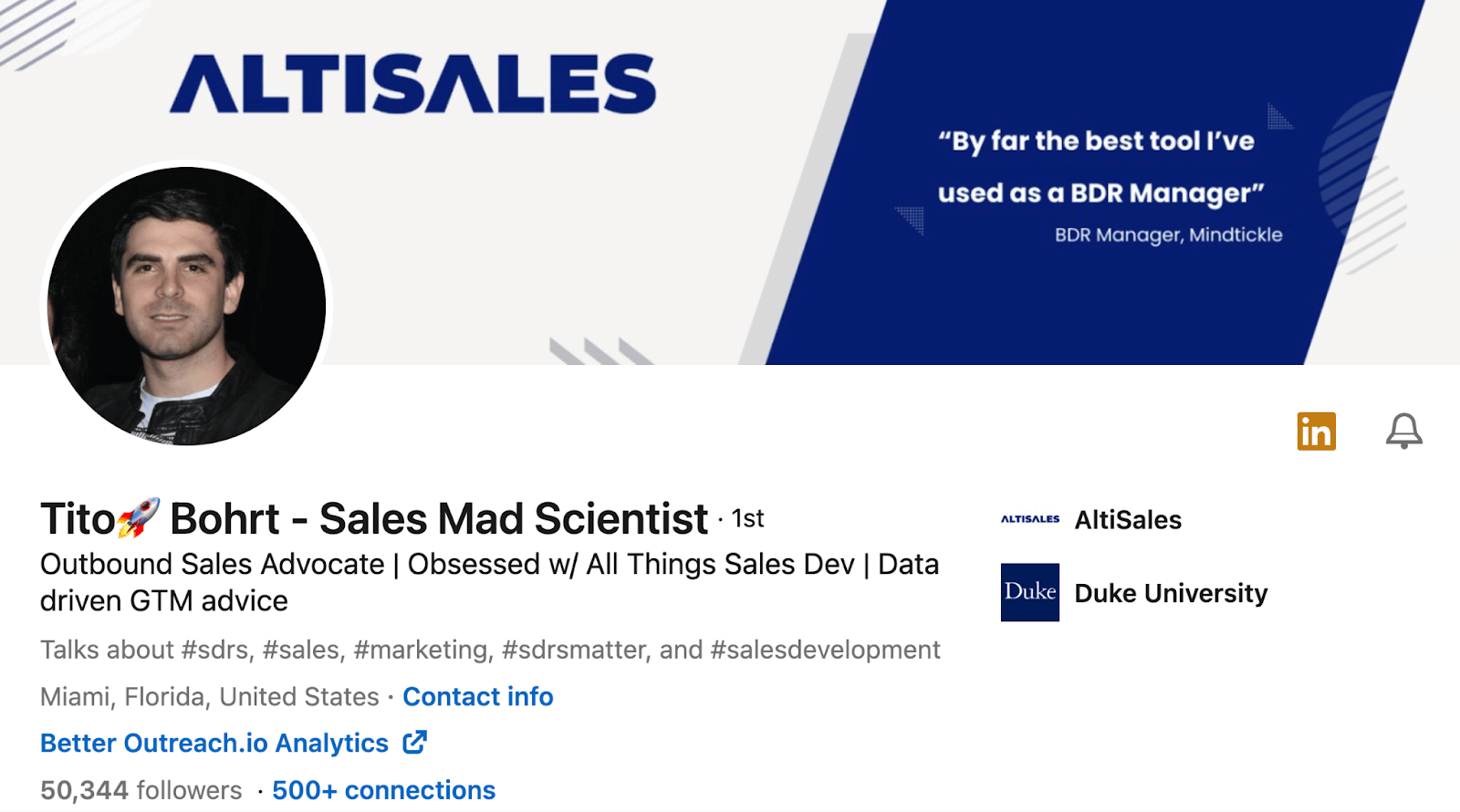
Here is an example of a well-optimized profile that brings these elements together.
Conclusion: Key Takeaways
Your LinkedIn profile is a dynamic version of your resume. To optimize it for your SDR job search, you must:
- Nail the first impression with a professional photo and a keyword-rich headline that clearly states your goal.
- Tell a compelling story in your "About" section that connects your past experience to your future in sales.
- Reuse your resume content by pasting your quantified, metric-driven achievements into your "Experience" section.
- Load your profile with keywords in the skills, headline, and summary sections to ensure you appear in recruiter searches.
- Signal your availability smartly by using the "Open to Work (Recruiters only)" feature.
Your task now is to go through your own LinkedIn profile, section by section, and apply these changes. This is a high-impact activity that will directly contribute to your job search success.
In our next lesson, we will complete your application toolkit by learning how to write a compelling cover letter that frames your lack of direct sales experience as a strength.