Hello! Welcome to the final lesson of your SDR crash course.
In our last session, we walked through the core of a successful cold call: asking targeted questions to qualify a prospect and book a meeting. You learned how to turn a brief interaction into a concrete next step.
Now, let's zoom out. As an SDR, you won't be managing one or two conversations; you'll be managing hundreds. You'll be making dozens of calls and sending scores of emails every single day. How do you keep it all organized and efficient? The answer lies in technology.
This lesson will address your final learning outcome: describing how to use a CRM and Sales Engagement Platform at a high level. Understanding these tools is non-negotiable for any aspiring SDR. Hiring managers will expect you to know what they are, what they do, and why they're important. This lesson will give you the clear, practical knowledge you need to discuss them confidently in your interviews.
Let's dive into the tech that powers modern sales teams.
1. The Foundation: Customer Relationship Management (CRM)
Imagine trying to run a sales team using spreadsheets and sticky notes. It would be chaos. Every company needs a central place to store all information about its customers and prospects. This is the job of a CRM.
What is a CRM?
A CRM is your team's collective memory. It's the "system of record," a central database that holds all information about every lead, prospect, and customer your company has ever interacted with.
To get a clear, jargon-free definition, please read the first section of this article.
Sales Engagement Platform vs. CRM: Key Differences for 2025
The article 'Sales Engagement Platform vs. CRM' from Sprouts.ai provides excellent, straightforward definitions. We'll use it to understand both types of tools.
Please read the section titled 'What is a CRM? The System of Record'. Focus on its core purpose as a database and its limitations.
As the article explains, the CRM's job is to answer questions like:
- "Who is the contact person at Company X?"
- "When did we last speak with them?"
- "What deals have we won or lost with this account?"
Think of it as the company's digital filing cabinet for all customer-related information. The two most dominant CRMs you'll see in job descriptions are Salesforce and HubSpot.
A Practical Look: The SDR's View of a CRM
So, how does an SDR actually use a CRM? Your main interaction will revolve around managing "Leads" and turning them into "Opportunities."
This video provides a great high-level tour of this exact process inside Salesforce, the most popular CRM.
Sales Process Explained in Salesforce!
The video 'Sales Process Explained in Salesforce!' by Nick Boardman walks through the fundamental workflow you'd use as an SDR.
Watch from the beginning to 06:52. Pay close attention to these key concepts: Leads vs. Opportunities: Understand the difference. Lead Status: See how a lead is moved through stages like 'New' and 'Contacted'. Lead Conversion: Watch what happens when a lead is qualified. This is the goal of your prospecting! You turn a Lead into an Account, a Contact, and an Opportunity. Opportunity Stages: See how the sales process continues after your handoff.
To connect this to your daily work, your job as an SDR primarily lives in the "Leads" part of the CRM. Your goal is to contact leads, qualify them, and then execute that "Convert" action you saw in the video. This creates an "Opportunity" for an Account Executive (the "closer") to then manage.
You will also use the CRM constantly to log your activities. When you make a call or send a one-off email, you log it in the CRM to keep the record updated.
2. The Engine: Sales Engagement Platforms (SEP)
The CRM is a great database, but as the article noted, it's reactive. It stores what happened but doesn't help you make things happen efficiently. That's where a Sales Engagement Platform comes in.
An SEP is your "system of action." It's the tool that helps you execute your outreach (calls, emails, social media messages) at scale.
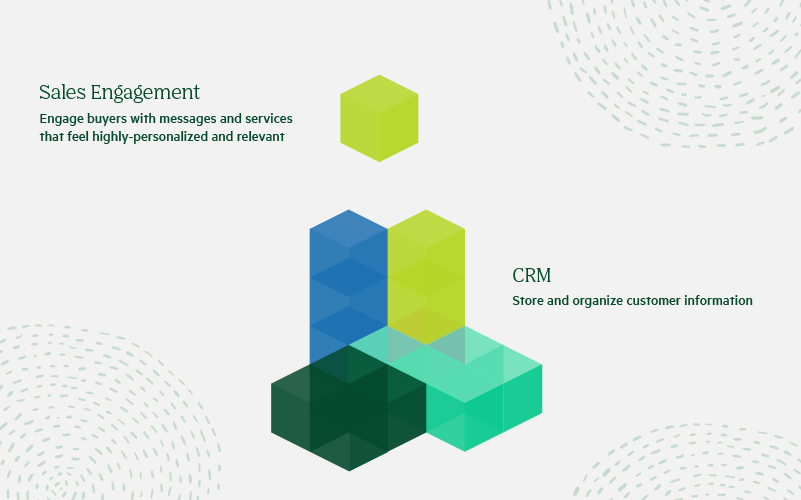
What is an SEP?
SEPs are designed to solve the SDR's biggest challenge: how to contact hundreds of prospects in a personalized and systematic way without spending all day on manual administrative work.
Let's go back to the Sprouts.ai article for a definition.
Sales Engagement Platform vs. CRM: Key Differences for 2025
Now, let's read the definition of a Sales Engagement Platform from the same article.
Please read the section titled 'What is a Sales Engagement Platform? The System of Action'. Focus on its core purpose: automating and optimizing outreach.
The key concept for an SEP is the "Sequence" (also called a "Cadence"). A sequence is a pre-built series of outreach steps that can be automated. For example, an SDR might build a 10-step sequence that looks like this:
- Day 1: Automated Personalized Email
- Day 3: Manual Call (Task created for SDR)
- Day 5: LinkedIn Connection Request
- Day 7: Automated Follow-up Email
- ...and so on.
The SDR can enroll hundreds of prospects into this sequence, and the SEP manages the workflow, sending the automated emails and creating tasks for the manual steps. It tracks who opens emails, clicks links, and replies.
The most popular SEPs you will see mentioned are Outreach and Salesloft.
Test your understanding!
An SDR needs to do two things:
- Find the contact history and notes from a conversation her manager had with a prospect six months ago.
- Launch a new prospecting campaign to 50 new leads, involving a mix of emails and calls over the next two weeks.
Which tool would she use for each task, and why?
Show answer
- She would use the CRM (like Salesforce or HubSpot). The CRM is the system of record and contains the complete historical log of all interactions with the prospect.
- She would use the Sales Engagement Platform (like Outreach or Salesloft). The SEP is the system of action, designed to build and execute automated multi-step, multi-channel outreach sequences at scale.
3. Putting It All Together: The Power of Synergy
A CRM alone is just a database. An SEP alone has no data to act on. The magic happens when they are integrated. This is the standard setup at almost every modern tech company.
The workflow is simple:
- The CRM acts as the "source of truth" for all prospect data.
- The SEP pulls lists of prospects from the CRM.
- The SDR uses the SEP to execute outreach sequences.
- All the activity from the SEP (emails sent, calls made, meetings booked) is automatically logged back into the CRM.
This creates a perfect loop where the system of action (SEP) constantly enriches the system of record (CRM) with real-time data, without the SDR having to do manual data entry.
Sales Engagement Platform vs. CRM: Key Differences for 2025
This final reading from the same article explains this crucial synergy. Understanding this relationship is what will set you apart in an interview.
Please read the section 'Why You Need Both for Complete Sales Operations'. Focus on how the two systems feed each other to make the whole process more effective.
This integration means you, as the SDR, get to spend more time on high-value activities—having conversations with prospects and booking meetings—and less time on administrative tasks like logging calls and copying/pasting emails.
Course Conclusion
Congratulations! You have completed your SDR crash course. Let's briefly recap the ground we've covered.
You started by building the assets for your job search: a targeted company list, a compelling resume and cover letter, and an optimized LinkedIn profile. You then dove into the core skills of the interview process, learning how to articulate your value, answer common questions, and prepare for success. From there, you mastered the practical research skills needed to find and understand your prospects. Finally, in this last module, you learned the hands-on outreach skills: writing emails, making calls, handling objections, qualifying leads, and now, understanding the technology that powers it all.
Key Takeaways from Today's Lesson:
- CRM is the System of Record: It's the central database for all customer and prospect information. Think Salesforce and HubSpot.
- SEP is the System of Action: It's the engine for executing and automating outreach (emails, calls, social). Think Outreach and Salesloft.
- They Work Together: The SEP pulls data from the CRM to run outreach campaigns and pushes activity data back to the CRM to keep the record complete. This synergy is key to SDR productivity.
You began this journey with the goal of breaking into an SDR role. You now have a practical, no-fluff foundation covering what you need to do to find a job, excel in the interview, and understand the core functions of the role itself.
Your "parallel study" approach is smart. Continue applying for jobs, and use these lessons as your guide during the interview process. Reread the sections on interview questions, company research, and outreach skills before you speak with hiring managers. You are prepared.
Good luck with your job search, and welcome to the exciting world of sales