Hello! Welcome back to our exploration of the ketogenic diet and intermittent fasting.
In our last lesson, we built a practical framework for comparing different intermittent fasting (IF) protocols, from daily time-restricted eating like 16:8 to more advanced weekly schedules. We established the what and the how of these various approaches.
Today, we transition from the what to the why. You're interested in IF not just as a dietary strategy, but as a tool for longevity and cognitive enhancement. One of the most powerful mechanisms underlying these benefits is a process called autophagy. This lesson is dedicated to fulfilling the learning outcome: Describe the process of autophagy and its role in cellular renewal during fasting.
We will break down this fundamental biological process into three parts:
- What autophagy is at the cellular level.
- How fasting acts as a master switch to turn it on.
- Why this cellular "housekeeping" is so critical for long-term health and longevity.
1. What is Autophagy? The Cell's Quality Control System
The term "autophagy" comes from the Greek for "self-eating." While this might sound destructive, it's actually a highly regulated and essential process of cellular maintenance and renewal. Think of it as your body's internal quality control, recycling, and waste-disposal system.
Every day, your cells accumulate damaged proteins, old and dysfunctional organelles (the "organs" of the cell, like mitochondria), and other cellular debris. If left unchecked, this accumulation can impair cellular function and contribute to aging and disease. Autophagy is the process that identifies this "junk," breaks it down into its basic components (like amino acids and fatty acids), and recycles those components for energy or to build new, healthy cellular structures.
The image below illustrates the key mechanical steps of this process.
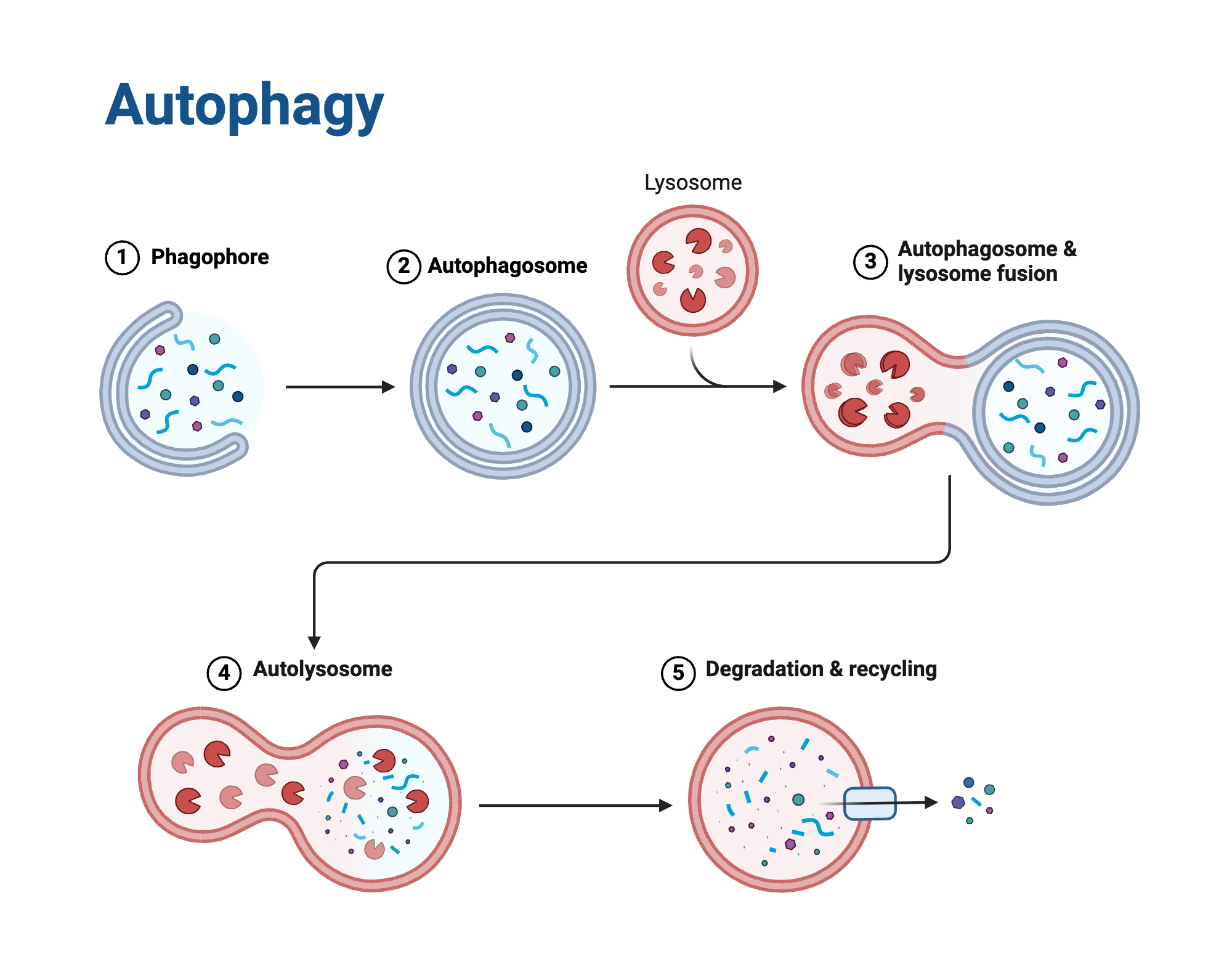
To get a clear and concise explanation of this process from a leading metabolism researcher, let's turn to Dr. Ben Bikman.
85: How Autophagy Protects Your Cells and Boosts Longevity with Dr. Ben Bikman
In this segment from 'How Autophagy Protects Your Cells', Dr. Bikman provides a foundational definition of autophagy, explaining what it is and identifying the key cellular machinery involved, such as the lysosome.
Watch the section from 01:44 to 04:32. Focus on the core definition of autophagy and its primary function as a recycling and quality control mechanism for damaged cellular components.
In essence, autophagy is not about random destruction; it's a precise system for maintaining cellular health and efficiency. By clearing out the old and damaged, it makes way for the new and functional.
2. The Triggers: How Fasting Activates Autophagy
So, what flips the switch to turn on this powerful cleanup process? The primary signal is nutrient scarcity. Your body exists in a constant balance between two opposing states:
- Anabolic State (Fed/Growth): When you eat, particularly carbohydrates and protein, insulin levels rise. This signals to your cells that energy is plentiful. The priority becomes growth, repair, and energy storage. A key pathway activated here is mTOR (mechanistic Target of Rapamycin), which acts as a master growth regulator. Since the focus is on building, mTOR actively inhibits autophagy.
- Catabolic State (Fasted/Cleanup): When you are fasting, insulin levels fall, and another hormone, glucagon, rises. This signals that external energy is scarce. The priority shifts from building to conserving energy and finding internal fuel sources. Another key pathway, AMPK (AMP-activated protein kinase), is activated. AMPK acts as a master energy sensor. When it detects low energy levels, it switches on processes that generate energy, including autophagy, to break down old parts for fuel. AMPK promotes autophagy.
Therefore, fasting—by lowering insulin and activating AMPK—removes the brakes (mTOR) and presses the accelerator (AMPK) on autophagy.
This academic review paper provides a superb diagram and explanation of this interplay.
The Effects of Intermittent Fasting on Brain and Cognitive ...
This paper, 'The Effects of Intermittent Fasting on Brain and Cognitive Function', includes a detailed section on the metabolic switch that occurs during fasting. It clearly outlines the signaling pathways we've just discussed.
Please read the section titled '2.1. The Metabolic Switch'. Pay close attention to the paragraph that begins 'In animal models, the lowered levels of glucose...' and the subsequent paragraph discussing the mTOR pathway. Also, carefully study 'Figure 2', which visually maps how fasting leads to the inhibition of mTOR and activation of AMPK, ultimately stimulating autophagy.
Now, let's tie this mechanism to a practical timeline. When do these benefits actually kick in? This is where the IF protocols we discussed last lesson become directly relevant.
A Comprehensive Guide To Fasting : Timeline, Stages & ...
The 'Comprehensive Guide to Fasting' by Dr. Alexis Shields provides a practical, hour-by-hour timeline of the physiological stages of a fast.
Read the sections '4 – 16 Hours', '16 – 24 Hours', and the 'To recap:' summary at the end. Note when autophagy is said to begin and when it significantly ramps up. This connects the abstract mechanism to concrete fasting durations.
As the guide highlights, while some autophagy may begin earlier, it is generally understood to start in earnest around the 16 to 18-hour mark and increases significantly after 24 hours. This provides a clear rationale for why protocols like 16:8 are popular starting points and why longer fasts (like OMAD or 24-36 hour fasts) are thought to produce more potent autophagic effects.
Test your understanding!
You have just finished a large meal rich in protein and carbohydrates. Based on the signaling pathways we've discussed, is your body's cellular environment currently promoting or inhibiting autophagy? Briefly explain why, mentioning the key hormones and pathways involved.
Show answer
The body is currently inhibiting autophagy. The protein and carbohydrate intake will cause a significant rise in insulin. High insulin levels signal a state of nutrient abundance, which activates the mTOR pathway. As a master "growth" regulator, mTOR's function is to promote synthesis and storage, so it actively suppresses the "breakdown" and "cleanup" process of autophagy.
3. Autophagy's Role in Longevity and Health
Now we arrive at the central reason for your interest: the connection between this cellular process and long-term health. Given your logical and skeptical mindset, it's important to approach this with a clear view of the evidence.
The longevity benefits of autophagy stem directly from its "quality control" function. By systematically clearing out dysfunctional components, autophagy helps prevent the cellular decline associated with aging.
Dr. Bikman and Dr. Peter Attia, both respected for their evidence-based approaches, offer excellent insights here.
85: How Autophagy Protects Your Cells and Boosts Longevity with Dr. Ben Bikman
Let's return to Dr. Bikman's lecture, where he discusses the broad physiological importance of autophagy, its connection to longevity, and how it is influenced by both keto and fasting.
Watch the following segments: Physiological Importance (04:32 - 07:55): Note the link between faulty autophagy and diseases of aging like neurodegeneration. Longevity Connection (12:02 - 17:09): Understand how autophagy declines with age and how enhancing it (in animal models) improves healthspan. Pay attention to his cautionary notes on pharmacological interventions like rapamycin. Insulin & Keto (17:09 - 24:02): This reinforces the mechanism, explaining how low insulin states (fasting or keto) promote autophagy, and how ketones themselves can have a direct beneficial effect.
Dr. Bikman makes a strong case based on cell biology and animal models. However, a key question for any critical thinker is: how good is the human data? This is where Dr. Attia provides crucial context.
Fasting, Longevity, Autophagy & mTOR Inhibitors - Peter Attia, MD
In this clip, Dr. Peter Attia discusses the challenges of studying longevity and autophagy in humans. His perspective is essential for maintaining a balanced and skeptical view of the current research.
Watch these two segments: Studying Longevity (12:32 - 16:17): Dr. Attia explains why we rely on animal data and backward-looking human studies, highlighting autophagy as a key overlapping mechanism. Measuring Autophagy (26:06 - 29:04): This is a critical point. He explains why we can't easily measure autophagy in humans with a simple test, which is a major limitation in research.
The key takeaway from these experts is that while the mechanistic evidence is strong and the results in animal models are compelling, direct measurement and quantification of autophagy in living humans remains a major scientific challenge. We infer its activity based on what we know about the underlying pathways.
Finally, it's crucial to remember that this is about balance. You don't want autophagy running unchecked 24/7. Your body also needs periods of anabolism (growth/mTOR activation) to build muscle and repair tissues. This is precisely why a cyclical approach—like intermittent fasting—that alternates between the fed (anabolic) and fasted (catabolic) states is so powerful.
Conclusion
Today, we've moved from the practical schedules of fasting to the profound cellular mechanisms they trigger. We've defined autophagy as the body's essential process for cellular renewal and quality control.
Key Takeaways:
- Autophagy is a catabolic ("breakdown") process where cells recycle damaged proteins and organelles, playing a crucial role in maintaining cellular health.
- It is activated by nutrient scarcity (fasting) via a hormonal and signaling switch: low insulin inhibits the mTOR (growth) pathway, while low cellular energy activates the AMPK (energy-sensing) pathway.
- In practical terms, meaningful autophagy begins around the 16-18 hour mark of a fast and increases significantly from there, providing a direct rationale for various IF protocols.
- By clearing cellular debris, autophagy is strongly linked to healthspan and the prevention of age-related diseases, although direct measurement in humans is still a challenge.
- Optimal health relies on a balance between anabolic (fed) and catabolic (fasted) states, which is what makes cyclical fasting a powerful strategy.
In our last lesson, we explored different IF protocols. Now we've seen how fasting triggers autophagy. Our next lesson will bridge another important gap by comparing fasting-induced ketosis with the nutritional ketosis achieved through a ketogenic diet. This will help you understand how these two powerful strategies can be used in concert.