Hello! Welcome back to our course.
In our last two lessons, we built a foundational understanding of ketogenesis. We first learned what ketones are and the biochemical "factory" in the liver that produces them. Then, we identified the systemic "on-switch" for that factory: a low insulin-to-glucagon ratio, achieved through carbohydrate restriction.
Now that we know how to make ketones, the logical next question is: what does the body do with them? This lesson directly addresses that question, fulfilling the learning outcome: Describe how different tissues (brain, muscles, heart) utilize ketones for energy. This is a critical piece of our framework, as it connects the metabolic process of ketosis directly to your goal of achieving mental sharpness and overall health.
Ketolysis: The Other Side of the Coin
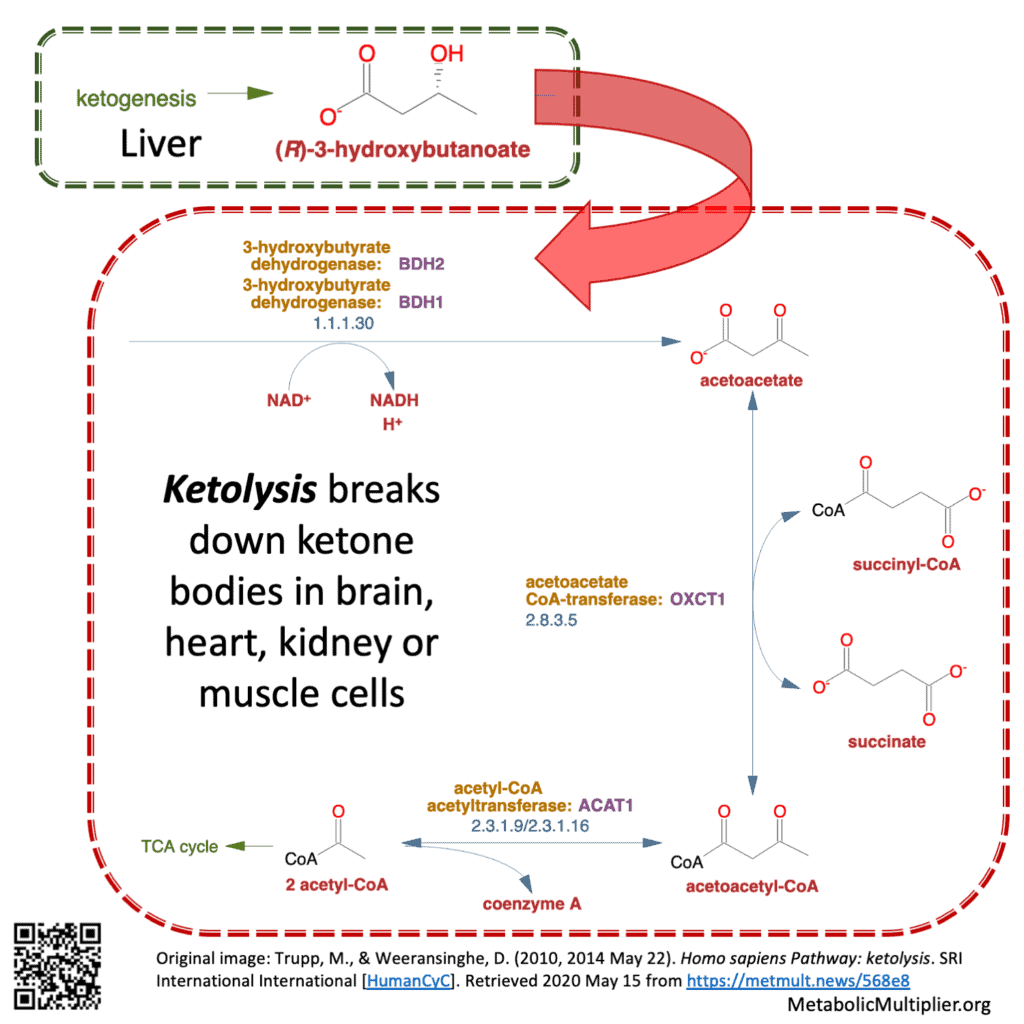
Once ketone bodies—primarily beta-hydroxybutyrate (BHB) and acetoacetate—are released from the liver into the bloodstream, they travel to other tissues to be used as fuel. The process of breaking down ketones for energy is called ketolysis. It is, in many ways, the reverse process of ketogenesis.
However, there's a crucial asymmetry in this system. The liver is the primary site of ketone production (ketogenesis), but it cannot use ketones for its own energy needs. This is because liver cells (hepatocytes) lack a key enzyme called thiophorase (or β-ketoacyl-CoA transferase). This makes the liver a generous, selfless producer, exporting this high-quality fuel for other, more demanding organs to use.
The diagram below shows how tissues that do have this enzyme convert ketone bodies back into acetyl-CoA, which can then enter the Krebs cycle to produce ATP, the cell's energy currency.
Now, let's look at the specific consumers of this special fuel.
The Brain: A Preferred Customer
Your primary interest is in cognitive optimization, and this is where the story of ketones becomes particularly compelling. For decades, it was taught that the brain runs exclusively on glucose. While it's true that the brain needs some glucose, this is an incomplete picture. When available, the brain not only uses ketones but appears to actively prefer them.
To understand why, let's hear from two leading researchers in the field.
57: Exogenous Ketones with Dr. Ben Bikman
First, Dr. Ben Bikman will explain the fundamental shift in our understanding of the brain's fuel preferences, referencing the classic research by Dr. George Cahill.
Please watch from 08:32 to 11:24. Focus on the key finding: even when blood glucose levels are more than double the ketone levels, the brain can derive up to 70% of its energy from ketones. This is a powerful argument against the idea that glucose is the brain's 'preferred' fuel.
This raises a key question: how does the brain accomplish this preferential uptake? The mechanism is fundamentally different from how it uses glucose.
- Glucose is "pulled": Brain cells pull in glucose from the blood on an as-needed basis. Its uptake is rate-limited and depends on cellular activity.
- Ketones are "pushed": The transport of ketones across the blood-brain barrier is directly proportional to their concentration in the blood. The more ketones in your blood, the more fuel is pushed into your brain.
This "push" mechanism ensures the brain has a steady, abundant energy supply during ketosis, which is not necessarily the case with glucose. Dr. Stephen Cunnane, a pioneer in brain metabolism imaging, provides some of the most compelling visual evidence for this.
Dr. Stephen Cunnane - Brain Glucose and Ketone Metabolism
In this next clip, Dr. Cunnane explains the 'push vs. pull' concept and shows PET scan evidence of the brain's preference for ketones. This will appeal to your skeptical and logical nature.
Please watch the following three short segments: 04:52 - 07:03: This section explains the 'pull' (glucose) versus 'push' (ketones) fuel strategies for the brain. 07:03 - 08:32: Here, Dr. Cunnane presents PET scan data showing that as the brain's uptake of ketones increases, its uptake of glucose simultaneously decreases. This is called the 'glucose-sparing' effect and is strong evidence of fuel preference. 24:35 - 25:44: This final clip shows that on a ketogenic diet, the total energy supply to the brain can actually increase beyond what is typical on a standard diet. Focus on the concepts, not the precise numbers. The key takeaway is that ketones provide a reliable, preferred, and abundant energy source that can even surpass the total energy provided by a glucose-based metabolism.
For someone seeking "mental sharpness," the implications of this are significant. A ketogenic state provides the brain with a more stable and potentially more abundant supply of energy, bypassing the fluctuations that can come with glucose metabolism.
The Heart and Muscles: The Body's Workhorses
While the brain is a major beneficiary, it's not the only organ that thrives on ketones. The heart and skeletal muscles are also highly metabolically active and readily use ketones.
The Wikipedia article on Ketone Bodies provides a concise summary of how the heart utilizes this fuel.
Please read just the short section titled 'Heart.' The key point is that under ketotic conditions, the heart actually prefers burning ketones over its usual primary fuel, fatty acids.
The heart, an organ that must beat continuously without rest, benefits from a fuel source that is both energy-dense and readily available.
Similarly, skeletal muscles can efficiently use ketones. In fact, there is evidence that ketones may be a more efficient fuel than glucose for muscle cells. In the video with Dr. Bikman you watched earlier, he briefly mentioned his lab's research (from 13:04 - 13:45) showing that muscle cells can produce more ATP (energy) for every unit of oxygen consumed when using ketones. This suggests an increase in metabolic efficiency at the cellular level.
Test your understanding!
A common misconception is that because the liver works so hard to produce ketones, it must be using them for its own significant energy needs. Based on what you've learned in this lesson, explain why this is incorrect. What does this reveal about the metabolic role of the liver in a ketogenic state?
Show answer
This is incorrect because liver cells lack the key enzyme, thiophorase, which is necessary to convert ketone bodies back into acetyl-CoA for energy use. This means the liver can produce ketones but cannot consume them.
This reveals that the liver's role in a ketogenic state is that of a central production and export hub. It transforms fatty acids into a water-soluble, easily transportable fuel (ketones) specifically for the benefit of other tissues like the brain, heart, and muscles. It is a selfless producer in this metabolic system.
Conclusion
Today, we've seen where the ketones produced by the liver actually go and how they are used. This completes a major part of our metabolic framework, connecting ketone production to energy utilization.
Key Takeaways:
- Ketones are broken down for energy in a process called ketolysis, which occurs in tissues outside the liver, primarily the brain, heart, and skeletal muscles.
- The liver cannot use ketones for fuel because it lacks the necessary enzyme, thiophorase, establishing its role as a dedicated ketone producer.
- The brain is a prime consumer of ketones. It utilizes a "push" mechanism, taking up ketones in proportion to their availability, and appears to prefer them over glucose, leading to a potential increase in total available brain energy.
- The heart and muscles are also efficient and eager consumers of ketones, with the heart preferring them to fatty acids and muscles potentially gaining efficiency in energy production.
We now understand how ketones are made and how they are used. But what is it like to transition your body to this new operating system? This is not an instantaneous switch.
In our next lesson, we will explore the final part of this module: Identify the typical timeline and physiological shifts during keto-adaptation. We will discuss the step-by-step process your body goes through as it becomes efficient at producing and, more importantly, using ketones as its primary fuel.