Hello. The previous lesson separated what a camera, collar, or feeding sign records from what a researcher infers. An encounter calls for the same discipline, but it adds a complication: a person and a bear can change one another’s behavior within seconds.
This lesson compares explanations for what a bear does near people. You will use the setting, the bear’s visible actions, and the sequence of events rather than treating a dramatic pose as a window into its intentions. That approach helps make sense of encounters without assuming that every close bear is attacking—or that an apparently calm bear is safe to approach.
Start with the event, not a character judgment
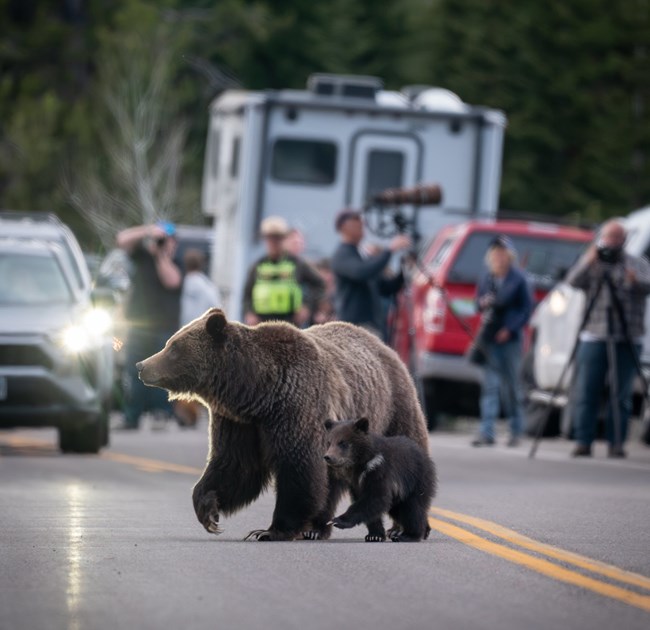
The photograph supports a modest description: an adult and cub were on the road, with people and vehicles in the background. It does not show that the adult was trying to confront the observers. Crossing to habitat on the other side is one plausible explanation for its presence. A nearby cub also matters: if people block the bears’ route or come too close, a defensive reaction becomes more plausible. Neither explanation can be confirmed from this still image.
An encounter account becomes more informative when it preserves three kinds of detail:
- Setting: a narrow trail or open ground; a visible cub or carcass; food or garbage nearby; room for the bear to leave.
- Observable behavior: the bear passes, stops, retreats, huffs, swats the ground, charges, or continues approaching.
- Sequence: what the bear and people did before and after the striking moment.
“The bear came toward us” is an observation worth taking seriously, but it is not a complete explanation. The bear might be following a route, investigating something unfamiliar, approaching an attractant, or reacting defensively to a close surprise. The alternatives gain or lose support as more of the sequence comes into view.
The Interagency Grizzly Bear Committee’s Encounter Behavior & Myths is useful here because it places visible signs beside common misreadings of those signs. Read its categories as guides to interpretation and response, not as a means of diagnosing a bear’s inner state with certainty.
Encounter Behavior & Myths (Be Bear Aware) - IGBC
Read the Interagency Grizzly Bear Committee's encounter guidance to distinguish a bear that is disengaging, displaying defensive agitation, or continuing to approach.
In “Encounter Behavior & Myths,” find the consecutive headings beginning “If a bear is not actively engaged with you,” followed by “If a bear shows agitated/defensive behavior” and “If a bear shows predatory/curious behaviors.” Read the encounter cases, including the charging-bear guidance between them. Then, under “Grizzly Bear Myths,” read the first four myth entries, from “Bears are naturally aggressive towards humans” through “Once a bear charges, it is attacking.” The four myths explain why standing upright, displaying agitation, and charging each need context. Focus especially on the difference between a warning display and proof that contact will occur.
Standing upright, for instance, can help a bear see or smell what is nearby. Huffing, jaw clacking, or swatting the ground are more concerning signs of agitation. But even a charge does not, by its appearance alone, reveal what the bear will do next: it may stop or veer away. A possible bluff charge is still a serious event, not permission to wait close by and test a prediction.
Compare explanations by their patterns
A single sign rarely settles the matter. It is more useful to compare combinations of observations, while allowing explanations to overlap.
| Observed pattern | Explanation it may support | What it does not establish |
|---|---|---|
| A bear continues along a route, looks away, or retreats after noticing people | Passing through or avoiding contact | That it cannot react if people close the distance |
| A close surprise occurs near a cub or carcass; the bear huffs, swats, or makes a sudden rush | A defensive response to proximity | That the bear was seeking people out |
| A bear slowly and persistently approaches as people move away | Investigation or a more concerning, potentially predatory approach | Predatory intent from the approach alone |
| A bear repeatedly approaches vehicles or occupied sites where food or garbage is accessible | Attraction to human-associated food may be involved | That every approach to a person is food-seeking |
These are competing interpretations, not four kinds of bear. A bear near a carcass might also be accustomed to seeing people; a bear approaching a vehicle might be following a route beside it. “Curious” and “predatory” are often grouped in encounter guidance because persistent approaches demand caution, not because an observer can reliably tell from a brief approach which motivation applies.
Movement offers information that a still photograph cannot. In this brief segment from Angry Bear – Aggressive Bear Body Language, Three Minutes Outdoors contrasts an upright bear with one moving past at a distance. Watch for the visible posture and path, while keeping the narrator’s interpretation separate from what the footage alone establishes.
Angry Bear – Aggressive Bear Body Language
Three Minutes Outdoors' “Angry Bear – Aggressive Bear Body Language” provides moving examples of behaviors that can look more threatening in a single frame.
Watch the upright posture for the distinction between gaining a view and preparing to charge. Continue through the passing bear, focusing on its route and distance from people. Neither example is a guarantee of how a different bear will behave.
The value of a longer observation is not that it makes interpretation infallible. It reveals whether an apparent approach persists, whether the bear has a route past people, and whether its behavior changes as people give it space.
Add context, then revise the explanation
The National Park Service’s Safety guidance for Yellowstone makes a useful comparison: a close, defensive encounter and a slow, persistent approach can look different over time and call for different safety responses. Its discussion of carcasses also shows why the same movement can mean something different in a different setting.
Safety - Yellowstone National Park (U.S. National Park Service)
Read the National Park Service's guidance as an example of how surroundings and a bear's continuing behavior alter the interpretation of an encounter.
In the “Bears” section, find the “Avoid carcasses” advice. Read the carcass guidance. Then read “Surprise Encounters” and “Charging Bears,” beginning with the close-encounter passage. Finally, under “Curious or Predatory Bears,” read the persistent-approach passage. Notice which observations distinguish the situations, and which responses depend on that distinction.
Consider two accounts that both begin, “A bear moved toward hikers.” In the first, hikers round a bend near a carcass, the bear huffs and rushes toward them, then stops. The carcass, close surprise, display, and stopping point together favor a defensive explanation over a claim that the bear was hunting the hikers. They do not prove exactly what the bear perceived.
In the second, no carcass or cub is visible; people move away, yet the bear continues to approach slowly and persistently. That pattern gives more weight to an investigative or potentially predatory explanation than the first account does. But the absence of a visible carcass does not prove none is nearby, and persistent approach alone cannot establish predation. The sensible conclusion is a stronger warning about the behavior, not certainty about motive.
This is the same evidence-first method used in the previous lesson. New observations can change which explanation is best supported. They should not be added merely to make an initial story sound more vivid.
A photograph is not the whole encounter

This image could prompt the sentence “the bear is coming after the person.” Yet it supplies no earlier position for the bear and no later one. It does not show whether the person has been standing still, backing away, or moving into the bear’s path.
Different additional observations would change the interpretation in different ways. Footage showing the bear continuing along the road and then turning into the trees would support travel. Footage showing it repeatedly closing the distance after the person moves away would make a persistent approach harder to dismiss. A carcass just outside the frame would raise the possibility of defense of food. Evidence of accessible food in a nearby pack would introduce another possible attractant. None of these details is visible merely because it would make a compelling story.
A careful account therefore uses calibrated language: “The bear was photographed on the road facing the person; its trajectory and response are unknown.” That statement is less dramatic, but someone else could check it against footage or subsequent observations. “The bear wanted to attack” is not comparably testable from this frame.
Interpret cautiously; respond promptly
Scientific restraint should not be mistaken for hesitation about safety. A person does not need to prove whether a bear is defensive, curious, or predatory before giving it space. Nor should anyone move closer to obtain better evidence. The encounter guidance you read advises keeping a group together, backing away slowly in a close encounter, not running, and having bear spray available; follow applicable local guidance for actual travel in bear habitat.
The distinction between explanations becomes especially important if an encounter escalates. The National Park Service distinguishes a defensive charge from a slow, persistent approach and gives different instructions if contact occurs. A rule heard about one kind of attack should not be applied indiscriminately to another. At the same time, behavior categories remain provisional during a fast-moving event: treat warning signs seriously rather than betting on a label such as “just a bluff.”
The research question and the immediate safety question have different thresholds. A researcher may say, “The evidence favors a defensive response, but other explanations remain possible.” A person present must act on the risk supported by the observable behavior, without waiting for certainty about what the bear intends.
Takeaways
An encounter is best interpreted as a sequence in a setting. Cub or carcass proximity, a close surprise, warning displays, a route past people, and continued approach each help distinguish explanations; no single image or posture reveals a bear’s intentions. Compare alternatives, state what remains unseen, and revise the interpretation when new observations arrive. Caution about motives can coexist with prompt, sensible safety decisions.
The next module turns from individual encounters to conservation: why human-caused losses can slow recovery in a species whose reproduction is slow and whose populations depend on connected habitat.