Hello. In the previous lesson, autumn feeding helped explain how a female grizzly can give birth and nurse cubs while living on stored energy in the den. Now the focus moves beyond the bear: what changes in an ecosystem when a grizzly feeds? A bear may kill prey, consume an animal that died for another reason, carry fish away from a stream, or deposit seeds after eating fruit. The ecological consequence depends on the food, the setting, and what the bear does with what remains.
Start with the feeding event, not the bear’s reputation
A grizzly is an omnivore, so “a bear ate” does not specify its ecological role. Consider a bear feeding on a large animal. If it caught and killed a young elk, it acted as a predator. If the elk had already died and the bear fed on its remains, it acted as a scavenger. Both events nourish the bear, but only the first directly caused that elk’s death.
The National Park Service’s Bear Ecology distinguishes these routes in its account of grizzlies’ spring foods. Read the short passages with that distinction in mind.
Bear Ecology - Yellowstone National Park (U.S. National Park Service)
The National Park Service describes when grizzlies feed on young ungulates, winter-killed animals, and carcasses obtained from wolves. These examples provide a grounded starting point for predicting consequences.
In “Diet,” find the paragraph beginning “From late-March to early-May.” Read from that opening through the distinction between carrion and calves. Then, in “Bears Coexisting with Wolves,” find the paragraph beginning “Wolves prey on ungulates year-round.” Read the feeding account through the sentence about wolf-killed carcasses. Focus on which animal caused the death and which animal ate the remains.
For a spring landscape with newborn elk calves, bear predation can lower the number of calves that survive their first weeks. That is a defensible local consequence. It does not, by itself, establish how much the entire elk population will change: other causes of calf death, the number of bears, and the number of surviving calves also matter.
Now consider a winter-killed bison. A grizzly feeding on it gains energy but did not cause its death. The bear may also change access to the carcass—consuming some of it, moving pieces, or competing with other animals for food. Those are ecological effects of scavenging, not evidence of predation.
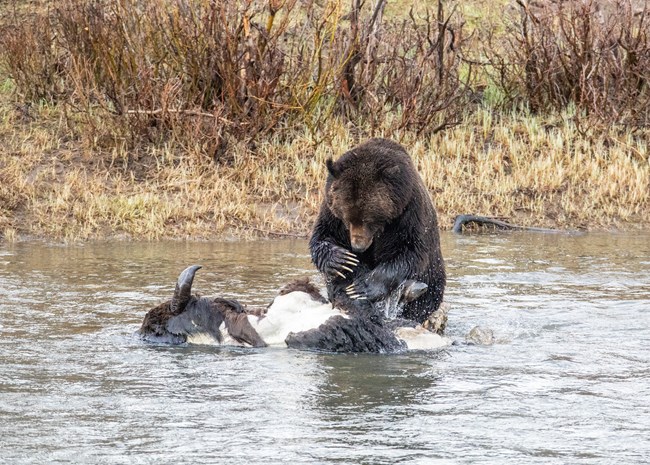
That caution matters because dramatic images can make a grizzly look like the cause of every carcass it occupies. To predict a feeding effect, first establish what the observation actually shows.
A salmon stream connects water to forest
In a stream with spawning salmon, a grizzly may catch a fish and eat it on the bank rather than in the water. When salmon are abundant, a bear can consume preferred, energy-rich portions and leave much of the fish behind. The uneaten material is no longer simply “waste”: it is food for scavengers and decomposers in a different place from where the fish was caught.
Watch the BBC Earth footage for the physical details of that transfer. Notice where the bear feeds and where the remains end up.
Grizzly Bear Hunts Salmon | How Nature Works | BBC Earth
“Grizzly Bear Hunts Salmon,” from BBC Earth, shows both the catch and what happens to discarded fish. It makes the bear’s role as a transporter easier to see.
Watch the catch for the bear’s selective feeding, then the remains for the carcasses and decomposers on the forest floor. The key observation is the change in where salmon material becomes available.
A scientific review, Community Ecology and Conservation of Bear-Salmon Ecosystems, by Taal Levi and colleagues, follows those remains through the streamside food web. Its examples concern bear–salmon ecosystems; they are not a description of every grizzly habitat.
Frontiers | Community Ecology and Conservation of Bear-Salmon Ecosystems
This review in Frontiers in Ecology and Evolution examines how bear-distributed salmon remains become food for scavengers and a source of nutrients for streamside plants. Read the selected passages for the mechanisms and for the authors’ limits on what can be concluded.
In “Bear-Distributed Salmon Carcasses as Resource Subsidies,” read from the paragraph beginning “After capturing salmon in estuaries and streams” through the overview of carcass movement. In the “Vertebrate Scavengers” subsection, read from the opening sentence about species feeding on adult salmon through the scavenger examples. Finally, in “Riparian Plants,” read from the opening paragraph about transfer to streamside areas through the plant evidence. Pay particular attention to the fertilization experiment’s qualification that tree-growth effects were small compared with other factors.
Here is a prediction for a small stream with a strong salmon run and bears that carry fish onto its banks: more salmon remains should become available to land-based scavengers and decomposers near the stream. As carcasses break down, some of their nutrients can enter streamside soils and plants. Salmon acquired those nutrients while living in the ocean, so this is also a case of nutrient transport between ecosystems.
The predicted location matters. A fish left on a forest floor can feed terrestrial insects and birds and release nutrients beside roots. A fish that remains in the stream becomes available to a different set of consumers. Bears do not create the nutrients, and salmon can reach streamside land by other means, including flooding. The claim is that bear feeding changes how much material reaches particular places, not that plants would receive no salmon nutrients without bears.
Nor does a nutrient input guarantee a forest-wide surge in growth. Plants must be able to use the released nutrients, and other conditions affect growth. The review reports evidence for salmon-derived nitrogen in streamside plants, while noting that a long-term carcass-fertilization experiment produced a tree-growth effect that was small relative to other factors. A strong prediction identifies the likely pathway; it does not promise a dramatic result everywhere.
Berries carry a different kind of consequence
A grizzly eating berries may swallow many seeds and later deposit them in scat away from the parent shrub. If some seeds remain viable and land in suitable places, the bear has acted as a seed disperser. This is different from fertilizing a plant: dispersal changes where new plants might establish, whereas nutrient transport changes the resources available at a site.
The same review examines this pathway and a less obvious one. Seed-filled bear scat can attract small mammals; some eat seeds, while others move and store them. Read these two subsections as a continuation of the salmon-stream example, not as a claim that salmon is required for every bear to disperse berries.
Frontiers | Community Ecology and Conservation of Bear-Salmon Ecosystems
Return to Levi and colleagues’ review to see what happens after a bear eats fruit. The account distinguishes seed deposition from successful plant establishment and shows how small mammals can alter the outcome.
In “Salmon and Seed Dispersal,” read from the opening description of fleshy-fruited shrubs through the full subsection. Then read “Resource Subsidies to Small Mammals,” from its opening sentence through the small-mammal account. Focus on the contrast between mice that move and cache seeds and voles that may consume them.

Imagine a berry patch beside an open area suitable for new shrubs. A bear eats fruit in the patch and deposits seed-filled scat in the open area. A plausible consequence is an increased supply of seeds there. Some may be eaten; some may be carried again by small mammals; some may remain where deposited. Whether more shrubs ultimately grow depends on seed survival and conditions at those sites.
This example also shows why one feeding event can have more than one beneficiary. Fruit feeds the bear, seeds in its scat can feed small mammals, and uneaten viable seeds may reach places where plants could establish. These outcomes are compatible, but none is automatic.
Make predictions that fit the setting
The most useful way to reason about a grizzly’s ecological role is to specify four things in prose: what it ate, how it obtained or handled that food, where the remains or seeds went, and which organism could be affected. Add a condition when the final outcome depends on something you have not observed.
In a spring elk-calving area, a bear killing a calf predicts one fewer calf surviving that event. At a winter-killed carcass, a bear feeding predicts consumption and possible changes in food available to other scavengers, but not a bear-caused prey death. Beside a salmon stream, fish carried onto land predict food and nutrient inputs near the banks. In a berry-rich landscape, seed-filled scat predicts seed deposition and a potential food source for small mammals; it does not guarantee new shrubs.
These are not four separate identities assigned to different kinds of grizzly. The same omnivorous bear can play several roles across a year. Context determines the consequence. The earlier lessons’ seasonal diet now becomes a way to anticipate where—and when—each role is possible.
Takeaways
Grizzly feeding can affect other organisms through predation, scavenging, seed dispersal, and nutrient transport. The crucial distinctions are whether the bear caused an animal’s death, whether it moved food or remains to a new location, and whether seeds or nutrients can be used after deposition. A credible prediction names a specific pathway and acknowledges what must happen for the effect to extend beyond the immediate feeding event.
The next module turns to evidence: how tracking records, camera images, and feeding signs can support some conclusions about bear behavior while leaving others unresolved.