Hello. The previous lesson showed why preventing the loss of a breeding female matters, and why a landscape must allow bears to move safely between habitats. This final lesson brings those ideas to a practical decision: which coexistence measure addresses a particular conflict, and what might keep it from working? We will consider bears drawn to food near homes, bears encountering people outdoors, and the limits of judging success from a few observations.
Diagnose the conflict before choosing a measure
A bear seen near a house is not, by that fact alone, a bear seeking human food. It may be moving between habitats or feeding on a natural food source nearby. The distinction matters because measures aimed at garbage will not remove a natural feeding area, while moving a bear will not make accessible garbage disappear.
A field project offers a useful case. In its study area, spawning fish and spring forage drew grizzlies to low-elevation habitat near homes. Garbage and livestock added food opportunities on private property. The report calls a place that draws bears toward food and exposes them to conflict an attractant sink. Good feeding habitat can therefore become dangerous habitat: bears arrive for food, but some die following encounters with people.
Meadow Creek Bear Education and Management Project ...
Read this field report for its explanation of why natural feeding habitat near homes can become a conflict site, and why moving a bear may not resolve the cause.
In “Introduction,” find the subsection “Attractant sinks” on printed pp. 6–7. Read the conflict setting, continuing through the subsection “Meadow Creek Spawning Channel and the community of Meadow Creek” and stopping at its sentence about livestock-related conflicts. Then, under “Less-lethal management” on printed pp. 7–8, read the management explanation. Focus on what remains in place when a bear is moved but the food reward is not.
This case separates two things that can look alike from a distance: access to natural food near people and access to food supplied by people. A workable goal is not necessarily to exclude bears from every nearby fish stream. It is to reduce the rewards available at homes and other human-use sites, while protecting people and allowing bears safe access to natural habitat where feasible.
The same distinction explains why relocation or hazing has limits. Moving a bear can address its immediate presence. If an accessible food source remains, that bear may return or another may find it. A deterrent may help establish a boundary, but repeated food rewards work against it. The first task is thus to identify the attraction or encounter mechanism, rather than label the animal a “problem bear” and stop there.
Match the barrier to the food
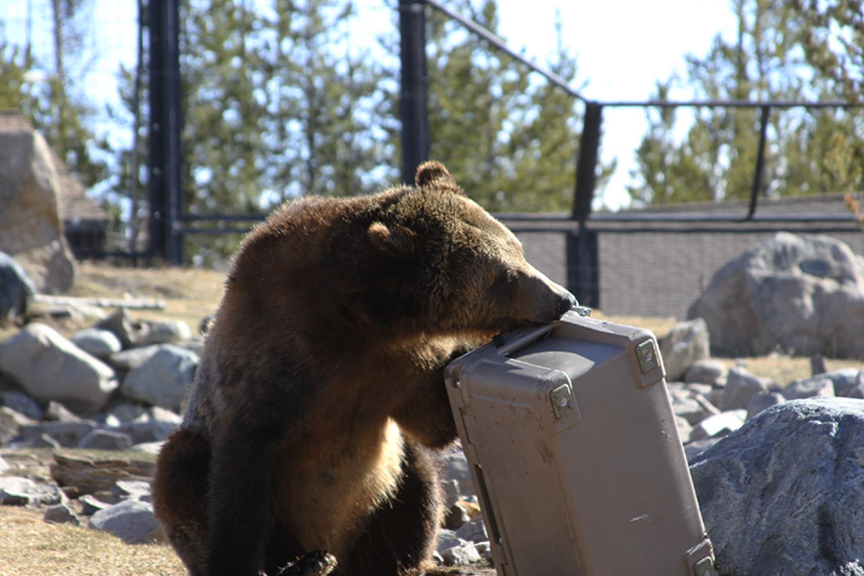
Suppose the immediate conflict is a grizzly repeatedly opening household garbage. A bear-resistant container directly addresses access to that garbage. It must be closed correctly, have enough capacity, and be emptied before waste accumulates beside it. The photograph below shows why the relevant test is what a bear can actually get into, not whether a container merely looks sturdy.
If instead a bear is taking poultry, a household garbage bin does little for the animals left outside. A properly installed electric fence around the enclosure addresses that access route. It presents a deterrent at the boundary, before the bear reaches the food. The diagram shows the basic circuit; it is an explanation of the principle, not an installation specification.

How To Install an Electric Fence to Prevent Bear Conflicts
Watch “How To Install an Electric Fence to Prevent Bear Conflicts” from Defenders of Wildlife for the parts that explain the components and why wire placement must account for how a bear investigates a barrier.
Watch the components, including the energizer, insulators, tester, and ground rod. Then watch wire placement and the explanation of deterring a bear before it gains food. Treat the video as an illustration of the mechanism, not a substitute for site-specific installation guidance or local electrical requirements.
The field report compares bins, fencing, and bear spray in the same community. Notice that these tools act at different points in a conflict: a bin denies access to waste, a fence protects a bounded food source, and spray is a last-resort deterrent for a close encounter—not a way to secure a yard.
Meadow Creek Bear Education and Management Project ...
Return to the field report for its assessment of three practical tools, including the effort and expense that can determine whether residents can keep using them.
Under “Education and coexistence,” on printed pp. 28–29, start at the “Bear resistant bins” subsection and read the tool comparison through “Electric fencing” and “Bear spray.” Pay particular attention to the cost of bins and the requirement to install and maintain fencing properly.
A measure is only as effective as its use over time. A bin that residents cannot afford or have no practical way to empty may cease to protect waste. A fence with a failed power supply or an accessible gate may cease to protect livestock. Cost-sharing, loans, collection services, and maintenance are therefore part of the coexistence measure—not merely details added afterward.
Keep a close encounter distinct from a food-storage problem
Some conflicts begin without an attractant at a residence. A person may surprise a grizzly at a carcass, near cubs, or along a route with poor visibility. Bear-resistant bins at homes do not prevent that particular meeting. Measures that reduce the chance of a surprise—such as remaining aware of surroundings and making your presence known while traveling in bear habitat—address a different cause. Carrying bear spray accessibly and knowing how to use it can provide a response if an encounter becomes dangerous, but it does not replace prevention and is not guaranteed to work.
Watch the prevention and deterrent portion of “Staying Safe in Bear Country” from the International Bear Association. Use it to distinguish practices that reduce the likelihood of an encounter from a tool used if one escalates.
Watch encounter prevention, focusing on avoiding surprise, noticing bear sign, and keeping food and waste inaccessible. Then watch deterrent limits, especially the need for accessible equipment, familiarity with its use, and the warning that deterrents are not fully reliable. Waste-disposal practices must also follow the rules of the place being visited.
This gives a useful way to compare proposals. If the conflict is repeated feeding at a poultry enclosure, safer travel practices for hikers will not remove the reward. If the conflict is people surprising a bear on a trail with no evidence of human food, fencing one household’s chickens will not address the encounter. Both proposals might be useful somewhere; neither is automatically the answer to every bear sighting.
Test the measure against ordinary failures
The hard part of coexistence is often not selecting a tool in principle, but keeping food inaccessible across a whole property or community. One unsecured site can continue rewarding bears even when neighboring sites are well managed.
The field report describes two revealing incidents during a period when spawning fish were scarce. At one residence, a loaned bear-resistant bin filled up and garbage accumulated; a later shed made the property look tidier but did not keep bears out. At another, poultry were left outside an electric-fenced enclosure. A fence installed after birds were killed deterred the bears at that enclosure on the following night’s camera footage. That observation supports a local, short-term result, not a claim that those bears would avoid all poultry thereafter.
Meadow Creek Bear Education and Management Project ...
Read these incidents as tests of the proposed measures under real constraints, rather than as examples of bears with a single fixed “temperament.”
In “Discussion 2015-16,” on printed pp. 23–25, begin with the paragraph describing two residences where bears accessed human-related foods. Read the garbage incident. Then, from the paragraph beginning with poultry left outdoors, read the poultry incident. Distinguish what the report directly documents, such as the camera observation, from its suspicions or reported rumours about later events.
The garbage incident shows why supplying a container without a feasible plan for emptying it may be insufficient. The poultry incident shows why installing a barrier after a food reward is obtained can still protect that site, but may be harder than preventing access in the first place. Neither justifies assuming that a bear seen near a home will inevitably seek human food.
Waste protection also has to extend beyond individual households. Garbage stored securely at home can become accessible at an overflowing collection point, an open dumpster, or a disposal site. A community plan must account for each place waste is held or transferred.
“Bear Smart” Community Program: Background Report - Gov.bc.ca
Read this government background report for the idea that waste management must remain bear-resistant throughout collection and disposal, not just at the first container.
In section 6.3, “Bear-Proof Waste Management System,” on printed pp. 27–29, read the waste chain. Then, under “Handling Residential Garbage,” locate “2. LARGE COMMUNITY DUMPSTERS” and read the transfer-site limitation. Focus on who must do what, and on how an open or overflowing container defeats an otherwise sound design.
The report is a planning document, not proof that one bin design suits every community. A shared container may solve a household storage problem but be difficult to reach or use; collection must be frequent enough to prevent overflow. Education can help people close lids and remove attractants, but information alone cannot compensate for an inaccessible disposal service. Likewise, fencing a landfill while leaving other food sources available can shift where bears look for food rather than end the conflict.
Judge both the proposed benefit and the evidence
A clear evaluation of a coexistence proposal has four parts:
- Specify the cause. Identify the food reward or encounter circumstance supported by the observations. Preserve uncertainty when the evidence does not establish one.
- Name the mechanism. Explain how the measure blocks access, changes an encounter, or reduces a particular risk.
- State the operating conditions and gaps. Include cost, correct use, maintenance, access for residents, other exposed attractants, and any natural food or habitat that bears still need.
- Define evidence of success. Look for sustained reductions in food access and harmful encounters, not just a bear’s absence from one camera frame.
For instance, a proposal to lend bear-resistant bins where grizzlies repeatedly obtain residential garbage has a plausible mechanism: denying a food reward. Its limitations include inadequate capacity, waste left beside full bins, and households that cannot transport or store garbage conveniently. Records of closed, usable bins and fewer documented garbage-access events over multiple seasons would provide more relevant evidence than a single week without a sighting. To assess population benefits, researchers would also need longer-term evidence about bear survival.
Interpret trends cautiously. Reports of conflicts can change with public reporting, natural food availability, and the number of bears present. A decline in complaints alone does not prove that a measure worked; in a slow-recovering population, it might even follow bear deaths. The strongest evaluation connects observations to the proposed mechanism while checking for other plausible explanations.
Conclusion
Effective coexistence begins with a specific cause, not a universal remedy. Bear-resistant waste systems target accessible garbage; maintained electric fencing can protect bounded attractants such as poultry; encounter-prevention practices and bear spray address a different kind of risk. Moving or deterring a bear without removing a continuing food reward may leave the conflict in place. Every proposal also depends on people being able to use and maintain it, and every claim of success needs evidence over an appropriate period.
This completes the course’s progression from grizzly biology and habitat to interpreting behavior and making conservation decisions. The central thread is that bears respond to seasonal opportunities in landscapes shared with people. Coexistence becomes more achievable when a measure changes the particular conditions that produce risk—while keeping both human safety and bear survival in view.