Hello! Welcome back to our module on the Plunge Bra.
In our previous lesson, we took a deep dive into the engineering of the plunge bra, examining how its low central gore and angled cups work together to provide support and create cleavage without spillage. You learned that the bra's effectiveness relies on a system of structural elements, including a tacking gore and prestressed cups with asymmetrical contours.
Today, we'll address a common point of confusion for both consumers and aspiring designers: the difference between a plunge bra and a push-up bra. While both can create cleavage, their design philosophies, structures, and intended functions are distinct. The learning outcome for this lesson is to differentiate the plunge bra from the push-up bra in terms of structure, silhouette, and intended use. Mastering this distinction is crucial for making deliberate design choices that align with a specific functional purpose.
1. A Tale of Two Bras: An Overview
At first glance, plunge and push-up bras seem to share a similar goal: enhancing the bust. However, they achieve this through fundamentally different means. Let's start with a quick visual introduction to both styles.
Bras Styles Explained How to Choose The Best Bras For You | Bra Shapes, Styles & Bra Fit Explained
This video from Nicola Crook Online provides a concise overview of several bra styles. We'll watch the segments on the plunge bra and the push-up bra back-to-back to get a baseline understanding of their key features.
Please watch from 02:13 to 03:29. As you watch, pay close attention to the specific language used to describe how each bra creates its effect. Notice the mention of 'without any extra padding' for the plunge and 'added graduated padding' for the push-up.
This initial comparison highlights the single most important structural difference: padding. While a plunge bra's primary mechanism is its shape and construction, a push-up bra relies on adding volume through padding. Let's explore this and other differences in more detail.
2. Deconstructing the Designs: Structure
The most significant differences between these two styles lie in their internal architecture—specifically the gore, cups, and use of padding.
To get a comprehensive overview, let's turn to an article that directly compares the two.
Plunge Bras vs. Push-Up Bras: Understanding the Difference
The article 'Plunge Bras vs. Push-Up Bras' from Joy Bra is an excellent resource that breaks down the key distinctions. We'll use it to guide our analysis.
Please read the introduction and the sections titled 'The Plunge Bra: Embracing Depth and Cleavage' and 'The Push-Up Bra: Adding Lift and Volume'. Focus on how each bra's construction (gore, padding, design) contributes to its primary function.
Based on this reading, let's break down the structural differences:
Plunge Bra Structure:
- Central Gore: The defining feature is a very low and narrow central gore. This is an absolute requirement for its function.
- Underwire: The underwires are dramatically shorter at the center front to accommodate the low gore.
- Cups: The cups are angled inward to push the breasts together from the sides, creating cleavage through positioning.
- Padding: Padding is minimal or non-existent. The effect comes from the bra's cut and engineering, not from adding mass.
The image below shows the side-by-side difference, with the plunge bra on the right. Notice how low the purple bra's central gore is compared to the black push-up bra.

Push-Up Bra Structure:
- Central Gore: Can be low, but is generally higher than a plunge bra's. Its height is secondary to the cup construction.
- Underwire: Standard height or slightly lowered.
- Cups: The defining feature is graduated padding—foam or gel inserts that are thickest at the bottom and outer sides of the cup.
- Padding: This padding is the primary mechanism. It physically lifts the breast tissue up and pushes it inward, creating cleavage and volume through augmentation.
To better understand the specific structure of a plunge bra's neckline, let's look at another resource.
Is That Bra a Demi, Balconette, or Full Cup?
The 'Cloth Habit' blog offers excellent technical illustrations of bra construction. This section on the plunge bra clearly describes its unique wire and gore structure.
Please read the section titled 'The Plunge'. Pay attention to the description of 'dramatically shorter wires in the front' and the accompanying illustration. This reinforces the core structural identity of the plunge style.
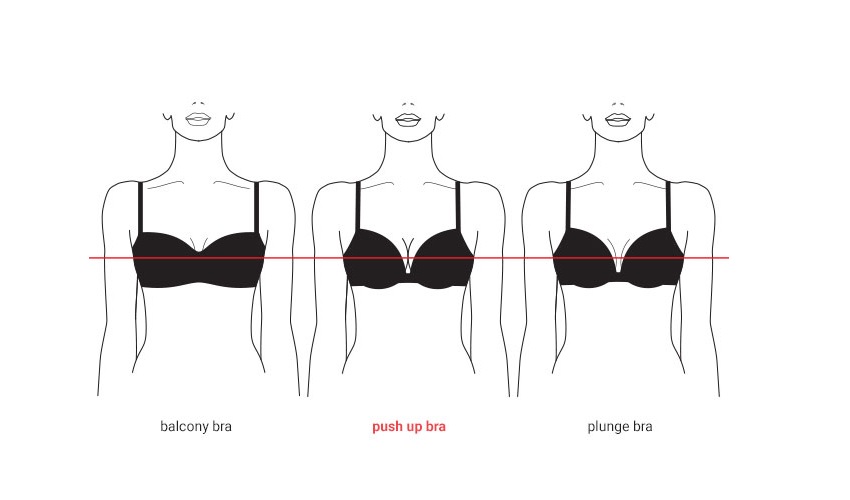
3. Shaping the Form: Silhouette
The structural differences directly lead to two distinct silhouettes. The choice between them depends entirely on the aesthetic effect the wearer or designer wants to achieve.
-
Plunge Silhouette: Creates a deep, defined cleavage, often described as a "canyon" or "V" shape. It works by separating and pushing the breasts inwards. The overall volume is more natural, as the bra primarily reshapes the existing breast tissue rather than adding to it. The silhouette accentuates the natural contours of the bust.
-
Push-Up Silhouette: Creates a lifted, rounded cleavage, often described as "mounded." It works by lifting the breasts from below and pushing them together, creating a visibly fuller and more prominent bustline. The silhouette is one of enhanced volume and a rounder, more dramatic shape.
4. Usability and Intended Use
Finally, let's connect structure and silhouette to usability—the "why" behind the design.
Plunge Bras vs. Push-Up Bras: Understanding the Difference
Let's return to the Joy Bra article to read its summary of the key differences, which connects directly to intended use.
Please read the section 'Key Differences: Plunge vs. Push-Up'. Focus on the 'Neckline Compatibility' and 'Lift vs. Enhancement' points.
-
Plunge Bra Intended Use: Its primary purpose is invisibility under low necklines. It is the solution for V-necks, wrap dresses, and any garment where a higher gore would be visible. Its cleavage-creating ability is a secondary benefit derived from this primary function.
-
Push-Up Bra Intended Use: Its primary purpose is volume enhancement and creating a lifted look. It is chosen specifically for the silhouette it creates. While it can be worn with some lower necklines, its main function is not stealth but aesthetic augmentation.
The Designer's Cheat Sheet
Your background in statistics gives you a great appreciation for structured data. Here is a table summarizing the key distinctions to help you internalize the differences.
| Feature | Plunge Bra | Push-Up Bra |
|---|---|---|
| Primary Goal | Invisibility under low necklines | Augmentation of volume and lift |
| Structure | ||
| Central Gore | Very low and narrow | Low to medium height |
| Cups | Angled; shaping via cut | Padded; shaping via volume addition |
| Padding | Minimal or none | Graduated padding (defining feature) |
| Cleavage Method | Pushes breasts inward (positioning) | Lifts breasts upward and inward (augmentation) |
| Silhouette | ||
| Cleavage Type | Deep 'V', natural separation | Rounded, 'mounded' lift |
| Volume | Natural, emphasizes existing contours | Enhanced, visibly larger and fuller |
| Intended Use | ||
| Best Garments | Deep V-necks, wrap fronts | Scoop necks, V-necks, or when seeking a fuller bust |
Conclusion
You can now confidently differentiate between a plunge bra and a push-up bra across the three critical domains of design: structure, silhouette, and intended use.
Key Takeaways:
- Structure: The plunge bra is defined by its very low gore and angled cups. The push-up bra is defined by its graduated padding.
- Silhouette: The plunge bra creates a natural, separated 'V' cleavage. The push-up creates a lifted, rounded cleavage with added volume.
- Intended Use: The plunge bra's primary purpose is functional—to remain hidden under deep necklines. The push-up bra's primary purpose is aesthetic—to enhance bust size and lift.
Next Up:
In the final lesson of this module, we will apply this knowledge in a practical design context. You will learn to propose suitable pairings for a plunge bra with both Western and Indian attire, solidifying your understanding of its role in a wardrobe.