Welcome to the first lesson of your course on bra design!
I'm excited to guide you through this journey. Given your background in design and interest in lingerie, we'll be able to build a strong technical and conceptual foundation for your creative work.
This first module, "Foundations: Usability, Aesthetics, and Support," establishes the core principles we'll use throughout the course. Today's lesson focuses on the first of these principles: usability.
Your goal for this lesson is to define 'usability' in bra design as the functional purpose of a specific style. We'll explore why different bra styles exist and what specific job each one is designed to do. This concept is the starting point for every design choice, from fabric selection to construction techniques.
What is 'Usability' in Bra Design?
In this course, when we talk about 'usability,' we are referring to the specific functional purpose a bra is designed to fulfill. It's not about general comfort or ease of use, but rather the answer to the question: "What problem is this bra solving for the wearer?"
Think of it this way: a toolbox contains many different tools. A hammer is for driving nails, and a wrench is for turning bolts. You wouldn't use a wrench to hammer a nail because it’s the wrong tool for the job. Each tool has a specific purpose.
Similarly, every bra style is a unique "tool" in a lingerie wardrobe. A plunge bra is the right tool for a low-cut dress, while a T-shirt bra is the right tool for a fitted knit top. Their usability lies in how well they perform that specific function.
Let's start with a quick visual overview of the variety that exists.
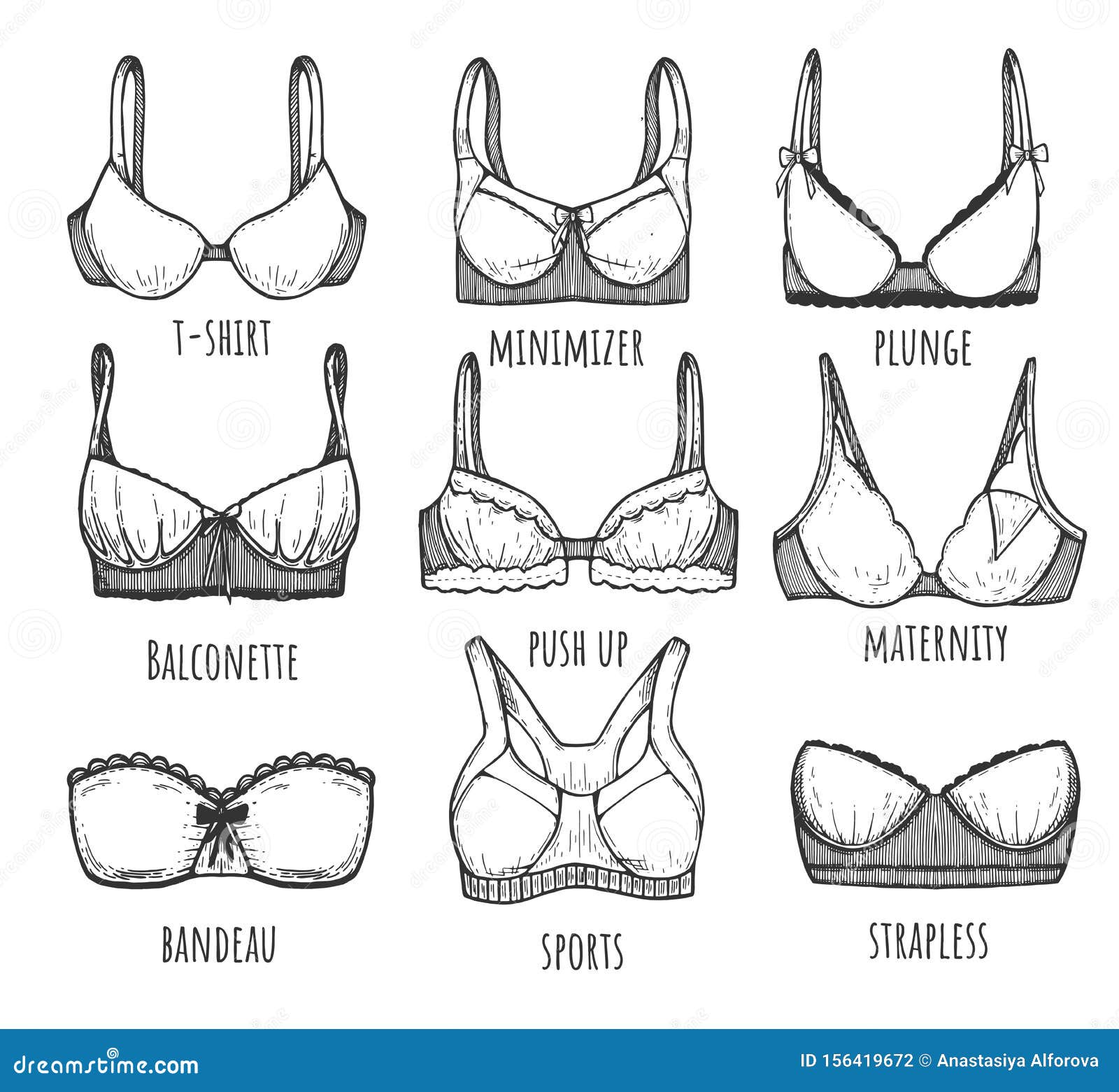
As you can see, there is a wide range of shapes and constructions. This diversity isn't random; each design was developed to offer a different combination of support, shape, coverage, and compatibility with specific types of clothing.
Over the next ~45 minutes, we will examine the specific functional purposes of several key bra styles, including the five that will be the focus of this course: the T-shirt bra, push-up bra, plunge bra, bandeau, and triangle bikini top.
The Functional Purpose of Key Bra Styles
Let's break down what some of these common styles are designed to do.
1. The T-Shirt Bra: The Goal of Invisibility
The T-shirt bra is perhaps the most common "everyday" bra. Its primary function is to be invisible under clothing.
- Functional Purpose: To create a perfectly smooth, rounded silhouette under close-fitting garments, with no visible seams, textures, or nipple show-through.
To understand how its construction achieves this, please read the first section of the following article.
13 Different Types of Bras and Bra Styles for Every Woman
The article '13 Different Types of Bras' from Bare Necessities clearly outlines the purpose of several key styles. We'll start with the T-shirt bra.
Please read section '1. T-Shirt Bras,' focusing on the 'What It Does' paragraph.
As the article notes, this seamless effect is typically achieved with smooth, molded cups. This construction ensures a consistent shape and is fundamental to the bra's purpose.
2. The Push-Up Bra: The Goal of Enhanced Volume and Cleavage
The push-up bra is designed for a very specific aesthetic effect: creating the appearance of a fuller bust.
- Functional Purpose: To lift the breasts upwards and push them towards the center, creating enhanced cleavage and a more voluminous profile.
This effect is achieved through strategic padding. The following video provides a clear explanation.
Bras Styles Explained How to Choose The Best Bras For You | Bra Shapes, Styles & Bra Fit Explained
In this clip from 'Bras Styles Explained' by Nicola Crook Online, the presenter explains exactly how a push-up bra achieves its function.
Please watch the segment from 02:54 to 03:29. Notice her explanation of 'graduated padding' and how it lifts the bust.
The key design element here is the graduated padding—thicker padding at the bottom and/or sides of the cup that displaces the breast tissue. This is a perfect example of a structural element directly serving a functional, aesthetic goal.
3. The Plunge Bra: The Goal of Compatibility with Low Necklines
At first glance, a plunge bra might seem similar to a push-up bra, as both can create cleavage. However, their primary purposes are different.
- Functional Purpose: To remain hidden under deep V-neck or scoop-neck tops and dresses while still offering support and separation.
The defining feature of a plunge bra is its very low and narrow central gore (the piece of fabric connecting the cups). The following video explains this style and others based on their cup shape and coverage.
Understanding bra types and styles
The video 'Understanding bra types and styles' provides a great overview of styles based on their shape. Pay close attention to the description of the plunge bra.
Watch the section from 00:40 to 01:28, which covers the full coverage and plunge styles. Note how the presenter contrasts the two by highlighting the height of the inner wire and the amount of coverage.
While a push-up bra's goal is volume, a plunge bra's goal is discretion under low necklines. Though it often provides cleavage as a byproduct, its main job is to disappear.
4. The Bandeau: The Goal of Strapless Coverage
The bandeau is one of the simplest bra forms, often resembling a tube of fabric. Its usability is tied directly to the absence of straps.
- Functional Purpose: To provide basic coverage for the bust without straps, making it suitable for strapless, off-the-shoulder, or thin-strapped garments.
Support is often a secondary concern for bandeaus, especially simpler, un-structured styles. The following article provides a concise definition.
13 Different Types of Bras and Bra Styles for Every Woman
Let's return to the Bare Necessities article to see how it defines the bandeau.
Please read section '7. Bandeau Bras,' focusing on the 'What It Does' and 'When To Wear It' paragraphs.
Later in the course, we will explore how features like silicone grips and side boning can be added to a bandeau to increase its support and stability, enhancing its usability.
5. The Triangle Bikini Top: The Goal of Minimal, Adjustable Coverage
Finally, let's look at a style you've worked with before: the triangle top. As swimwear, its purpose is driven more by aesthetics and activity than by the demands of daily clothing.
- Functional Purpose: To provide minimal and adjustable coverage, primarily for sunbathing and resort-style aesthetics. The focus is on achieving minimal tan lines and a classic beach look, rather than providing significant support.

The following reading explains the purpose of the triangle top in the context of other swimwear styles.
Understanding Bikini Tops - SwimOutlet.com
This article from SwimOutlet.com, 'Understanding Bikini Tops,' is a great resource for swimwear styles. It clearly defines the triangle top's purpose.
Please read the section titled 'Triangle Tops.' Notice how it emphasizes minimal support, adjustability, and the goal of minimal tan lines.
Check Your Understanding
To solidify this concept, let's do a quick matching exercise. Match the functional purpose on the left with the most appropriate bra style on the right.
| Functional Purpose | Bra Style |
|---|---|
| 1. Create a smooth look under a thin, fitted sweater. | A. Plunge Bra |
| 2. Provide coverage for an off-the-shoulder top. | B. Push-Up Bra |
| 3. Accommodate a dress with a very deep V-neckline. | C. Triangle Top |
| 4. Enhance volume and create maximum cleavage. | D. T-Shirt Bra |
| 5. Offer minimal, adjustable coverage for sunbathing. | E. Bandeau |
Click here to see the answers
1. **D. T-Shirt Bra:** Its core purpose is to be seamless and invisible.
2. **E. Bandeau:** Its strapless design is made for this type of garment.
3. **A. Plunge Bra:** Its low central gore is specifically designed for deep necklines.
4. **B. Push-Up Bra:** Its function is to create lift and volume through padding.
5. **C. Triangle Top:** It's designed for minimal coverage and adjustability, ideal for tanning.
Conclusion
In this lesson, we established the first core principle of our design framework: usability is the functional purpose of a bra style. We've seen that every style, from the T-shirt bra to the triangle top, is a purpose-built solution for a specific need—be it silhouette, clothing compatibility, or aesthetic effect.
Key Takeaways:
- Usability as Function: In bra design, 'usability' refers to what a bra is designed to do.
- Purpose-Driven Design: Each bra style exists to fulfill a specific function (e.g., invisibility, lift, coverage for certain necklines).
- Structure Follows Function: A bra's key structural features, like molded cups in a T-shirt bra or a low gore in a plunge bra, are direct results of its intended purpose.
Understanding a bra's core purpose is the essential first step in the design process. In our next lesson, we will explore the second foundational pillar: aesthetics, and how visual elements like shape, color, and texture are used to create beauty and appeal.