Welcome back! In our last lesson, we explored the crucial numerical relationships in bra sizing, understanding how band and cup sizes work together and how sister sizing allows for flexibility in fitting. We saw that for a size like 34C, the "34" band must provide a firm, stable foundation. However, that foundation can only function correctly if it's made from the right materials—ones that can stretch to fit the body snugly but also recover their shape to maintain support.
This brings us to the core of our new module, "Material Science for Lingerie." Today's lesson directly addresses the learning outcome: Classify common bra fabrics by their functional properties (e.g., stretch, recovery, breathability). By the end of this hour, you will have a systematic framework for understanding and categorizing the materials that are the building blocks of any bra design.
Fabric Fundamentals: Fiber and Construction
Before we can classify fabrics, it's helpful to understand what gives a fabric its unique character. A fabric's properties are determined by two fundamental elements:
- Fiber: The raw material or "ingredient" (e.g., cotton, nylon, spandex).
- Construction: The method used to turn those fibers into a sheet of fabric (e.g., weaving, knitting).
Think of it as baking: the same ingredients (fibers) can produce vastly different results depending on the recipe and cooking method (construction).
To get a clear overview of these foundational concepts, let's watch a short video.
Learning About Fabrics 1: The Who, What, and How
This video from fashion educator Zoe Hong provides an excellent primer on the basics of textiles. It clearly distinguishes between fiber and construction, which is the essential first step in understanding why fabrics behave the way they do.
Please watch from 01:40 to 02:53 to understand the difference between fiber and fabric. Then, watch from 22:21 to 25:05, which introduces the main fabric construction categories: wovens and knits. Pay close attention to the structural difference between them (interlaced vs. looped yarns).
As the video explained, the most critical distinction for lingerie design is between wovens and knits:
- Wovens have a grid-like structure (like a basket weave) and are generally stable with no stretch, unless they contain elastic fibers.
- Knits are made of interlocking loops (like a sweater) and have inherent stretch.
This structural difference is the primary reason why different fabrics are chosen for different parts of a bra.
Key Functional Properties for Bra Fabrics
When selecting a fabric for a bra, we are less concerned with its name and more with its performance. Given your background in statistics, you can think of these properties as the key variables we need to measure and control.
Let's read a short guide that outlines these properties.
Choosing the right lingerie fabrics
The article 'Choosing the right lingerie fabrics' from Seamwork magazine provides a concise overview of the most important functional properties to consider when selecting fabrics for lingerie.
Please read the first four sections, titled 'Stretch', 'Weight', 'Look', and 'Feel'. Then, read the section 'How to shop', focusing on the paragraphs about testing stretch percentage and recovery. This will provide a practical understanding of these key properties.
Based on that reading, here are the critical functional properties for bra design:
- Stretch: The fabric's ability to elongate under tension. This can be 2-way stretch (stretches in one direction, usually cross-grain) or 4-way stretch (stretches both crosswise and lengthwise).
- Recovery: The fabric's ability to return to its original size and shape after being stretched. This is vital for a bra band, which would otherwise become loose and unsupportive over time.
- Rigidity/Stability: This refers to a lack of stretch. Rigid fabrics are essential for providing support and structure in components like the bra's frame (cradle) and in non-stretch cups.
- Breathability: The ability of a fabric to allow air and water vapor to pass through it. This is crucial for comfort, especially in bras intended for daily or long-term wear.
- Moisture-Wicking: The ability to pull moisture (like sweat) away from the skin to the fabric's outer surface, where it can evaporate. This is a key feature of technical and sports fabrics.
- Weight: Measured in grams per square meter (GSM) or denier. Lighter fabrics add less bulk under clothing, while heavier fabrics often provide more structure and opacity.
The process of testing these properties can be quite scientific, using specialized equipment to ensure consistency and quality control in manufacturing.

A Classification of Common Bra Fabrics
Now, let's put this all together and classify common bra-making fabrics by their properties and their typical use in a bra. The following video gives an excellent visual tour of these materials.
What Fabrics Do I Use to Make a Bra? | EmeraldErin
In this video, 'What Fabrics Do I Use to Make a Bra?', lingerie-making expert Erin of Emerald Erin Sews categorizes fabrics based on which part of the bra they are used for—cups, cradle, and band. This practical approach is perfect for a designer.
Please watch the video from 01:38 to 04:33. Notice how she groups fabrics by their function and discusses their properties like stretch, support, and sheerness in that context.
Building on the video and our other resources, we can organize these fabrics into a classification table. This table summarizes the key materials, their primary application in a bra, and their defining functional properties.
| Fabric Name | Primary Bra Component | Key Functional Properties | Common Fiber(s) |
|---|---|---|---|
| Powernet/Power Mesh | Band, Back Wings | Firm 4-way stretch, excellent recovery, good breathability. | Nylon, Spandex |
| Duoplex | Cups, Frame/Cradle | Very low stretch (stable), supportive, opaque, smooth finish. | Polyester |
| Sheer Cup Lining | Cup Lining, Frame | No stretch (rigid), very strong for its weight, sheer. | Nylon |
| Nylon Tricot | Cup Lining | Low stretch (stable), smooth, durable, thin. | Nylon |
| Stretch Lace | Decorative Overlays, Cups, Bands | Varies in stretch/recovery; provides shape and aesthetic appeal. | Nylon, Spandex, Rayon |
| Cotton/Bamboo Jersey | Comfort Bras, Bralettes, Linings | Soft, very breathable, absorbent, comfortable stretch; poor recovery. | Cotton, Bamboo, Spandex |
| Foam Padding | Molded Cups, Lining | Provides shape, smooth silhouette, and modesty. It is a material, not a fabric. | Polyurethane |
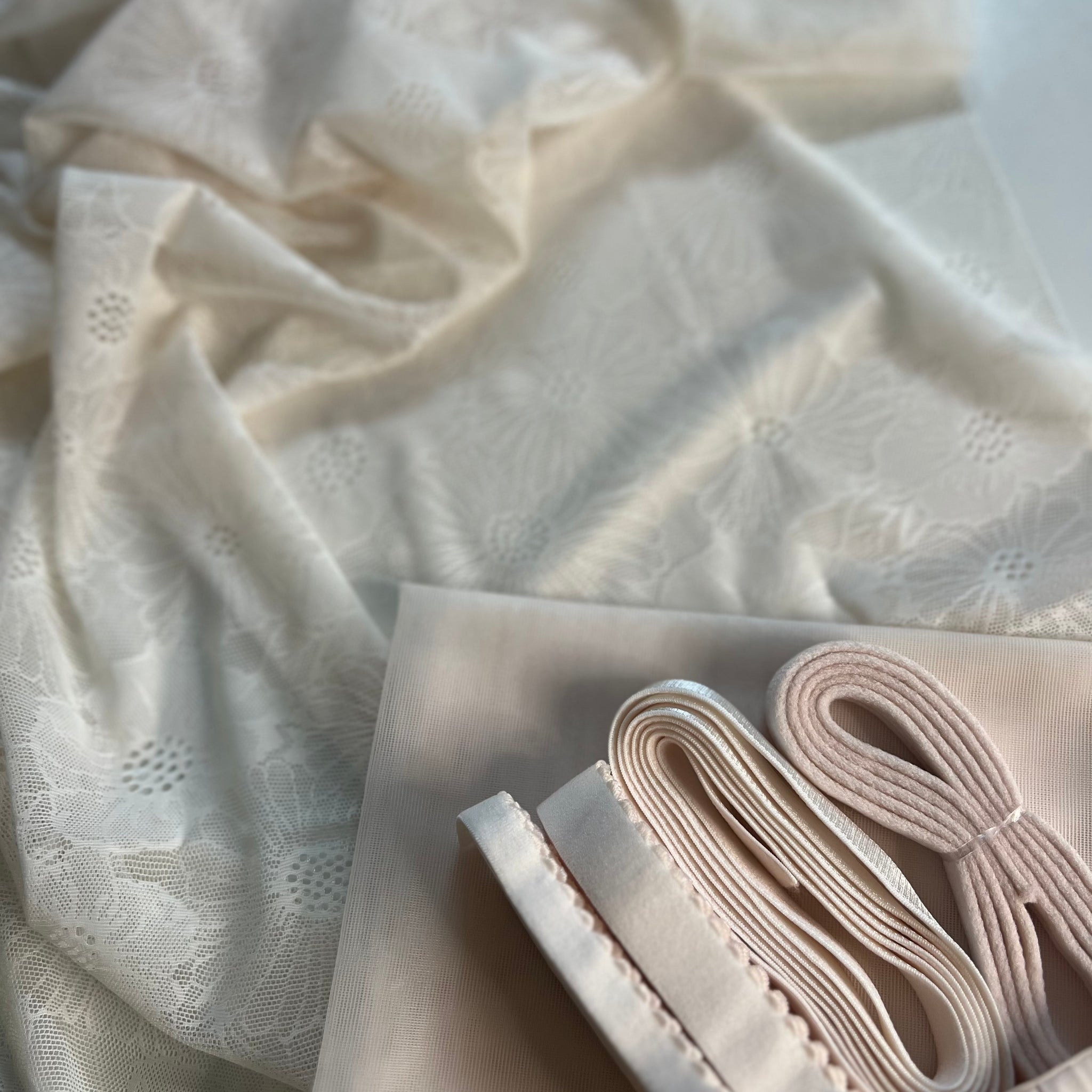
For a deeper dive into each of these material types, the following articles provide extensive detail. You can use them as a reference now or in the future.
- "Choosing the right lingerie fabrics" (LINK): The sections "Types of Fabric - Fibers," "Knit fabrics," and "Woven fabrics" give detailed descriptions of everything from spandex and silk to simplex and satin.
- "Bra Material Selection: A Comprehensive Guide" (LINK): This guide is organized by bra part, offering specific material suggestions for cups, linings, padding, and bands, aligning perfectly with a designer's thought process.
Conclusion
In this lesson, we moved from the abstract structure of a bra to the tangible materials used to create it. You learned how to classify fabrics not just by their names, but by their performance characteristics—the very properties that make a bra functional.
Key Takeaways:
- A fabric's properties are determined by its fiber content and its construction (knit, woven, etc.).
- The most important functional properties in bra design are stretch, recovery, rigidity, breathability, and weight.
- Fabrics are chosen for specific bra components based on their functional role:
- Bands require materials with excellent stretch and recovery, like Powernet.
- Supportive Cups and Frames require stable or rigid materials, like Duoplex or Sheer Cup Lining.
- Comfort-focused styles use soft, breathable materials like Cotton Jersey.
You now have a foundational vocabulary to describe and select materials. In our next lesson, we will answer the question: "How does fabric choice impact the support, shape, and aesthetic of a bra?" We will connect the properties we've defined today to the specific design goals you'll have for your future creations.