Hello! Welcome to the third lesson in our foundational module.
In the previous two lessons, we established the groundwork for two of your potential project paths. We started by defining flaky tests and their impact on CI/CD pipelines, then we delved into technical debt and the various indicators used to identify it in a codebase.
Today, we turn our attention to the third and final project direction: test case generation. You're familiar with test automation from your experience with Selenium, which focuses on executing pre-written scripts. This lesson explores a paradigm shift where machine learning automates the creation of those tests in the first place.
By the end of this lesson, you will be able to:
- Describe how ML-based test case generation differs from traditional methods.
This will complete our foundational overview of the three project areas, setting you up to make a more informed decision about which path to pursue.
The Test Creation Bottleneck
Before we dive in, let's frame the problem. In modern, fast-paced development environments, a common challenge is that the creation of thorough test suites can't keep pace with the rate of new feature development. Manually writing and maintaining test scripts is a significant investment of time and specialized skill, often leading to testing backlogs and incomplete test coverage. This is the "test creation bottleneck" that ML-based approaches aim to solve.
What is Traditional Testing?
First, let's establish a clear baseline. When we talk about "traditional testing," we're referring to a spectrum that includes both purely manual testing and script-based automation, which you've practiced with tools like Selenium and Cucumber.
To formalize this, please read the following section from an article by OwlityAI. It provides a concise overview of the traditional paradigm.
AI testing vs Traditional testing: Complete comparison guide
This article provides a solid definition of traditional software quality assurance, covering its history, key features, and limitations.
Please read the section 'Understanding traditional testing'. Focus on its key features (like reliance on human expertise) and, more importantly, its limitations (being time-consuming, facing scalability issues, and susceptibility to human error).
As the article highlights, while traditional methods benefit from human intuition, they suffer from several major drawbacks:
- Time-Consuming: Manual execution is slow, and writing automation scripts requires significant engineering effort.
- High Maintenance: Scripts are brittle. When the application's UI or underlying code changes, test scripts often break and require manual updates.
- Scalability Issues: As an application grows, the effort required to maintain comprehensive test coverage increases exponentially.
- Human Error: Repetitive tasks can lead to oversights, and different testers might execute tests with subtle inconsistencies.
The Rise of ML-Based Test Case Generation
ML-based test generation represents a fundamental shift. Instead of a human manually scripting every step and assertion, an AI model analyzes the application and its requirements to generate tests autonomously.
So, how does an AI actually do this? The process involves several interconnected capabilities.
A Practical Guide to AI Test Case Generation for QA
This article from VirtuosoQA provides an excellent breakdown of the mechanics behind AI-powered test generation.
Read the section 'How AI Generates Tests'. Pay close attention to the five capabilities it describes, from 'Application analysis' to 'Edge case synthesis'. This gives a clear picture of what the AI is actually doing under the hood.
To summarize those key capabilities, the AI:
- Analyzes the Application: It inspects the UI, identifies elements, and builds a model of user flows and business logic.
- Interprets Requirements: Using Natural Language Processing (NLP), it can read user stories or specifications to understand the intent of a test.
- Recognizes Patterns: It identifies common workflows like login processes, searches, or e-commerce checkouts to apply proven testing strategies.
- Generates Assertions: It automatically creates validation steps, like verifying that a shopping cart total is calculated correctly.
- Synthesizes Edge Cases: It intelligently produces tests for boundary conditions and error scenarios that a human tester might overlook.
From Theory to Practice
Let's see what this looks like in action. The following video clips demonstrate an "Agentic AI" tool for software testing. This is a form of AI that is given a goal and can autonomously plan and execute the steps to achieve it.
This first clip shows the agent generating tests from a simple requirements document.
Agentic AI for Software Testing By ContextQA - Naveen Automation Labs
This demonstration from a Naveen AutomationLabs video shows how an AI agent can ingest requirements and interactively generate tests.
Watch from 16:23 to 23:35. Notice how the agent reads an Excel file with requirements and then asks clarifying questions to handle missing information (like the application URL and user credentials) before generating the test cases.
The true power of this approach becomes apparent when the AI has even less information to start with. The next clip shows the agent generating tests by autonomously "crawling" an application, given only a URL and a high-level goal.
Agentic AI for Software Testing By ContextQA - Naveen Automation Labs
This next clip demonstrates the agent's ability to operate with even less initial information, a key differentiator from traditional scripted automation.
Watch from 23:58 to 28:50. The key takeaway is how the AI explores the application on its own to understand the context and build a 'knowledge graph' to fulfill the testing goal, without explicit step-by-step instructions.
This ability to autonomously explore and learn the application is a core difference from traditional automation, where every interaction must be explicitly scripted.
Head-to-Head Comparison
Now that we've seen both approaches, let's formalize the comparison.
AI testing vs Traditional testing: Complete comparison guide
The OwlityAI article we looked at earlier contains a very useful head-to-head comparison table that summarises the key differences.
Study the 'AI testing vs Traditional testing: Head-to-head comparison' table. Focus on how the two methods stack up on parameters like Speed, Adaptability, Accuracy, and Human Involvement.
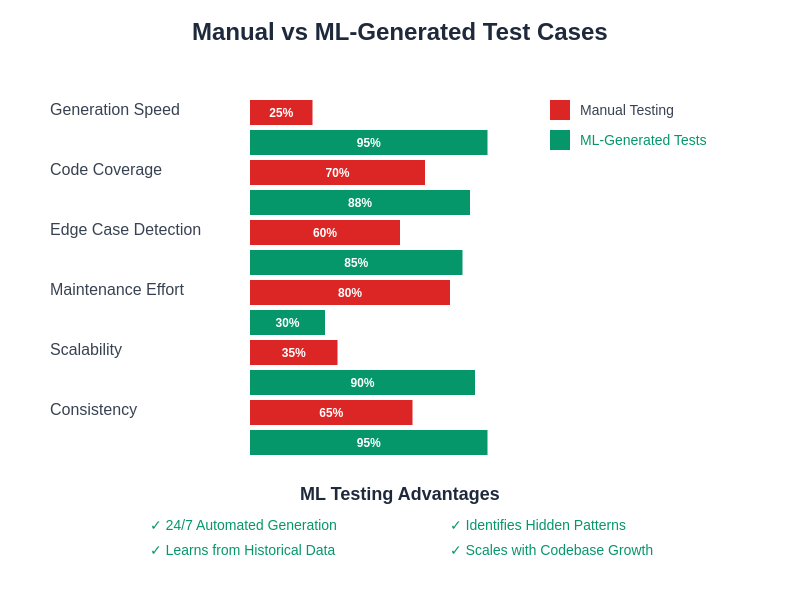
This chart provides a great visual summary of these points, highlighting the performance gap between manual/traditional methods and ML-driven generation.
The core technologies that enable these advantages are:
- Machine Learning & Computer Vision: To analyze the application's UI, identify elements, and adapt to changes (the basis for "self-healing" tests).
- Natural Language Processing (NLP): To interpret requirements from plain text.
- Generative AI & LLMs: To synthesize novel test scenarios, generate realistic test data, and even write test code from natural language prompts.
The Evolving Role of the QA Engineer
This technological shift naturally raises a question: what does this mean for the role of a QA professional? Rather than making the role obsolete, it elevates it. The focus shifts from repetitive, manual scripting to higher-level strategic work.
Agentic AI for Software Testing By ContextQA - Naveen Automation Labs
This final clip from the Naveen AutomationLabs video touches on how the QA role changes in a world with AI agents.
Watch the segment from 57:22 to 58:18. It frames the shift from being a test script author to becoming a director and validator of AI-driven testing efforts.
In this new paradigm, the QA engineer becomes an "augmented tester" whose responsibilities include:
- Defining the high-level testing strategy and goals for the AI.
- Validating the quality and relevance of the AI-generated tests.
- Focusing on complex, exploratory testing where human creativity and domain knowledge are most valuable.
- Analyzing the results from AI-driven test runs to identify risk areas.
Conclusion
In this lesson, we've contrasted traditional test creation with modern, ML-driven approaches. This completes our initial exploration of the three potential project areas.
Key Takeaways:
- Traditional testing (manual and script-based) is powerful but creates a bottleneck due to its time-consuming and high-maintenance nature.
- ML-based generation automates the creation of tests, not just their execution. It does this by analyzing applications and interpreting requirements.
- The key differences are that ML-based methods offer greater speed, broader test coverage (especially for edge cases), and significantly lower maintenance effort due to self-healing capabilities.
- This shift is powered by technologies like NLP, Computer Vision, and LLMs, and it elevates the role of the QA professional toward strategy and oversight.
Preview of the Next Lesson:
We have now covered the foundations for flaky tests, technical debt, and test generation. In our next lesson, we will synthesize this knowledge by framing each of these challenges as a specific type of machine learning problem: classification, ranking, and generation. This formalization will be a crucial step in helping you compare the three project directions and decide which one you're most excited to build.