Welcome to the final lesson of our first module, "Foundations of Data Analytics." In our last session, we walked through the data analytics lifecycle, noting that one of the most critical and time-consuming stages is data preparation. This stage is where we confront the messy reality of raw data and work to make it trustworthy.
This lesson dives deep into that very concept: data quality. We will address the principle of "garbage in, garbage out" by defining the specific characteristics that make data reliable and fit for analysis. For you, aiming for a Business Intelligence role in finance, mastering these concepts is non-negotiable. Financial reporting, forecasting, and risk assessment are all built on the assumption that the underlying data is sound. Understanding data quality provides the theoretical foundation for ensuring that assumption holds true.
By the end of this lesson, you will be able to explain the four key dimensions of data quality: accuracy, completeness, consistency, and timeliness.
What Makes Data "Good"?
Before we can analyze data, we must be confident in its quality. But what does "data quality" actually mean? It isn't a single, absolute measure. Instead, it refers to the data's fitness for a specific purpose. Data that is perfectly adequate for one task might be entirely unsuitable for another.
For example, a marketing team analyzing regional sales trends might be satisfied with aggregated, slightly rounded sales figures. However, the finance department, responsible for official revenue reporting, would require transaction-level data that is accurate to the penny. The quality of the data is relative to the user's needs.
The following article offers a clear definition of data quality and its business implications, especially in a financial context.
Financial Decision Data Quality: Reduce Business Risks
This article from TKXEL frames data quality as a core business concern, not just a technical one. It provides an excellent high-level perspective before we dive into the specific dimensions.
Please read the first few sections of the article. Start with the introduction to understand how quality issues arise, then read the section "What Data Quality Really Means" for a concise definition.
As the article states, high-quality data is "accurate, complete, consistent, and timely enough to support confident decision-making." These four terms represent the core dimensions of data quality that we will now explore in detail.
The Core Dimensions of Data Quality
While experts sometimes discuss many different facets of data quality, they almost always start with a core set. The diagram below illustrates several common dimensions, including the four we will focus on.
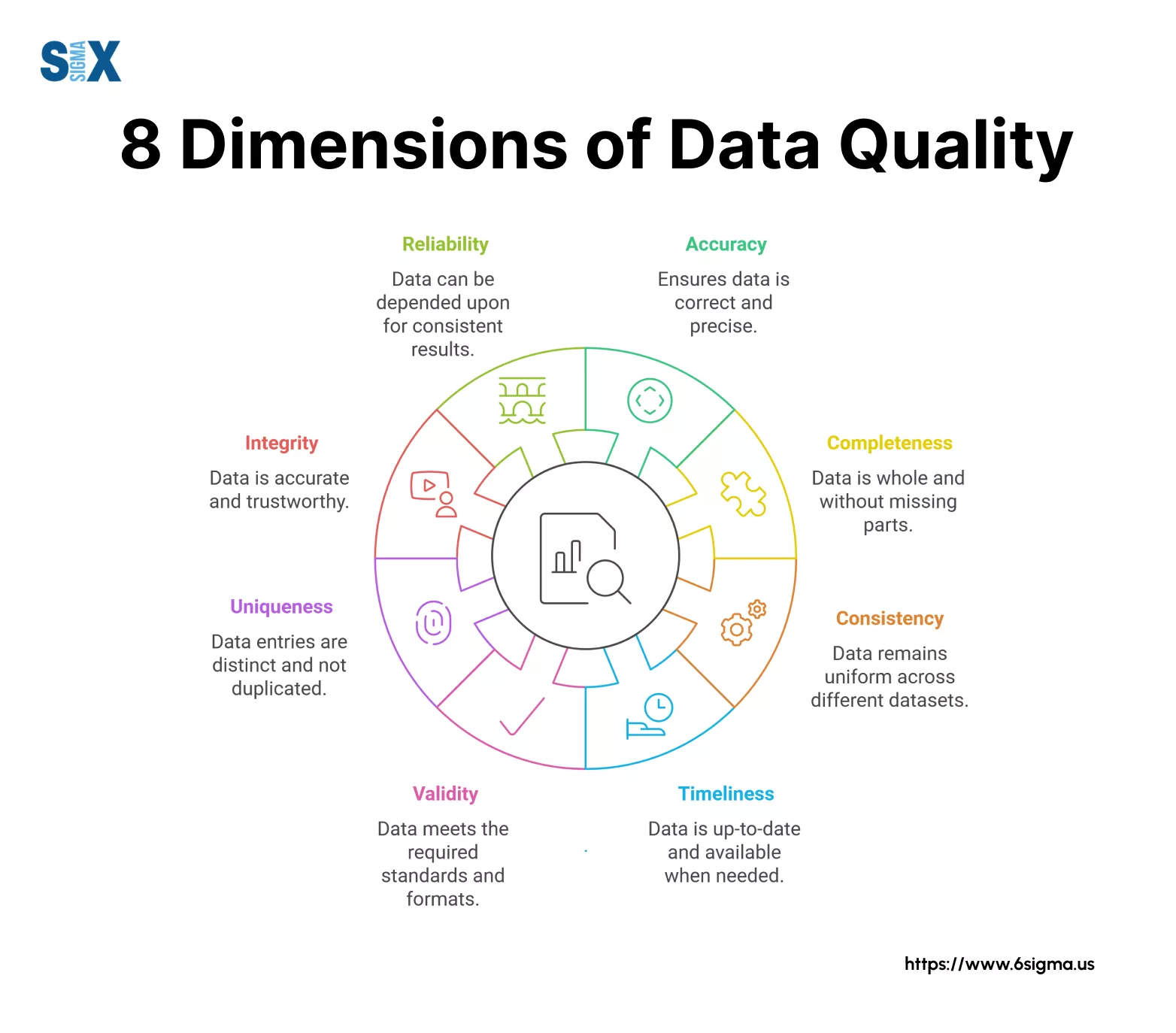
Let's dissect each of these four fundamental dimensions. For a detailed exploration, we'll turn to a comprehensive guide from iceDQ that breaks down each concept with practical examples.
6 Data Quality Dimensions: Complete Guide with ...
This guide provides in-depth explanations and examples for the core data quality dimensions. Since you prefer a thorough, theory-first approach, this resource will give you the detailed definitions you need.
As you read, focus on the sections for the four key dimensions covered in this lesson: Accuracy: Start by reading the definition under the heading "What is Accuracy...". Note the examples of comparing data to the physical world or a trusted reference source. Completeness: Read the definition and the examples under the "Completeness" section. Pay attention to the different types of incompleteness, such as missing records versus null attributes. Consistency: Under the "Consistency" heading, read the definition and review the examples, particularly "Record level data consistency" and "Data consistency between two subject areas." Timeliness: Finally, read the definition and examples in the section "What is Timeliness...". The distinction between data being late versus being outdated is important here.
To reinforce these concepts with different examples, the following short video from DataMuscle provides a concise summary of each dimension.
How to Measure Data Quality? 📏 | Key Data Quality Dimensions 📊
This video offers clear, quick definitions that complement the detailed reading.
Watch the segments that cover our four main dimensions: Accuracy Completeness Consistency Timeliness
Let's summarize these four critical dimensions:
1. Accuracy
Accuracy is the degree to which data correctly reflects the real-world object or event it describes.
- Why it matters: Inaccurate data leads to flawed analysis and bad decisions. Imagine calculating a company's profitability based on incorrect cost data or trying to contact a client using the wrong phone number.
- Financial Example: A company's quarterly earnings report states a revenue of $10.5 million. Accuracy means this figure is the true, verifiable sum of all sales transactions for that period. An inaccurate report could mislead investors and regulators.
2. Completeness
Completeness refers to the extent to which all required data is present. It checks for missing records or empty fields.
- Why it matters: Incomplete data can skew analysis or make certain tasks impossible. If a significant number of customer records are missing email addresses, an email marketing campaign becomes ineffective.
- Financial Example: A dataset used for credit risk assessment is incomplete if it's missing the
annual_incomefield for 30% of applicants. Any model built on this data would be unreliable.
3. Consistency
Consistency means that data is uniform and free from contradiction, especially when it exists in multiple places. The same piece of information should be the same across all systems.
- Why it matters: Inconsistent data erodes trust. If the sales team's dashboard shows different monthly revenue figures than the finance team's report for the same period, which one is correct? This leads to time wasted on reconciliation instead of analysis.
- Financial Example: An employee's salary is listed as $75,000 in the HR system but $72,000 in the payroll system. This inconsistency creates an obvious operational and financial problem.
4. Timeliness
Timeliness means that the data is available when it is needed. It measures the delay between when an event happens in the real world and when that event is recorded and accessible in a system.
- Why it matters: Outdated data can lead to missed opportunities or incorrect actions. Making stock trading decisions based on yesterday's prices would be a recipe for disaster.
- Financial Example: A company's budget variance analysis requires actual spending data for the month of March. If that data is only available on April 20th, it is not timely enough for managers to take corrective action within the first quarter.
The Financial Cost of Poor Data Quality
For an analyst in the finance industry, these dimensions are not abstract concepts; they have a direct and material impact on business outcomes. Poor data quality introduces risk, creates operational drag, and ultimately costs money.
The article we looked at earlier, "Financial Decision Data Quality," elaborates on these risks.
Financial Decision Data Quality: Reduce Business Risks
This section connects the dimensions of data quality directly to business performance, highlighting the tangible costs and strategic risks that are particularly relevant in a financial context.
Please read the sections titled "Financial Impact of Bad Data" and "Strategic Risks to Financial Decisions". Think about how these issues could manifest in a BI role.
As the article highlights, issues with accuracy, completeness, consistency, or timeliness can distort forecasts, weaken cost controls, and skew performance assessments. The result is an organization that may believe it is making data-driven decisions while in reality reacting to flawed signals.
A Glimpse at Other Dimensions
While the four dimensions we've covered are the most fundamental, you may also encounter others. To give you a more complete picture, here are a few more:
- Uniqueness: Ensures there are no duplicate records in a dataset. For example, a customer should only be listed once in a customer database.
- Validity: Confirms that data conforms to a specific format or follows business rules. For instance, a valid email address must contain an "@" symbol, and an order delivery date must occur after the order placement date.
- Integrity: Refers to the validity of relationships between data elements and datasets. For example, in a database of sales orders, every
order_idin theorder_detailstable must correspond to a validorder_idin theorderstable.
You will see these concepts in action as we begin working with data in the upcoming modules.
Conclusion
This lesson completes our foundational module by establishing the importance of data quality. Without trustworthy data, even the most sophisticated analysis is worthless.
Key Takeaways:
- Data quality is about "fitness for purpose" and is relative to the specific business need.
- Accuracy ensures data reflects reality.
- Completeness ensures no critical data is missing.
- Consistency ensures data is not contradictory across different systems.
- Timeliness ensures data is up-to-date and available when needed.
- Poor data quality has direct financial and strategic consequences, undermining decision-making and increasing risk.
We have now covered the core theoretical concepts of data analytics. In the next module, we will move from theory to practice by opening our first tool: Microsoft Excel. You'll learn how to use sorting, filtering, and conditional formatting to explore datasets and begin identifying some of the very data quality issues we've discussed today.