Hello. The previous lesson explained why an isolated lapse of attention is not enough to establish ADHD: the broader pattern, developmental history, settings, and impact matter. This lesson adds another part of that picture. Attention difficulties can also arise from sleep problems, anxiety, depression, or learning difficulties—and these can coexist with ADHD.
The aim is not to identify a condition from a few clues. It is to use when difficulties began, where they appear, and what else is happening to understand why a professional might investigate more than one explanation.
Timing and context are clues, not verdicts
Imagine someone who has trouble concentrating at work. That observation leaves much unresolved. Did the difficulty appear after several weeks of poor sleep, or has it been evident since childhood? Is it strongest during feared situations, during a period of low mood, or when reading dense material? Does it also affect unrelated activities? Each detail changes what is worth exploring, but none settles a diagnosis by itself.
A useful distinction is between an alternative explanation, which may account for the attention difficulty without ADHD, and a coexisting difficulty, which adds to an ADHD pattern already present. The same person may have longstanding ADHD symptoms and become markedly more distracted during a period of anxiety or disrupted sleep.
The following short video introduces those overlaps. Treat its examples as reasons to investigate, not as rules for deciding which condition someone has.
Is it ADHD, anxiety, depression, or something else? A psychologist explains | Experts Answer
Watch “Is it ADHD, anxiety, depression, or something else? A psychologist explains” from Understood for examples of how similar-looking difficulties may arise together.
Watch anxiety and attention for the distinction between distraction by worry and broader attention difficulties; sleep difficulties for ways sleep and ADHD can affect each other; depression for an example of coexistence; and learning difficulties for the difference between disrupted studying and a specific learning disability. The physical signs of anxiety mentioned in the video are possible clues, not a reliable test for anxiety or ADHD.
Sleep: an easily missed contributor
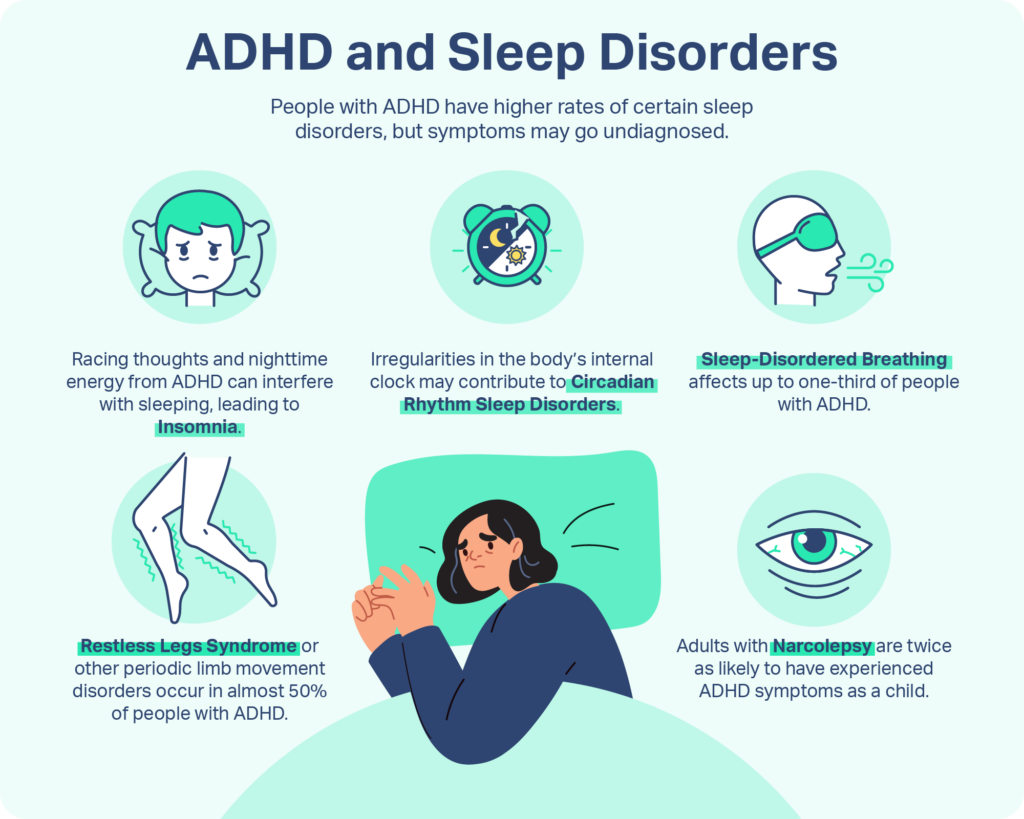
Insufficient or disrupted sleep can make sustained attention harder the next day. It can also affect activity and impulse control; in children, tiredness does not always look like quiet sleepiness. A pattern of late bedtimes followed by morning grogginess and poorer concentration therefore calls for attention to sleep, not an immediate conclusion about ADHD.
The relationship is not simply either–or. ADHD-related difficulties with routines or finishing tasks may delay bedtime. Anxiety may keep someone awake. A separate sleep disorder may interrupt sleep even when enough time is set aside for it. Sleep problems can mimic, worsen, or coexist with ADHD symptoms.
The American Academy of Pediatrics’ supplemental guidance gives concrete examples of what clinicians consider when a child’s apparent inattention may involve sleep or a learning difficulty. Its broader principle applies here: look for a problem that changes attention rather than assuming every lapse has the same source.
Read the “Sleep Disorders” and “Learning Disabilities” subsections for examples of alternative and coexisting explanations. This is clinical guidance about children and adolescents; focus on the reasoning rather than treating it as a way to assess yourself.
In “Sleep Disorders” (printed pp. 10–11), begin with “Sleepiness impairs most people’s ability to sustain attention.” Read the opening discussion through the examples of sleep disorders, noting the distinction between mimicry and worsening an existing difficulty. Later in that same subsection, find “For this reason, all children and adolescents who are evaluated for ADHD” and read the screening sentence through its examples of symptoms worth reporting. Then go to “Learning Disabilities” (printed p. 12). From “Learning disabilities frequently co-occur with ADHD,” read the opening paragraph through the example of a child disengaging because they cannot keep up.
The sleep examples show why context matters. Frequent snoring, observed pauses in breathing, restless sleep, or pronounced daytime sleepiness provide information that a simple report of “poor concentration” does not. A professional can decide whether a sleep assessment is warranted. Conversely, better attention after a good night’s sleep does not prove that sleep was the only difficulty: sleep affects attention in people with and without ADHD.
Anxiety and depression: what else changed?
Anxiety can occupy attention with worry or anticipation of a threat. Someone might repeatedly lose the thread of a meeting because they are preoccupied with how others will judge their contribution. The timing of the concentration problem—particularly whether it intensifies in feared situations—makes anxiety relevant to an evaluation. But the distinction is not absolute: someone with ADHD may also feel anxious about repeatedly missing deadlines, and the two conditions can occur together.
Depression can likewise affect concentration, often alongside changes such as persistently low mood or loss of interest, fatigue, and altered sleep. If attention deteriorates during the same period as those changes, depression deserves consideration. Depression need not be a consequence of ADHD, even though the conditions can coexist.
The previous lesson’s developmental perspective remains useful here. A newly pronounced concentration problem after a substantial change in mood is different evidence from a longstanding pattern that predates the mood change. Neither pattern permits a diagnosis from timing alone. Anxiety or depression can persist and affect multiple settings, while longstanding ADHD may still be present beneath a newer difficulty. A timeline helps a professional investigate both possibilities rather than forcing a choice too early.
Learning difficulties: attention to a task versus learning the material
Consider a student who seems inattentive during reading but remains engaged during spoken explanations and other activities. If decoding text is unusually difficult, apparent disengagement may reflect a specific learning difficulty rather than a general inability to pay attention. Difficulties with mathematics or written expression can raise similar questions within their respective tasks.
The reverse inference is also unsafe. ADHD can interfere with learning by disrupting attention during instruction, completion of assignments, or organization of work. A person can have both ADHD and a learning disability. The distinction matters because help with organizing assignments does not necessarily address a difficulty learning to read, and instruction targeted at reading does not necessarily address broader ADHD-related difficulties.
The most useful observation is therefore more precise than “does badly at school.” It describes which tasks are hard, how the person approaches them, and whether attention changes when the learning demand changes. In a professional evaluation, that pattern can indicate whether further educational or psychological assessment is appropriate.
Bringing the clues to an evaluation
Across these examples, timing and context help turn a vague concern into information a professional can use. A description might include:
- When it changed: longstanding difficulties, or a marked change after sleep disruption, mood symptoms, or another event.
- Where it occurs: broadly across activities, mainly in anxiety-provoking situations, or especially with reading or mathematics.
- What accompanies it: daytime sleepiness, worry, low mood, or difficulty mastering specific material.
- What it affects: missed work, disrupted learning, strained relationships, or other everyday functioning.
These details are not a scoring system. A sudden change does not automatically rule out previously unrecognized ADHD, and a childhood history does not rule out a current sleep or mental health problem. They help identify what deserves assessment, including the possibility of more than one condition.
Conclusion
Poor attention is a meaningful observation, but it does not reveal its cause on its own. Sleep disruption, anxiety, depression, and specific learning difficulties can produce ADHD-like problems, add to ADHD-related impairment, or both. Looking at onset, changes over time, task demands, accompanying symptoms, and daily impact makes the account more useful without turning it into a self-diagnosis.
In the next module, you will see how a professional assessment brings this kind of information together with developmental history and functioning across settings—and what conclusions that process can and cannot establish.