Welcome to the module on executive functions, persistent impairment, and overlapping difficulties. In the previous lesson, you saw how interest, task demands, and external structure can change performance without proving or disproving ADHD. This lesson looks more closely at the mental work involved in getting things done: beginning a task, keeping information in mind, pausing an impulse, and managing time.
By the end, you should be able to connect an everyday difficulty to the executive functions it may involve, while keeping an important distinction intact: an executive-function difficulty describes a pattern of performance; it does not, by itself, identify its cause or establish ADHD.
Executive functions help turn intentions into actions
Knowing what matters is not always enough to make it happen. A person might intend to pay a bill, understand the instructions, and have the money available, yet still need to notice the deadline, choose when to act, find the account details, stay with the task, and check that payment went through. Executive functions is an umbrella term for mental processes that help coordinate actions toward a goal.
The infographic below uses an air-traffic-control analogy: several demands compete for attention, and someone must keep track of what is happening, decide what needs priority, and prevent conflicting actions. It is a useful picture of coordination, not a claim that the mind has one literal “controller” or that every executive skill always rises and falls together.
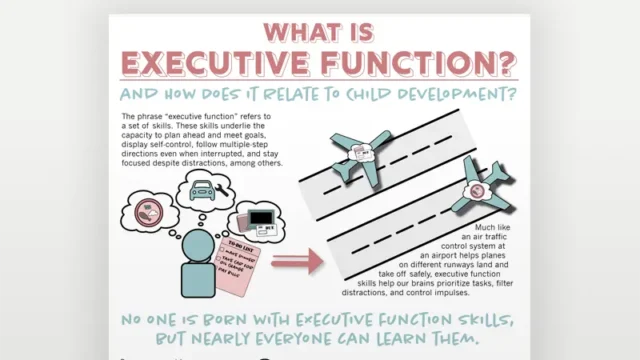
CHADD’s Executive Function Issues and ADHD gives a compact definition before describing what difficulties with these processes can look like. Read the passage under “Definitions and characteristics” to establish the vocabulary for the rest of the lesson.
Executive Function Issues and ADHD - CHADD
Read CHADD’s account of executive functioning as a set of processes used to pursue goals. Focus on the difference between having an intention and managing the attention, information, and actions needed to carry it out.
In “Definitions and characteristics,” find the paragraph beginning “The term executive functioning has gained popularity.” Read from its definition, goal-directed skills, through the following paragraph ending with “maintaining an orderly space.” Notice that the article groups several skills under one umbrella; it does not define one single ability called executive function.
That umbrella matters because the same visible result can have different points of difficulty. An unfinished form might reflect trouble choosing a first step, holding the instructions in mind, resisting interruptions, or allocating enough time. It might also reflect something else entirely, such as unclear instructions or missing information. Mapping a difficulty to an executive function is a way of asking what the activity required, not a way of reading a diagnosis from the result.
Four useful connections to everyday life
Dr. Tracey Marks’s What is Executive Function – How it Relates to ADHD illustrates several of these processes with ordinary tasks. Watch the selected portions for the distinctions among planning, starting, inhibiting a response, and working memory. The examples are illustrations, not rules that divide people neatly into those who have a difficulty and those who do not.
What is Executive Function - How it Relates to ADHD
Watch Dr. Tracey Marks’s explanation of executive-function skills for concrete examples to compare with the distinctions below.
Watch planning and time for estimating effort and setting priorities, then getting started for task initiation. Continue with self-inhibition for pausing a response. Skip ahead to working memory for holding and using information during an activity. Focus on what each process does rather than treating any example as a sign unique to ADHD.
Task initiation: crossing the starting line
Task initiation is the ability to move from intending to do something to taking its first workable action. Suppose a report is due next week. Someone understands its importance and plans to do it, but repeatedly sits down without opening the relevant files or deciding what the first paragraph needs to contain. The possible executive-function connection is not a lack of knowledge about the deadline; it is difficulty launching a task that requires several self-directed steps.
The distinction is especially useful when a task is vague. “Write the report” may conceal a series of decisions: locate notes, decide on an outline, check a figure, draft a section. Not knowing which step comes first can make starting harder. But delayed starts are not automatically executive dysfunction. Waiting for essential information, being exhausted, fearing a particular outcome, or simply choosing another priority can all produce delay. The observation worth keeping is specific: the task remained unstarted despite an intention to begin, and choosing or acting on a first step appeared difficult.
Working memory: keeping information active while using it
Working memory holds information briefly in a usable form while an activity is underway. Imagine reading a message that requests three changes to a document. While editing the first section, someone needs to retain the other two requests, compare them with what is already on the page, and return to them afterward. If the requests vanish from mind as attention shifts, the difficulty may involve working memory.
This differs from remembering something learned long ago. It also differs from every kind of everyday forgetting. Missing an appointment may involve noticing a cue at the right moment, tracking time, or having a reminder available; the missed appointment alone does not demonstrate a working-memory weakness. A stronger working-memory example shows the information being held and manipulated during a task—such as retaining a short instruction while carrying out its steps.
Inhibition: pausing or filtering a competing response
Inhibition helps a person hold back an immediate action or filter something that competes with the current goal. In conversation, this might mean waiting while another person finishes speaking, even though a thought feels urgent. During desk work, it might mean noticing a notification without immediately leaving the document to follow it. These examples involve somewhat different demands: restraint of an action in the first case and resistance to interference in the second.
This connection clarifies how an executive process can relate to an ADHD symptom without being identical to a diagnosis. Frequent interrupting can be an example of impulsive behavior; difficulty pausing a response is one possible process involved. Yet a single interruption may arise from excitement, a misunderstanding of the conversational turn, or an urgent need to clarify something. Describing the action and the possible process is more precise than assigning a cause from one moment.
Time management: coordinating several processes
Time management involves planning when to act, estimating how long activities will take, monitoring progress, and adjusting when a plan changes. Consider someone who leaves for an appointment at the stated start time despite intending to be punctual. They may have underestimated travel and preparation time, failed to check the clock while occupied, or postponed the transition from one activity to another.
“Poor time management” names the visible difficulty, but it is not a complete explanation. Planning, prioritizing, working memory, and monitoring progress may all contribute. The precise question for understanding the activity is whether the difficulty lay in making a realistic schedule, keeping the schedule in view, switching tasks when it was time, or something outside those processes, such as a changed bus route. Likewise, the informal term time blindness can describe an experience of losing track of time; it is not, on its own, a diagnosis or proof of a particular mechanism.
One missed task can involve several functions
Suppose a person needs to renew an important document online. They receive a reminder, intend to do it that evening, and nevertheless miss the deadline. It would be easy to call the entire episode “forgetfulness.” A closer account reveals several possible points where the task could have stalled.
They might remember the renewal but not begin because the first step—finding the required account details—is unclear. That points toward task initiation and planning. They might start, switch tabs to retrieve a reference number, and lose track of what the form asked for. That makes working memory relevant. They might repeatedly leave the form to respond to messages, making inhibition of distractions relevant. They might expect the process to take five minutes, start too late, and discover that identity verification needs extra time. That brings in time estimation and management.
These are possible mappings, not four conclusions about the person. The same missed deadline could result from a website outage, an unusually demanding week, anxiety about an official process, or a reminder that arrived while the person was unable to act. The value of the mapping is that it replaces the vague judgment “they failed to do something simple” with a more informative description of the demands and where completion became difficult.
It also connects to the previous lesson’s point about structure. A reminder sent at the moment someone can act may reduce the need to hold an intention for days. A form that clearly displays its next step may reduce the work of planning how to begin. Better performance with those supports shows that the demands changed. It does not establish that ADHD caused the original difficulty—or that the original difficulty was not real.
Executive-function difficulties are neither required in one form nor unique to ADHD
ADHD and executive-function difficulties overlap substantially, but they are not interchangeable terms. People with ADHD can have different profiles: one person may struggle conspicuously with starting open-ended tasks, another with inhibiting interruptions, and another may perform well on a particular activity when its structure supplies the needed cues. It would be a mistake to require every executive difficulty, at the same severity, in every person or situation.
The reverse mistake is to assume that a difficulty with starting, remembering, or managing time must indicate ADHD. Those functions can be affected by other conditions and by circumstances. CHADD’s discussion makes this boundary explicit and gives anxiety and depression as examples of experiences that can also make concentration or starting tasks difficult.
Executive Function Issues and ADHD - CHADD
Return to CHADD’s article for the distinction between describing executive-function difficulties and identifying their cause. Read its general caution, then its brief comparison with other possible explanations.
Immediately before “Definitions and characteristics,” find the paragraph beginning “It’s important to know that there are many reasons.” Read the distinction through the paragraph ending “they are not the same conditions.” Then, under “Do EF issues sound a lot like ADHD?”, read the comparison to the end of that subsection, just before “Treatment options for EF issues.” Focus on how a similar difficulty can have more than one explanation.
A useful description therefore has two layers. The first describes the observable pattern: “The person often loses the second and third instructions while carrying out the first,” or “Open-ended tasks are repeatedly started only when a deadline becomes immediate.” The second remains appropriately uncertain: working memory or initiation may be involved, but the pattern alone does not establish why it occurs. That restraint is not evasive; it preserves the information a professional assessment would need rather than compressing it into a premature label.
Conclusion
Executive functions help coordinate goal-directed activity. Task initiation concerns getting underway; working memory keeps information available for use; inhibition helps pause responses and resist interference; and time management draws on planning, estimation, and monitoring. An everyday task often requires several of these at once, so its outcome rarely reveals one isolated weakness.
The key boundary is that executive-function language describes how a difficulty may arise, not who has ADHD. The next lesson distinguishes core ADHD symptoms from related experiences, including emotional dysregulation and intense absorption sometimes called hyperfocus.