Hello! Welcome to the next lesson in your journey to mastering backend engineering.
In our last lesson, we discussed rate limiting, a crucial pattern for protecting our services and ensuring stability. We saw how a distributed architecture adds complexity, requiring tools like Redis for shared state. This theme of distributed systems and their trade-offs is central to modern backend development.
Today, we're zooming out from a specific pattern to the highest level of architectural decision-making. We will compare monolithic and microservice architectures, dissecting the primary trade-offs of each. This decision fundamentally shapes how an application is developed, deployed, scaled, and maintained. It impacts everything from developer productivity to team organization.
By the end of this lesson, you'll understand the characteristics, benefits, and drawbacks of both architectures, enabling you to reason about which style is appropriate for a given context.
What are Monoliths and Microservices?
Before we can compare them, we need clear definitions. The best way to start is with a visual overview.
Monolithic vs Microservice Architecture: Which To Use and When?
This video from Alex Hyett provides a concise and clear introduction to both monolithic and microservice architectures, laying the groundwork for our deeper discussion.
Please watch these two short clips: What is a Monolith? (00:09 - 00:45): This defines the core concept of a monolith. What are Microservices? (03:33 - 04:14): This introduces the microservice approach as a solution to the monolith's problems.
To summarize and solidify these definitions:
- Monolithic Architecture: The entire application is built and deployed as a single, unified unit. All features, from user authentication to payment processing to product catalogs, reside in a single codebase and run as a single process. Communication between these components happens through simple, in-process function calls.
- Microservice Architecture: The application is broken down into a collection of small, autonomous services. Each service is self-contained, responsible for a specific business capability, runs in its own process, and can be deployed independently. These services communicate with each other over the network, typically using APIs (like REST) or asynchronous messaging.
Your experience with Django likely falls into the monolithic category, where different functionalities are organized into "apps" but are ultimately part of the same project, deployed as a single unit.
The Trade-Offs: A Detailed Comparison
The choice between these two styles is not about which is "better," but which is more suitable for a specific problem, team, and scale. Let's dive into the trade-offs, guided by one of the most respected voices in software architecture, Martin Fowler.
This article, 'Microservice Trade-Offs' by Martin Fowler, is a foundational text on the topic. It systematically breaks down the pros and cons in a way that will clarify the core issues at stake.
Please read through the main sections of the article, which are clearly laid out as pros and cons. Focus on understanding each of the following points: Pros of Microservices: Strong Module Boundaries, Independent Deployment, Technology Diversity. Cons of Microservices: Distribution, Eventual Consistency, Operational Complexity.
Let's unpack the key points from Fowler's article and other resources.
Benefit 1: Scalability & Independent Deployment
This is often the primary driver for adopting microservices.
- Monolith: If one part of your application (e.g., video processing) experiences high load, you must scale the entire application. You create more instances of the whole monolith, even the parts that aren't under load. This is resource-inefficient.
- Microservices: You can scale services independently. If the video processing service is a bottleneck, you can spin up more instances of just that service. This is highly efficient and cost-effective. Furthermore, a failure in one non-critical service (like recommendations) might degrade the user experience but won't necessarily bring down the entire system, leading to greater resilience.
Independent deployment also means changes to one service can be deployed without affecting others, enabling faster and safer release cycles for large teams.
Benefit 2: Strong Module Boundaries & Team Autonomy
- Monolith: In theory, a monolith can be well-structured with clear modules. In practice, as a project and team grow, boundaries tend to blur. It becomes easy for developers to create tight coupling between components, leading to a "Big Ball of Mud" that is difficult to change and understand.
- Microservices: The architecture forces strong boundaries. Since services are physically separate, you can't just write a quick, coupled function call. You have to communicate over a well-defined network API. This aligns with Conway's Law, which states that a system's design will reflect the communication structure of the organization that built it. Microservices allow small, autonomous teams to own and operate their services independently.
Cost 1: The Complexity of Distributed Systems
This is the single biggest drawback of microservices. When you move from in-process function calls to network calls, you introduce a host of problems.
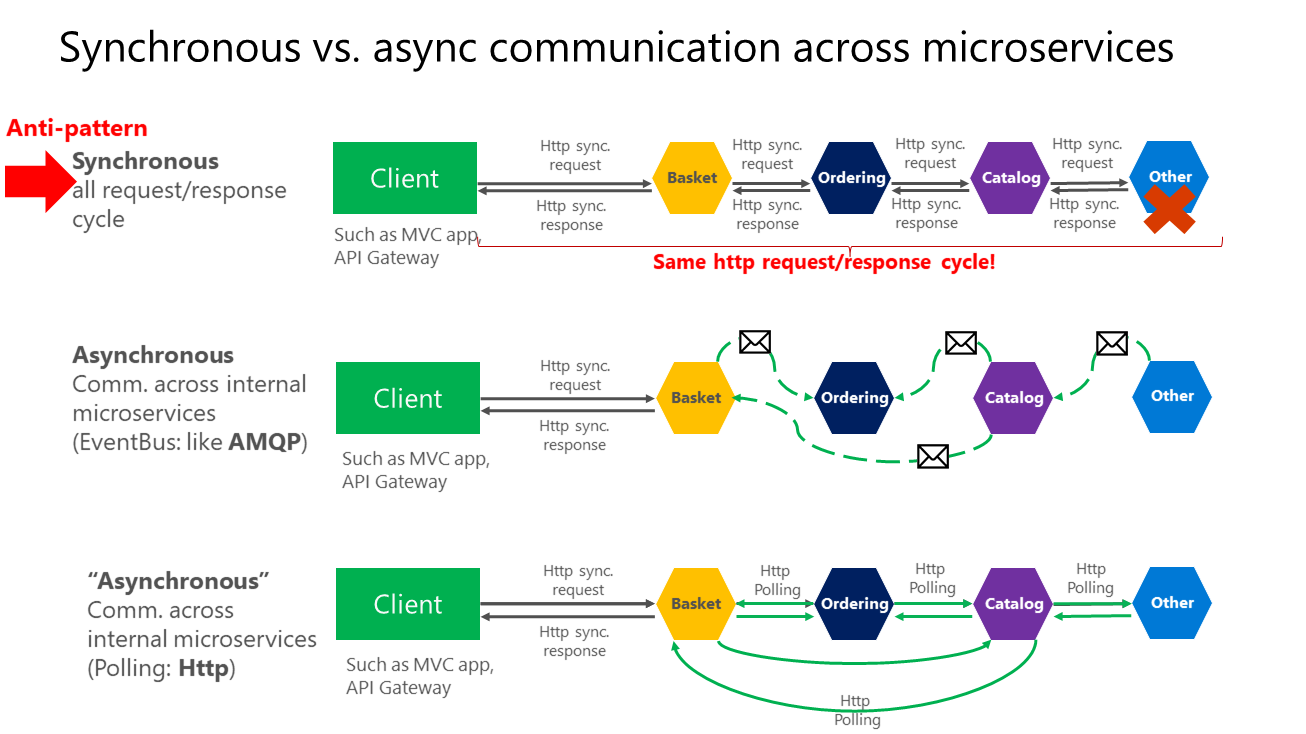
This complexity is captured by the Fallacies of Distributed Computing: a set of assumptions that programmers new to distributed systems often make, to their peril.
Why Comparing Monoliths and Microservices Makes No Sense
The article 'Why Comparing Monoliths and Microservices Makes No Sense' contains a perfect, concise list of these fallacies.
Read the section titled 'Fallacies of Distributed Computing'. Internalize these eight points, as they are the root cause of nearly every challenge in a microservice environment.
The key fallacies to remember are:
- The network is not reliable.
- Latency is not zero.
- Bandwidth is not infinite.
- The network is not secure.
Every network call you make between services can fail, is orders of magnitude slower than a local function call, and must be secured.
Cost 2: Operational Complexity & Data Consistency
- Operational Overhead: Instead of deploying and monitoring one application, you now have to manage dozens or hundreds. This requires significant investment in automation, tooling for logging, monitoring, and tracing (observability), and a mature DevOps culture.
- Eventual Consistency: In a monolith with a single database, you can use ACID transactions to update multiple tables at once, ensuring strong consistency. In a microservice architecture where each service owns its own database, a single business operation might require updates across multiple services. Distributed transactions are complex and often avoided, so you must design your system to handle eventual consistency, where data across the system will become consistent over time, but may be temporarily out of sync. This makes reasoning about the system state much harder.
The Productivity Trade-Off
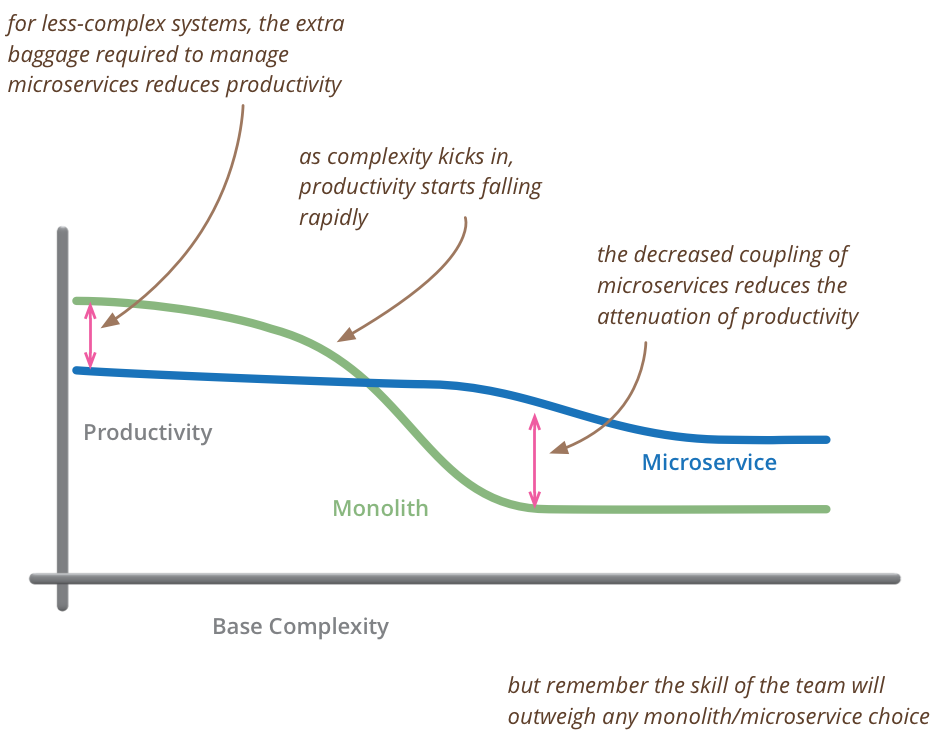
This brings us to the "Microservice Premium." Microservices introduce an upfront complexity cost. For simple applications, this cost outweighs any benefits, making a monolith far more productive. However, as system complexity grows, the cost of managing a monolithic "Big Ball of Mud" skyrockets, while the productivity in a well-designed microservice architecture remains more stable.
A More Critical Perspective: Are Microservices Just Glorified Modules?
There's a growing sentiment that the industry may have over-indexed on microservices, applying them where they aren't needed. This next video offers a brilliant critical take.
Stop Creating Microservices | Prime Reacts
In this video, ThePrimeTime reacts to an article that challenges the hype around microservices. The key argument is that many of the supposed benefits of microservices are actually benefits of good modularity, which is not exclusive to microservices.
Please watch these two key sections: The Heart of Microservices is Modules (19:34 - 21:42): This is the core argument. Pay close attention to the idea that concepts like independent, versioned units of code have existed for decades. Organizational Clarity and Distributed Fallacies (23:54 - 29:30): This part connects the architecture to team structure (Amazon's 'two-pizza teams') and re-emphasizes the inherent costs of distributed computing.
The crucial insight here is that the primary benefit of microservices—enforced modularity—comes at the very high price of becoming a distributed system. This leads to a powerful practical strategy.
The Middle Ground: The Modular Monolith & Monolith-First
So, what should you do when starting a new project? The consensus among many experienced architects is to start with a monolith.
But not just any monolith. A Modular Monolith.
Why Comparing Monoliths and Microservices Makes No Sense
Let's return to the article 'Why Comparing Monoliths and Microservices Makes No Sense' to explore this practical approach.
Read the sections 'The Middle Ground: Modular Monolith' and 'Monolith-First Approach'. This explains how to get the benefits of modularity without the immediate costs of a distributed system.
The strategy is as follows:
- Start with a Modular Monolith: Build your application as a single deployment unit, but with strict internal boundaries between modules. In Django, this means designing your apps to be highly cohesive and loosely coupled. One app should not reach into another app's database tables or internal functions; it should only communicate through a well-defined API layer.
- Evolve to Microservices (If Needed): As the system grows, you may find that a specific module becomes a scaling bottleneck or is complex enough to warrant its own team. Because you've maintained clean boundaries, you can then "strangle" that module out of the monolith and extract it into its own microservice. This is an incremental, much lower-risk process than trying to guess the right service boundaries on day one.
This "Monolith-First" approach allows you to move fast initially while keeping your options open for future scaling.
Conclusion
We've covered a lot of ground, moving from simple definitions to a nuanced discussion of one of the most significant architectural decisions in backend development.
Key Takeaways:
- Monoliths are single-unit applications. They are simple to develop, deploy, and test initially, and benefit from strong data consistency. Their main drawback is that they become difficult to scale, maintain, and release as complexity grows.
- Microservices are collections of small, independent services. They offer superior scalability, technological diversity, and team autonomy. However, this comes at the cost of the immense complexity inherent in any distributed system: network latency, potential failures, eventual consistency, and high operational overhead.
- The choice is context-dependent. There is a "Microservice Premium," meaning they are only worth the cost for systems of sufficient complexity.
- Many of the benefits of microservices stem from modularity. Good modularity can and should be pursued even within a monolithic architecture.
- The Modular Monolith is a powerful hybrid pattern, offering the operational simplicity of a monolith with the clean boundaries of microservices. The Monolith-First strategy is a widely recommended approach for new projects.
Preview of the Next Lesson
A key reason to choose microservices or even to scale a monolith is to run multiple instances of our code to handle more traffic. This is called horizontal scaling. But once you have multiple instances, a new question arises: how does incoming traffic get distributed among them?
In our next lesson, we will answer that question by diving into load balancers. We'll explain how they work and compare the common algorithms they use to distribute traffic, such as round-robin and least connections.