Welcome to the third lesson in our exploration of film's core concepts. In our last session, we drew a crucial distinction between a film's story (fabula)—the chronological sequence of events—and its plot (syuzhet)—the specific way those events are presented to the audience. This showed us how filmmakers sculpt narrative time to create specific effects.
Today, we shift our focus from the arrangement of time to the composition of the film's world itself. We will explore the boundary between what exists within the story's reality and what is added for the audience's benefit from the outside. Your goal for this lesson is to learn how to distinguish between diegetic and non-diegetic elements. Mastering this concept is fundamental for you as a filmmaker, as it governs everything from sound design and music selection to how you present information visually, ultimately shaping the viewer's immersion and understanding.
The World of the Story: Defining Diegesis
The term "diegesis" (pronounced dai-uh-JEE-sis) is a formal term for the world in which a film's story takes place. It encompasses the setting, the characters, the events, and everything that constitutes their reality. Once we understand this, the distinction between diegetic and non-diegetic becomes quite straightforward:
- Diegetic elements are anything that is part of the diegesis—the story's world. The characters can perceive and interact with these elements.
- Non-diegetic elements are things that exist outside the story's world. They are added for the audience only, and the characters are unaware of them.
The simplest test you can apply is to ask: "Could a character in the scene hear, see, or otherwise perceive this element?" If the answer is yes, it's diegetic. If the answer is no, it's non-diegetic.
This flowchart provides a helpful visual breakdown, primarily using sound as an example, which is where this distinction is most commonly applied.
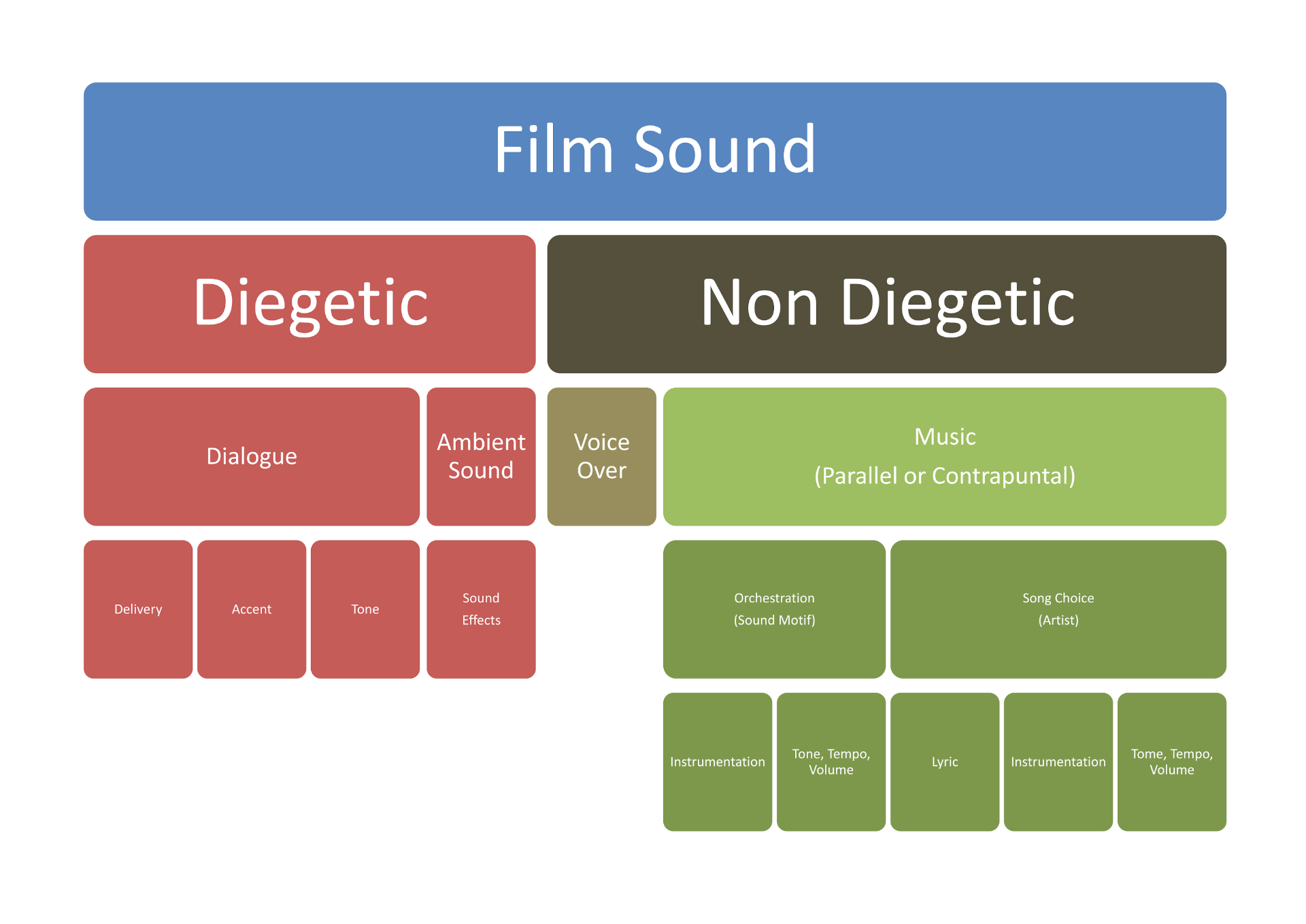
Let's watch a video that brings these definitions to life with clear examples.
Ultimate Guide to Diegetic vs Non-Diegetic Sound — Definitions, Examples, & How to Break the Rules
This video from StudioBinder provides an excellent and concise introduction to the core concepts of diegetic and non-diegetic elements, focusing on sound.
First, watch the initial segment that defines the terms from the introduction. Notice how it establishes the "world of the film" as the key idea. Next, watch the section covering diegetic sound. Pay attention to the variety of examples, including dialogue, atmospheric sounds, and even a character's internal thoughts (internal diegetic sound). Finally, watch the section on non-diegetic sound, which focuses on the most common examples: the musical score and external narration.
As the video demonstrates, the line is usually very clear. The sound of footsteps on pavement, a conversation between two characters, or music playing from a car radio are all diegetic. The characters can hear them. In contrast, the orchestral score that swells during a dramatic moment or the voice of an omniscient narrator explaining the setting are non-diegetic.

Beyond Sound: Visual Elements
While the distinction is most frequently discussed in relation to sound, it applies to every element in a film. Let's briefly expand the concept to visual elements using an article from Videomaker.
A deep dive into diegesis - Videomaker
This article reinforces the definitions and extends them clearly into the visual realm.
Please read the section titled "Diegesis in practice." Focus specifically on the two subsections discussing Music and Visual effects and graphics.
As the article explains, visual elements follow the same logic:
- An explosion, a car, or a costume are diegetic visual elements.
- The opening title card, informational subtitles (e.g., "Paris, 1942"), or cartoonish effects like stars circling a character's head are typically non-diegetic visual elements.
Understanding this distinction gives you, the filmmaker, two separate channels through which to communicate with your audience: one that is shared with the characters (diegetic) and one that is exclusively for the audience (non-diegetic). The real creative power comes from how you manage, and sometimes blur, the boundary between these two channels.
Blurring the Lines for Creative Effect
Some of the most memorable moments in film happen when filmmakers intentionally play with our expectations of what is diegetic and what is not. A seemingly non-diegetic element might be revealed to be diegetic, or vice versa. This technique is often used for comedy, to create a sense of surrealism, or to give the audience insight into a character's state of mind.
Let's return to the StudioBinder video to see some excellent examples of this "rule-breaking."
Ultimate Guide to Diegetic vs Non-Diegetic Sound — Definitions, Examples, & How to Break the Rules
This final section of the video is all about how filmmakers creatively subvert the audience's expectations.
Watch the segment from the beginning of this section. It covers what is sometimes called "trans-diegetic" sound—elements that cross the boundary. Pay close attention to the examples from films like Blazing Saddles, Birdman, and George of the Jungle.
These examples demonstrate that the "rules" are more like a set of conventions that audiences have learned to expect. By understanding these conventions, you can subvert them for a specific purpose:
- For comedy: Revealing the dramatic orchestral score is actually being played by an orchestra in the middle of the desert (Blazing Saddles).
- For character insight: Having a non-diegetic drum beat suddenly revealed to be an actual drummer on the street, blurring the line between the character's internal state and external reality (Birdman).
- For narrative surprise: Having a voice-over narrator, assumed to be non-diegetic, suddenly appear as a character in the final scene (The Big Lebowski).
Playing with this boundary is a sophisticated technique that, when used effectively, can elevate a simple scene into something clever and memorable.
Conclusion
Today, you've learned to identify the boundary of a film's story world and to classify the elements within a film based on whether they fall inside or outside that boundary.
Here are the key takeaways:
- Diegesis: The world of the story in which the characters live and the narrative takes place.
- Diegetic Elements: Any sound, image, or object that exists within the diegesis. Characters can perceive it. Examples include dialogue, ambient sounds, props, and source music (e.g., from a radio).
- Non-Diegetic Elements: Any element added for the audience that exists outside the diegesis. Characters are unaware of it. Examples include the film's musical score, title cards, and omniscient voice-over narration.
- Creative Application: The distinction is not just a classification system; it is a creative tool. Intentionally blurring the line between diegetic and non-diegetic can create comedy, surprise, and deeper thematic meaning.
As you continue to analyze films and plan your own, actively ask yourself: What is part of this world, and what is being added for me, the viewer? How does that choice affect my experience?
In our next lesson, we will continue exploring the fundamental language of film by examining the difference between film form (how a story is expressed) and content (what the story is about).