Introduction
Welcome to your next lesson in the Market Research module. In our last session, you took a major step by identifying a potential niche and a unique angle for your digital product business. You completed the "Niche Identification Template," which gave you a high-level sketch of who you plan to serve.
Today, we will bring that sketch to life. The goal of this lesson is to define a detailed target audience profile, or 'persona,' including their goals, pain points, and aesthetic preferences. A persona is a fictional character that represents your ideal customer. Creating one is not just a theoretical exercise; it's a foundational step that ensures every product you design, every color you choose, and every piece of content you create is precisely calibrated to resonate with the people you want to reach.
1. Why Personas Matter: It's Not About You, It's About Them
Before we get into the how, we need to internalize the why. The most successful products and businesses are not built on what the creator wants to sell, but on what the customer needs to solve. Shifting your mindset from selling a "thing" (like a wallpaper pack) to selling a "solution" (like a way to create a focused, aesthetic digital workspace) is the key. To do that, you have to deeply understand the person who has the problem.
Leveling Up Your Business 2024 (Business Bootcamp pt. 1)
To understand the power of focusing on a specific person and their problems, let's watch a few segments from a business workshop by The Futur. Chris Do shares a personal story that perfectly illustrates how trying to sell to the wrong audience leads to failure, while finding the right person with a 'starving' need leads to massive success.
Watch from 08:40 to 19:57. As you watch, pay close attention to: The distinction between selling what you do versus the result you achieve. How Chris struggled when he didn't know who his customer was, and how clear everything became once he identified a market with an urgent, painful problem. The examples of people paying high prices ($3,000/month for tweets) not for the task's difficulty, but to solve a significant pain point in their own lives.
The core message here is that value is determined by the customer's pain. Your job is to find a specific person with a specific, painful problem that you are uniquely equipped to solve. A persona is the tool you'll use to keep that person front and center.
2. The Anatomy of a Persona
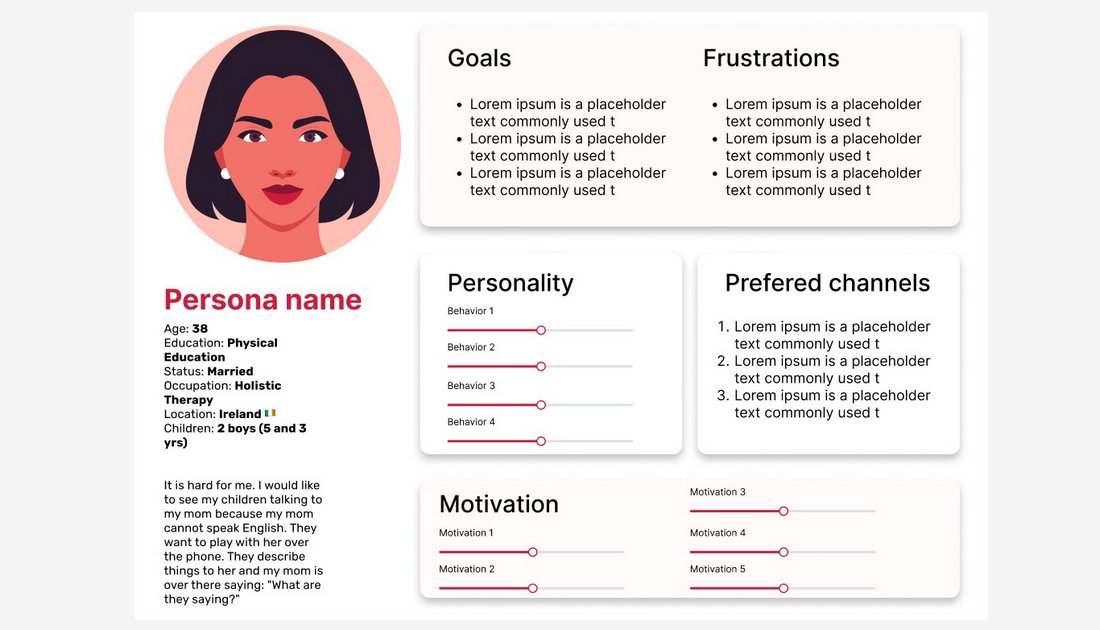
A persona profile is a one-page document that consolidates your research into a relatable character. It turns a vague "target market" into a concrete individual. This prevents you from making design or business decisions based on your own preferences, and instead forces you to ask, "What would [Persona's Name] think?"
To get a comprehensive view of how to construct a persona from the ground up, let's look at a detailed guide.
Creating a Persona — a step-by-step guide with tips and examples
The article 'Creating a Persona — a step-by-step guide' from UXPressia provides a fantastic, systematic walkthrough of the entire process, from research to final polish.
Read the sections 'Step One: Do research' through 'Step Seven: Define motivations and frustrations', and also the 'Persona creation checklist' at the end. Focus on understanding the different components that make up a persona (demographics, background, goals, frustrations) and why each one is important.
Here are two visual examples of what a finished persona can look like. Notice how they combine data with a humanizing narrative to create a complete picture.

3. How to Research Your Persona
So, where does the information to fill out these templates come from? You can't just invent it. As the UXPressia article noted, personas must be based on research. Since you likely don't have a large customer base yet, your research will involve some "digital detective work."
Given your interest in systematic processes and your tech skills, using online communities and even AI can be a very efficient way to gather initial data.
How to Find Your Target Audience in 2025 6 Step Framework + Free Templates
The HubSpot Marketing channel offers a very practical guide on how to find this information without conducting formal interviews. This video will show you where to look and what to look for.
Watch the segments from 03:44 to 05:24 and 07:32 to 09:32. Focus on: The 'detective mode' technique: searching Reddit, Quora, and other forums for common questions and pain points. Pay attention to the exact language people use. How to use this research to understand the tone and emotional language that will resonate with your audience.
This "detective work" is crucial. Finding posts that say "I wish there was a tool that..." or "I'm so frustrated with..." is gold. These are direct expressions of the pain points you want to solve.
4. Defining Aesthetic Preferences
For a digital product creator focused on design, understanding your persona's aesthetic preferences is just as important as understanding their functional needs. The visual style of your products, website, and branding must align with what your target audience finds appealing and trustworthy.
The article "Brand Aesthetic" by Adchitects explains this connection well. It states that identifying your target audience's interests, preferences, and values is crucial for creating a brand aesthetic that resonates. Your persona's background and goals will dictate their taste. For example:
- A persona who is a CS student focused on productivity might value a minimalist, tech-focused aesthetic. They'd likely prefer sans-serif fonts (like Inter or SF Pro), a clean layout with lots of whitespace, and a cool, muted color palette (blues, grays, blacks). This aesthetic communicates efficiency and modernity.
- A persona who is an art student creating a portfolio might value an expressive, artistic aesthetic. They might be drawn to unique serif fonts, more creative layouts, and a warmer or more vibrant color palette. This aesthetic communicates creativity and personality.
By defining your persona, you can make informed decisions about typography, color, and imagery that will attract them, not just please you.
5. Your Turn: Build Your Persona Profile
It's time to put this all together. Open your project management tool (Notion, Obsidian, etc.) and create a new page titled "Brand Persona."
Instructions:
- Start with the "Niche Market" (the "who") you defined in the last lesson's exercise. This is the foundation for your persona.
- Spend 15-20 minutes doing the "detective work" described in the HubSpot video. Go to Reddit, forums, or even YouTube comments related to your chosen niche. Search for your niche's problems (e.g., "student budget notion template," "minimalist gaming setup ideas"). Look for real quotes, frustrations, and goals.
- Use your findings to fill out the template below. Be as specific as possible.
Persona Profile Template
-
Name: Give them a realistic name.
-
Photo: Find a royalty-free photo (from Unsplash, Pexels, etc.) that represents them.
-
Archetype/Title: A short, descriptive title (e.g., "The Aspiring Creator," "The Overwhelmed Student," "The Productivity-Obsessed Developer").
-
Quote: A short, impactful sentence that captures their main frustration or goal. (e.g., "I just want my digital space to look as clean as my desk, but all these tools are so clunky.")
-
Background (Who are they?):
- Age:
- Occupation: (e.g., High school senior, part-time retail, college freshman)
- Key Characteristics: (e.g., Tech-savvy, organized, values aesthetics, systematic thinker)
-
Goals (What do they want to achieve?):
- (List 2-3 primary goals related to your niche. e.g., "Wants to create a visually appealing and functional Notion dashboard," "Wants to learn graphic design but doesn't know where to start.")
-
Pain Points / Frustrations (What's stopping them?):
- (List 2-3 key frustrations. e.g., "Finds existing templates ugly or too complicated," "Feels overwhelmed by the number of features in Adobe software," "Doesn't have a large budget for premium tools.")
-
Motivations (What drives them?):
- (What is the underlying 'why' behind their goals? e.g., "Desire for order and control," "Ambition to start a side hustle," "Appreciation for minimalist design principles.")
-
Aesthetic Preferences (What visuals do they like?):
- General Vibe: (e.g., Minimalist, techy, dark mode, clean, Apple-inspired)
- Favorite Colors: (e.g., Muted tones, monochrome, a single accent color)
- Typography Style: (e.g., Prefers clean sans-serif fonts over traditional serifs)
-
Tech & Tools They Use:
- (List the hardware and software they use daily. e.g., MacBook Pro, iPhone, Notion, Figma, VS Code, Adobe CC).
Conclusion
Excellent work. You have now moved from a broad market segment to a detailed, humanized persona. This single document will become one of your most valuable assets. You'll refer to it when designing your product, writing your website copy, and creating your brand identity. It is the compass that ensures you are always building for your customer.
Key Takeaways:
- A persona is a detailed, fictional profile of your ideal customer based on research.
- The most successful products solve a specific, painful problem for a specific group of people.
- You can research your persona by acting as a "digital detective" in online communities like Reddit to find real goals and frustrations.
- Understanding your persona's background, goals, and values is key to defining the aesthetic preferences (colors, fonts, style) that will resonate with them.
Preview of the Next Lesson:
Now that you have a crystal-clear picture of who you're serving, the next step is to clarify how you'll serve them differently from everyone else. In the next lesson, we will build on this foundation to "Formulate a unique selling proposition (USP) that differentiates your brand from competitors." You'll craft a powerful statement that communicates your unique value directly to the persona you created today.