Hello! Welcome to the first lesson in your CPA Marketing course. I'm excited to guide you on this journey.
Given your interest in generating income online and your existing knowledge of digital marketing, this course is designed to provide a practical, step-by-step path into the world of Cost Per Action (CPA) marketing. We'll balance hands-on application with the essential theory you need to build sustainable campaigns.
Today's lesson focuses on the absolute foundation: explaining the CPA marketing business model and how you, as an affiliate, earn commissions. By the end of this 60-minute session, you'll have a clear understanding of what CPA marketing is, why it's a powerful model, and the fundamental process of how it generates income.
Let's begin.
What is CPA Marketing?
At its core, CPA marketing is a form of affiliate marketing. However, it has a key distinction that makes it particularly appealing.
The acronym CPA stands for Cost Per Action or sometimes Cost Per Acquisition. Unlike traditional affiliate marketing where you might only get paid when someone buys a product, in CPA marketing, you earn a commission when a user completes a specific, predefined action. This action doesn't have to be a sale. It could be something as simple as:
- Submitting an email address
- Filling out a contact form
- Signing up for a free trial
- Installing an app
This focus on actions rather than just sales opens up a wide range of opportunities.
To get a clear overview, let's start with a short video that defines the concept.
What is CPA Marketing and How to Get Started? (Important Details for Beginners)
Watch this segment from the video 'What is CPA Marketing and How to Get Started?' by PaidFromSurveys. It provides a straightforward definition of CPA and explains how it relates to general affiliate marketing.
Watch from 01:31 to 02:36. Pay close attention to how the presenter defines 'Cost Per Action' and the examples of actions that can earn you a commission.
CPA vs. Other Models (CPC & CPM)
If you've looked into digital marketing, you've likely encountered terms like CPC (Cost Per Click) and CPM (Cost Per Mille/Thousand Impressions). It's crucial to understand how CPA is different.
- CPC (Cost Per Click): The advertiser pays every time someone clicks their ad, regardless of what happens next.
- CPM (Cost Per Mille): The advertiser pays for every 1,000 times their ad is shown, regardless of clicks or actions.
- CPA (Cost Per Action): The advertiser only pays when a specific conversion action is completed.
For an advertiser, the CPA model is low-risk because they only pay for tangible results. For you, the affiliate, it means your goal is crystal clear: drive traffic that converts into the desired action.
To solidify this distinction, please read the following short sections from an article by YepAds.
The Ultimate Guide to CPA Marketing: Tips and Strategies
This article, 'The Ultimate Guide to CPA Marketing,' clearly defines CPA and contrasts it with other common advertising models.
Read the sections 'What is CPA Marketing in 2026?', 'How CPA Differs from CPC and CPM?', and view the 'Comparison of Affiliate Models' table. This will take about 5 minutes and will clarify the unique position of CPA in the advertising landscape.
The Core Business Model: How Affiliates Profit
So, how do you actually make money? The fundamental business model, especially when using paid advertising, is arbitrage.
In simple terms, arbitrage in CPA marketing means:
You aim to pay less for traffic than you earn in commissions.
For example, if an offer pays you $2.00 for every user who signs up (the "action"), your goal is to acquire that user for less than $2.00. If you can spend $0.80 on ads to get one user to sign up, you've made a $1.20 profit.
Now, imagine scaling this. If you can do this 100 times a day, you've generated $120 in daily profit. This principle is the engine that drives profitable CPA campaigns.
The next video explains this concept of arbitrage very effectively. While the presenter's style is high-energy and includes large income claims, the underlying business principles he explains are sound and important to understand.
CPA Marketing 101 - $219k In 30 Days Case Study With CPA Marketing
This clip from 'CPA Marketing 101' by Mr.Opulent breaks down the core business model of arbitrage.
Watch from 06:15 to 07:28. Focus on the simple formula he presents: spending $1 on traffic to generate $2 in commissions. This is the central idea behind profiting with paid CPA.
How It All Works: The Players and the Process
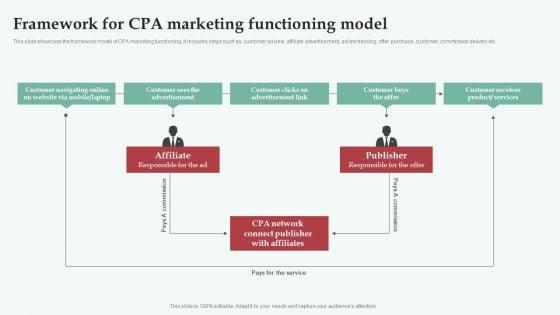
To understand the business model fully, you need to know the key players involved and the step-by-step process of a conversion.
The Key Players (The CPA Ecosystem)
- The Advertiser (or Merchant): The company that owns the product or service. They want more customers or leads and are willing to pay for them.
- The Affiliate (or Publisher): This is you. You promote the advertiser's offer to an audience.
- The CPA Network: An intermediary platform that connects advertisers with affiliates. They list offers from various advertisers, handle tracking, and process payments. Think of them as a marketplace for CPA offers.
- The User (or Customer): The person who sees your promotion, clicks your link, and completes the action.
This flowchart shows how these players interact.
The Step-by-Step Conversion Flow
So, how does a click turn into a commission? The process is straightforward and is managed by tracking technology.
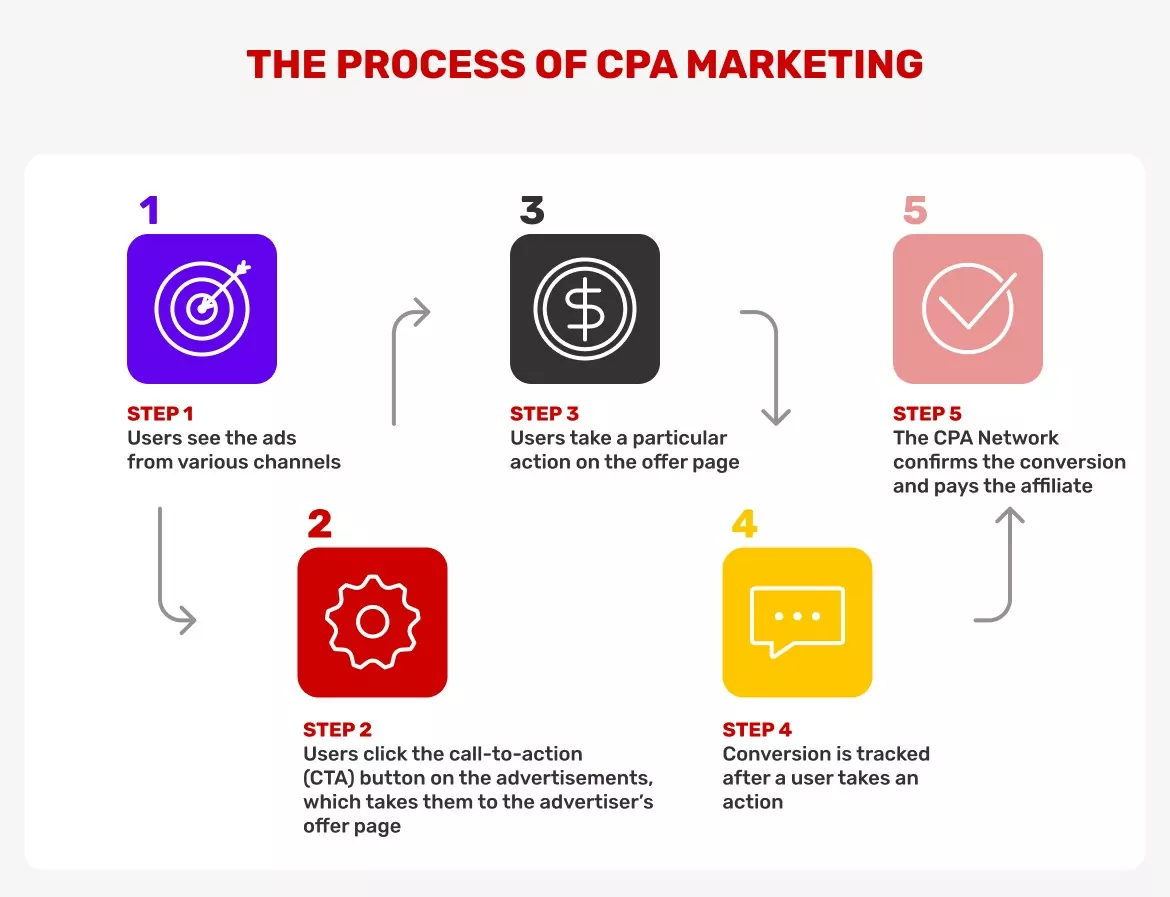
Let's formalize this with a clear, step-by-step breakdown.
The Ultimate Guide to CPA Marketing: Tips and Strategies
Let's return to 'The Ultimate Guide to CPA Marketing' to read a concise explanation of the conversion process.
Please read the short section titled 'CPA Offer Flow: How does a CPA conversion Happen?'. This clearly outlines the four main steps from finding an offer to getting paid.
To see what this looks like in practice, the next video gives you a peek inside a real CPA network dashboard. This will help connect the theoretical process to the tools you'll actually be using.
What is CPA Marketing and How to Get Started? (Important Details for Beginners)
In this clip from 'What is CPA Marketing and How to Get Started?', you'll see a demonstration inside the MaxBounty CPA network.
Watch from 02:54 to 04:54. Notice how the presenter finds offers, sees the payout ('how much you would get'), and mentions getting a unique 'tracking link.' This is the link you would use in your promotions.
How Affiliates Earn Commissions: Types of Payouts
We've established that you get paid for an "action." Now let's break down the most common types of actions and their corresponding payout models.
- CPL (Cost Per Lead): You get paid when a user submits their information. This is very common for offers like insurance quotes, solar panel inquiries, or newsletter sign-ups. The user doesn't have to buy anything.
- CPS (Cost Per Sale): This is the classic affiliate model. You earn a commission or a percentage of the sale price when a user makes a purchase.
- CPI (Cost Per Install): You get paid every time a user installs a mobile app or a piece of software through your link. This is huge in the mobile gaming and utility app space.
- Revenue Share / Recurring Payments: For subscription-based services, some advertisers pay you a percentage of the customer's recurring payments. This can create a long-term, passive income stream from a single conversion.
Understanding these types is key because the offer you choose will dictate your marketing strategy. It's generally easier to get someone to submit an email (CPL) than to make a purchase (CPS), but the CPS payout is usually much higher.
Test your understanding!
An affiliate marketer is promoting a mobile game. The CPA offer pays $1.50 for every user who installs the game from the Apple App Store. The affiliate spends $100 on social media ads and generates 80 installs.
- What is the total commission earned?
- What is the total profit or loss from this campaign?
- Which payout model is being used here?
Show answer
- Total commission: 80 installs * $1.50/install = $120.
- Total profit: $120 (commission) - $100 (ad spend) = $20 profit.
- Payout model: This is a CPI (Cost Per Install) model, as the affiliate is paid for each installation of the app.
Conclusion
Excellent work. You've just covered the conceptual bedrock of the entire CPA marketing industry.
Here are the key takeaways from this lesson:
- CPA stands for Cost Per Action. Affiliates earn commissions when a user completes a specific action, not necessarily a sale.
- The business model is often built on arbitrage: ensuring your commission from an action is greater than your cost to acquire it.
- The CPA ecosystem consists of four key players: Advertisers, Affiliates (you), CPA Networks, and Users.
- The process is simple: you promote an offer using a unique tracking link, a user completes the action, the network tracks it, and you get paid.
- Commissions are tied to specific models like CPL (lead), CPS (sale), and CPI (install).
In our next lesson, we will dive deeper into the key players in the CPA ecosystem. You'll learn more about the roles of advertisers, networks, affiliates, and users, which will prepare you to navigate this world and start choosing your partners.