Hello! Welcome back to your CPA marketing journey.
In our last lesson, we mapped out the CPA ecosystem by identifying the four key players: the Advertiser, the Affiliate (you), the CPA Network, and the User. We learned that advertisers pay for a specific "action" completed by a user.
Today, we're going to define what those "actions" are. Our learning outcome is to distinguish between the main CPA offer types: lead generation, sales, app installs, and trials. Understanding these is the next critical step, as the type of offer you choose will directly influence your marketing strategy, the traffic sources you use, and your potential earnings.
An Overview of CPA Offer Models
Before we dive into the details, let's get a high-level view of the most common models. The term "CPA" (Cost Per Action) is an umbrella term, and the "action" can be many different things.
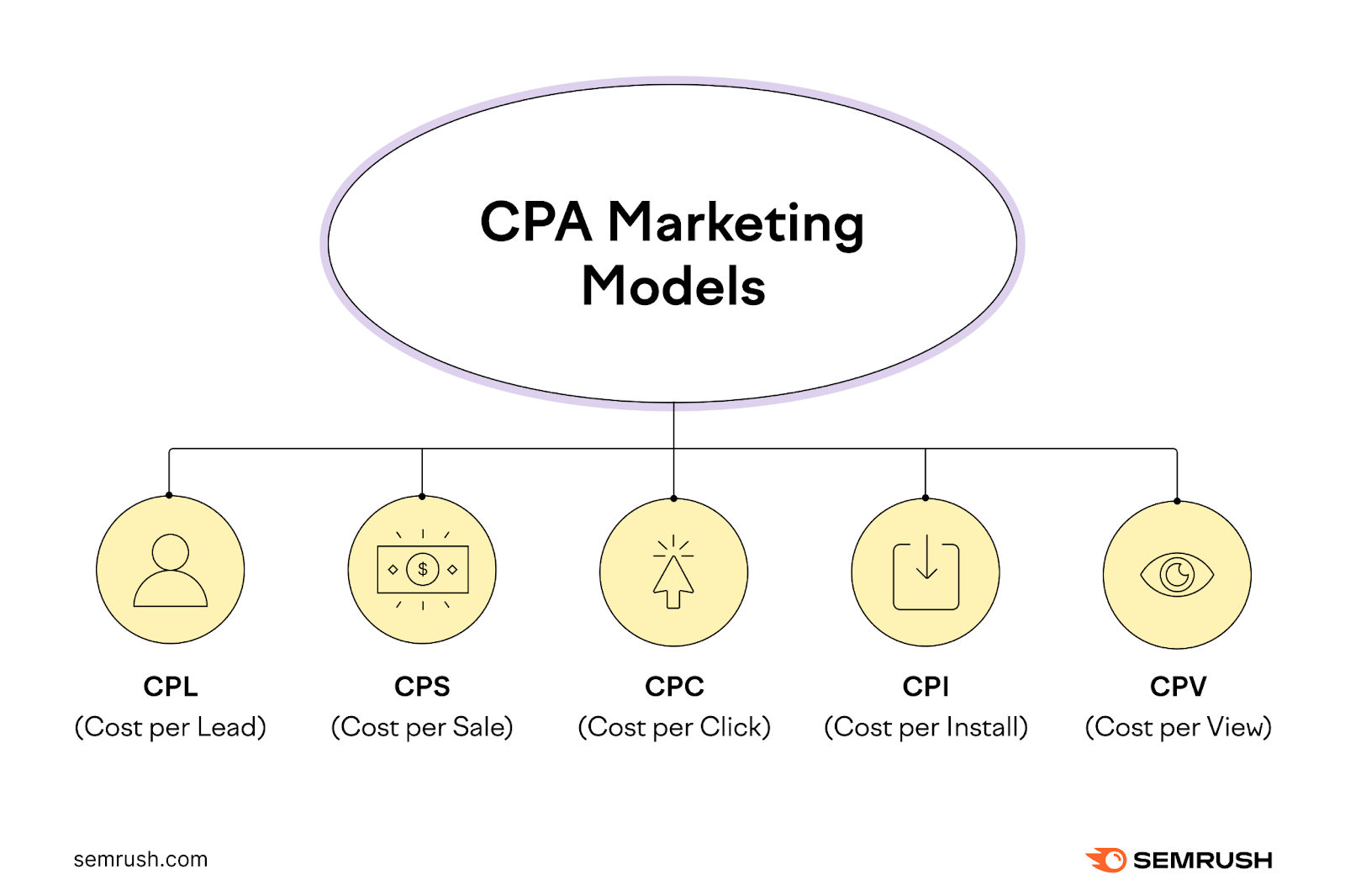
As you can see, advertisers are willing to pay for various outcomes. Your job as an affiliate is to choose an offer and generate the specific action required. Let's break down the four most important types you'll encounter.
The Core CPA Offer Types
To get a comprehensive understanding of the different "conversion flows," we'll refer to a detailed guide from Mobidea Academy. It provides clear, concise definitions for each offer type.
How to Choose The Best CPA Offers in 2026 (Step-By-Step)
Please read the following section from the Mobidea Academy guide, 'How to Choose The Best CPA Offers'. This section is crucial as it breaks down the exact 'actions' or 'conversion flows' that define different CPA offers.
Read the entire section titled 'Types of CPA Conversion Flows'. As you read, focus on understanding the definitions for CPL (SOI/DOI), CPS, CPI, and CC Submit. These correspond directly to the offer types we're studying.
Now that you've read the definitions, let's organize and expand on these concepts.
1. Lead Generation (CPL - Cost Per Lead)
This is one of the most common offer types, especially for beginners.
- The Action: You get paid when a user submits their contact information. This is typically an email address and/or phone number.
- The Advertiser's Goal: To build a list of potential customers they can market to in the future through email campaigns, newsletters, or sales calls.
- Key Sub-types (from your reading):
- SOI (Single Opt-In): The user just needs to submit their details. The conversion is instant. This is easier to achieve, so payouts are generally lower.
- DOI (Double Opt-In): The user must submit their details and confirm their submission, usually by clicking a link in a verification email. This is a higher-quality lead for the advertiser, so payouts are higher than for SOI.
The e-learning newsletter example from our last lesson was a classic CPL offer.
2. Sales (CPS - Cost Per Sale)
This model is what most people think of when they hear "affiliate marketing."
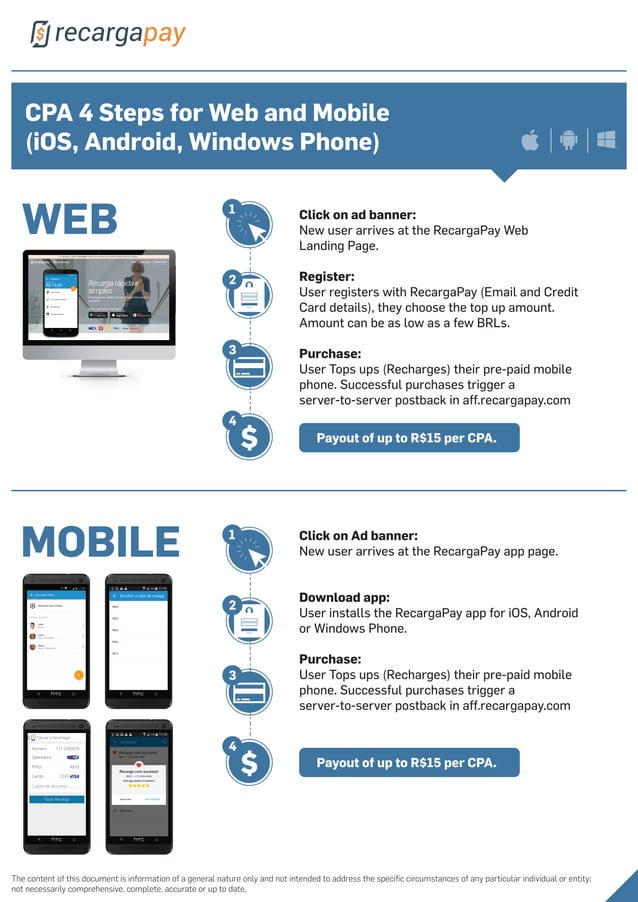
- The Action: You earn a commission when a user makes a purchase through your affiliate link.
- The Advertiser's Goal: To generate direct revenue.
- Payouts: Can be a fixed amount (e.g., $40 for a $100 product) or a percentage of the sale value, which is often called Revenue Share (RevShare).
Let's look at a visual example of a CPS flow.
3. App Installs (CPI - Cost Per Install)
With the world on mobile, this is a massive and growing category.
- The Action: You get paid when a user downloads and installs a mobile application (or sometimes desktop software) via your link.
- The Advertiser's Goal: To increase the user base for their app. This is common for mobile games, social media apps, and utilities.
- Important Note: Some CPI offers require more than just an install. The action might be "Install + Open" or "Install + Register," which are slightly more involved and usually pay more.
4. Trial Offers (CC Submit)
These offers are very popular because they present a low-risk proposition to the user.
- The Action: You get paid when a user signs up for a free or low-cost trial of a product or service. This almost always requires the user to submit their credit card details ("CC Submit") for future billing.
- The Advertiser's Goal: To get users to try their product, hoping they will love it and become paying subscribers after the trial period ends.
- Common Examples: Streaming services (Netflix), subscription boxes, and software-as-a-service (SaaS) tools often use this model.
To deepen your understanding, let's look at another resource that provides excellent context, especially on Trial offers and the pros and cons of each model.
Nutra Offers 101: CPA, COD, RevShare, Hybrid Models Explained
The article 'Nutra Offers 101' provides another perspective on these models. While it's focused on the 'nutra' niche, the explanations are universally applicable.
First, read the section 'CPL (Cost Per Lead): Getting Paid for a Lead' and look at its 'Advantages & Disadvantages' table. Then, do the same for the section 'Trial Offers: Free Samples and Low Entry Barrier'. Finally, review the 'Comparison of Nutra Offer Types' table at the end. This table is a fantastic summary of the trade-offs between offer types.
Seeing Offer Types in a Real CPA Network
Theory is one thing, but seeing these offers in the wild makes it click. Since you prefer a hands-on approach, let's watch a short clip of a marketer browsing offers on a real CPA network. This will help you see how these offer types appear in a dashboard you'll soon be using.
CPA Marketing For BEGINNERS Tutorial To Earn $100 A Day | Make money Online With Free Traffic
In this clip from 'CPA Marketing For BEGINNERS' by Marshall Malaba, you'll see how to find and identify different offer types on the CPAgrip network.
Watch the video from 06:21 to 08:30. Pay close attention to how he uses the 'Categories' filter to find 'email/zip submit' (CPL), 'mobile install' (CPI), and 'trial' offers. This is exactly the process you'll follow.
This practical view shows how you can quickly sort through hundreds of offers to find the specific type you want to promote.
Test your understanding!
You're browsing a CPA network and come across the following offers. Based on their descriptions, identify the primary offer type for each (CPL, CPS, CPI, or Trial).
- Offer A: "Tidal Music Streaming - Get a 30-day free trial! Payout: $10."
- Offer B: "Norton Antivirus - 25% off your first year's subscription. Payout: $50."
- Offer C: "Win a $500 Amazon Gift Card - Enter your email for a chance to win! Payout: $2.10."
- Offer D: "RAID: Shadow Legends - Install and open the game on iOS. Payout: $3.50."
Show answer
- Offer A: Trial. The user is signing up for a free trial period.
- Offer B: CPS (Cost Per Sale). The user must purchase a subscription for you to be paid.
- Offer C: CPL (Cost Per Lead). The action is simply submitting an email address.
- Offer D: CPI (Cost Per Install). The action is installing and opening a mobile game.
Conclusion
Excellent work. You can now confidently distinguish between the primary types of CPA offers. This is a fundamental skill that will guide all your future decisions in selecting and promoting offers.
Here are your key takeaways:
- CPL (Cost Per Lead): You get paid for generating leads (e.g., email submits). These are easier to convert but have lower payouts.
- CPS (Cost Per Sale): You get paid when someone makes a purchase. These are harder to convert but have the highest payouts.
- CPI (Cost Per Install): You get paid for app installs. This is a huge market, especially for mobile traffic.
- Trial (CC Submit): You get paid when a user signs up for a trial, usually by providing their credit card info. This is a balance between ease of conversion and a decent payout.
There is a direct relationship between the difficulty of the action for the user and the payout for the affiliate. An email submit is easy ($1-$3), while a purchase is hard ($20-$100+). Your job is to find the sweet spot where your marketing skills can profitably generate the required action.
In our next lesson, we'll explore common CPA marketing niches and their typical payout structures. This will help you connect these offer types to specific industries and start thinking about which niche might be the best fit for you.