Welcome to your first lesson. This course is designed to equip you with the deep technical and strategic knowledge required to position the Shimadzu Trinias family of angiography systems effectively against key competitors. Your background as a biomedical engineer already provides a strong foundation in the core technologies; our goal is to translate that engineering understanding into compelling value propositions for both clinical and technical audiences.
In this introductory lesson, we will focus on the first crucial step: building a clear mental map of the Trinias product line. We will decode the model nomenclature (B-plane, C-plane, floor-mounted, ceiling-mounted), map each configuration to its primary clinical applications, and articulate the core value propositions that form the bedrock of any successful sales conversation. By the end of this session, you'll be able to confidently explain which Trinias system is right for a given clinical need and why.
Decoding the Trinias Configurations
First, let's establish the fundamental building blocks of the Trinias family. The systems are primarily categorized by two factors: the number of C-arms and the mounting type. This determines the system's physical footprint, flexibility, and suitability for different interventional procedures.
The image below shows the three main physical setups: a bi-plane system, a single-plane ceiling-mounted system, and a single-plane floor-mounted system.
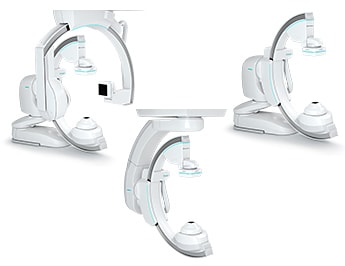
The model names, such as C12s or B12s, provide key information:
- Letter Prefix (B, C, F): This indicates the plane and mounting configuration.
- B: Bi-plane. These systems have two C-arms, providing simultaneous frontal and lateral views.
- C: Single-plane, Ceiling-mounted. The C-arm is suspended from the ceiling.
- F: Single-plane, Floor-mounted. The C-arm is mounted to the floor.
- Number (12, 16): This typically refers to the diagonal size of the Flat Panel Detector (FPD) in inches. A 12-inch detector is the standard for cardiology, while a larger 16-inch detector is better suited for vascular and general interventional radiology where a larger field-of-view is necessary.
Within the current generation, you will often hear the terms Unity and Smart. "Trinias Unity" is the name of the overall platform generation, characterized by the SCORE Opera image processing engine. "Smart" refers to the suite of intelligent workflow and technology features integrated into this platform, such as SMART Control and SMART Touch.
The Three Pillars of the Trinias Value Proposition
To articulate the value of these systems, we can ground our discussion in the three core design philosophies that Shimadzu emphasizes. These concepts are not just marketing terms; they are engineering principles that solve specific, tangible problems in the cath lab.
Let's explore these concepts using the official product webpage. As you read, focus on connecting each feature to one of these three pillars.
Trinias B12s/C16s/C12s/F12s with SCORE Opera - Shimadzu
This webpage provides the foundational marketing and technical language for the Trinias Unity series. It's organized around the three key value concepts we will be discussing.
Please read through the page, focusing on the following sections: Start by reviewing the three core concepts. This is our framework. In the "ALARA Design" section, read about SCORE Opera and SMART Control. Pay attention to how they promise to reduce dose while maintaining image quality. Next, in the "Lean Design" section, focus on the description of Single-Action 100+ and the ideas behind customization. Finally, in the "Sustainable Design" section, understand the purpose of SCORE Link and SMART Access.
As the reading highlights, the entire value proposition can be structured around these three pillars:
1. ALARA Design: Low Dose, High Image Quality
This directly addresses the primary concern of every cardiologist and radiologist: minimizing radiation exposure to the patient and staff without compromising the diagnostic quality of the image. Your engineering background gives you an advantage here, as you can appreciate the challenge of reducing quantum noise at lower photon counts.
- Core Technology: SCORE Opera (an AI-driven image processing engine) and SMART Control.
- Mechanism: These technologies work in concert to selectively enhance signal and suppress noise. This allows the system to produce clinically excellent images of fine structures, like stent struts and guidewires, at significantly lower pulse rates and dose levels.
- Sales Vocabulary Anchor: "While competitors also talk about low dose, our SCORE Opera engine uses AI to intelligently differentiate noise from signal. This means you can confidently perform complex procedures at lower frame rates, directly reducing patient and staff dose without losing critical device visibility. It's not just dose reduction; it's dose efficiency."
2. Lean Design: Workflow Efficiency
This pillar speaks to the operational and economic pressures on a modern cath lab. It's about maximizing patient throughput, reducing procedure time, and minimizing the cognitive load on the clinical team.
- Core Technology: SMART Touch with "Single-Action 100+" functions, customizable user interfaces, and ergonomic design.
- Mechanism: By consolidating multi-step operations into single button presses and allowing labs to tailor the interface to their specific procedures, the system removes friction from the workflow. This allows the operator to focus on the patient and the procedure, not the equipment.
- Sales Vocabulary Anchor: "We designed the system with a 'Lean' philosophy to optimize your lab's most valuable resource: time. With over 100 single-action functions accessible at the tableside via SMART Touch, you can reduce non-clinical interactions with the system, potentially shortening procedure times and improving team ergonomics."
3. Sustainable Design: Future-Proofing and TCO
This addresses the concerns of hospital administrators and biomedical engineers who think about the long-term viability and total cost of ownership (TCO) of a major capital investment.
- Core Technology: SCORE Link (subscription software updates) and SMART Access (versatile C-arm design).
- Mechanism: SCORE Link moves the system away from a static hardware purchase to an evolving platform, ensuring access to new clinical applications as they are developed. The physical design of the C-arm (SMART Access) allows it to cover a wide range of procedures, meaning the hospital's investment isn't locked into a single clinical specialty that might see reduced volumes in the future.
- Sales Vocabulary Anchor: "A cath lab is a 10-year investment. Our 'Sustainable Design' protects that investment. With our SCORE Link subscription, your system continuously evolves with the latest software innovations, preventing technological obsolescence. You're not just buying a system for today; you're investing in a platform for the next decade."
Mapping Models to Procedures and Value
Now, let's bring it all together. Here is how you can map the specific Trinias models to their target procedures and anchor your pitch in the most relevant value pillar.
| Model | Configuration | Primary Procedures | Primary Value Proposition Anchor |
|---|---|---|---|
| Trinias C12s / F12s | Single-plane, 12" FPD (Ceiling/Floor) | • Coronary Angiography • Percutaneous Coronary Intervention (PCI) |
ALARA Design: The definitive cardiology workhorse. Perfect for complex PCI, offering unmatched visualization of stents and guidewires at class-leading low doses thanks to SCORE Opera and StentView. |
| Trinias C16s | Single-plane, 16" FPD (Ceiling) | • Peripheral Vascular (run-offs) • Aortic Repair (EVAR/TEVAR) • Hybrid OR Procedures |
Lean & Sustainable Design: The versatile "crossover" system. The large detector and applications like SCORE Chase provide efficient imaging for long vascular anatomy, while the SMART Access C-arm makes it an ideal, future-proof platform for multi-disciplinary Hybrid ORs. |
| Trinias B12s | Bi-plane, 12" FPDs | • Electrophysiology (EP) • Pediatric Cardiology • Neuro-intervention |
ALARA & Lean Design: The ultimate tool for complex 3D procedures. Reduces procedure time and contrast dose by eliminating the need for repeated C-arm rotations. The extremely low dose profile is a critical safety advantage, especially in pediatric and neuro applications. |
This framework provides a clear, logical structure for your initial conversations with customers. It allows you to quickly identify the right system for their needs and pivot to the value proposition that will resonate most strongly with them.
Conclusion
In this lesson, we established the foundational knowledge of the Shimadzu Trinias product family. You are now equipped to:
- Deconstruct the Trinias model names (B/C/F) to understand their physical configuration and intended use.
- Articulate the three core value pillars of the Trinias Unity platform: ALARA Design, Lean Design, and Sustainable Design.
- Map specific Trinias models to their target clinical procedures and anchor the conversation in the most compelling value proposition for that use case.
This ability to connect hardware configurations to clinical needs and then to a core value message is the first step in building a winning technical sales strategy.
In our next lesson, we will perform a deep dive into the first and most critical value pillar for cardiologists. We will focus entirely on the SCORE Opera image processing engine, formulating a concise and powerful pitch that clearly explains the clinical problems it solves.