Hello! Welcome to the first lesson of your course on communication and relationship building. I'm excited to get started with you.
This course is designed to provide you with practical, real-world skills, beginning with the absolute fundamentals and progressively building toward more complex interactions. Our goal today is to establish a strong foundation by exploring the basic "how" of communication. By the end of this lesson, you will be able to identify the three core channels through which all communication flows: the verbal, the nonverbal, and the paraverbal. Understanding these distinct channels is the first crucial step in learning to interpret social cues more accurately and express yourself more effectively, which are key pillars for building stronger relationships both personally and professionally.
The Three Channels of Communication
Every time we communicate, we are sending messages on multiple levels simultaneously, whether we're conscious of it or not. Think of it like a broadcast on three different frequencies at once. Listeners tune into all three to get the full picture. These three channels are verbal, nonverbal, and paraverbal communication.
The image below gives a great at-a-glance summary of these three types.

To get a more precise understanding of these terms, please read a short excerpt from a training manual on communication skills.
This text provides clear, concise definitions for the three components of communication. It will help formalize the concepts introduced in the chart above.
Please start at the heading "THE THREE COMPONENTS OF COMMUNICATION". Read the section that defines the three components. Then, continue to the section "SENDING MESSAGES" and read the short descriptions for Verbal Messages, Nonverbal Messages, and Paraverbal Messages.
As you've just read, the distinction is:
- Verbal: The content itself—the specific words you choose.
- Nonverbal: Your body language—gestures, posture, and facial expressions.
- Paraverbal: How you say the words—your tone of voice, speed (pacing), and volume.
It's particularly important to distinguish paraverbal from verbal. The sentence "Great job" can be a sincere compliment or biting sarcasm. The words are identical; the paraverbal cues make all the difference.
The Relative Impact of Each Channel
Now that we have defined the three channels, a natural question arises: are they all equally important? Not always. The work of researcher Albert Mehrabian in the 1960s provided a compelling, though often misunderstood, answer to this.
He found that when we are communicating feelings and attitudes, the verbal component carries surprisingly little weight compared to the nonverbal and paraverbal channels. His findings are often summarized as the "7-38-55 Rule."
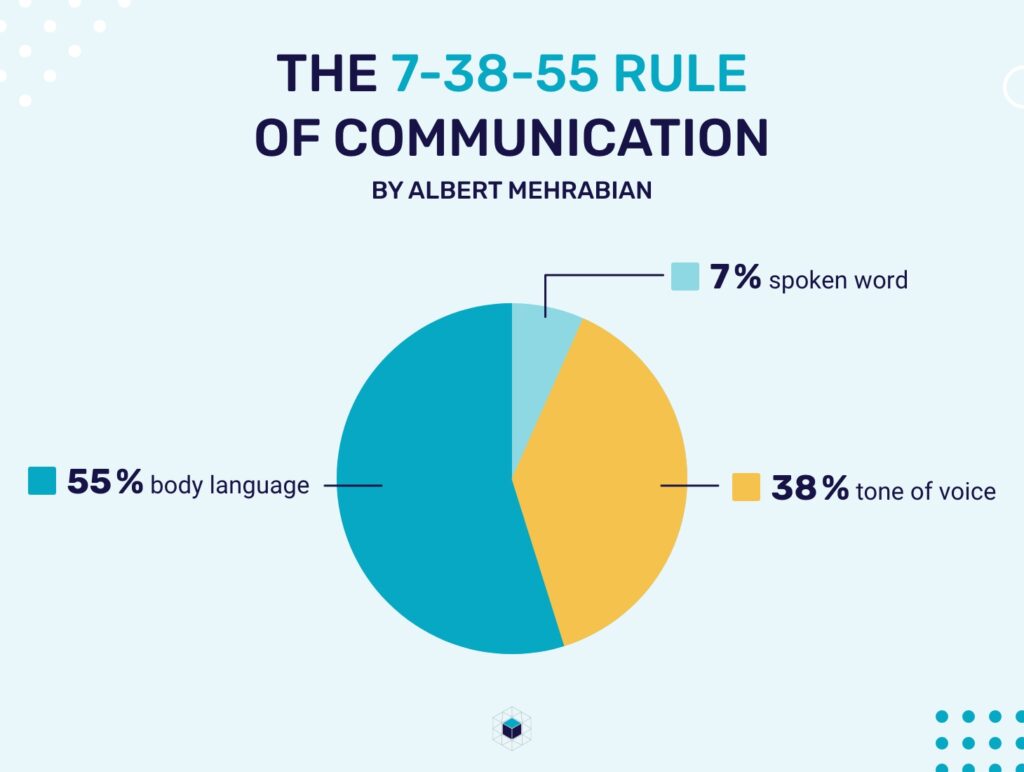
This rule suggests that in a conversation about feelings or attitudes:
- 55% of the message's impact comes from body language (nonverbal).
- 38% comes from tone of voice (paraverbal).
- Only 7% comes from the actual words (verbal).
A critical point of clarification: This rule applies most accurately when there is a contradiction between the channels. For example, if someone has slumped shoulders and a flat tone of voice, but says, "I'm having a wonderful time," we instinctively trust the 93% (the nonverbal and paraverbal) and discount the 7% (the words). It doesn't mean that words are meaningless; in a technical, fact-based conversation, the words are paramount. But in the social and relational contexts you're focused on, this rule highlights why being able to read beyond the words is so powerful.
The following short video provides a quick summary of these concepts in a workplace context.
Non Verbal Communication at Work
This video, "Non Verbal Communication at Work," will quickly reinforce the concepts of nonverbal and paraverbal communication and their outsized impact.
Please watch the entire video. It is less than two minutes long and provides a good visual summary of what we've discussed so far, touching on the 7-38-55 rule and giving examples for gestures and posture.
How the Channels Work Together
The three communication channels don't just exist side-by-side; they interact in complex ways to create, reinforce, or even undermine a message. Understanding these interactions is key to both sending clearer messages and better interpreting the messages of others.
A message can be enhanced when the channels are consistent and confusing when they are not. For instance, when you say "I'm so excited" with a wide smile and an energetic tone, the verbal, nonverbal, and paraverbal channels are all aligned, creating a clear and powerful message. But what happens when they're not aligned?
The next video offers an excellent breakdown of the six primary ways that verbal and nonverbal communication interact. Note that the presenter groups paraverbal elements like tone and pace into the broader category of "nonverbal," which is a common approach.
Verbal and Nonverbal Communication
In this video, Communication Coach Alexander Lyon will walk through the six functions of nonverbal communication and introduce the powerful concept of "nonverbal leakage."
Please watch the section that begins at "How do these work together?". The speaker outlines six ways verbal and nonverbal cues interact: repeating, substituting, turn-taking, complementing, emphasizing, and contradicting. After that, continue watching the next segment on nonverbal leakage. This is a fantastic concept that directly relates to your goal of reading social cues.
Let's quickly recap those six interactions with some practical examples:
- Repeating: Saying "two" while holding up two fingers. The gesture repeats the word.
- Substituting: Shrugging your shoulders instead of saying "I don't know." The gesture replaces the words.
- Turn-Taking (Regulating): Making eye contact and nodding to encourage someone to continue speaking, or looking away and breaking eye contact to signal the conversation is ending.
- Complementing: Smiling while telling a happy story. The nonverbal behavior adds to or enriches the verbal message.
- Emphasizing (Accenting): Pounding your fist on a table while saying "I will not accept this!" to accent a key word or phrase. The paraverbal equivalent is raising your voice on a single word for emphasis.
- Contradicting: This is the most important one for reading people. It's when the channels conflict, like in our earlier example of someone saying "I'm fine" while crying.
The video's introduction of nonverbal leakage is particularly relevant to your goal of understanding social cues. This is the idea that our true feelings can "leak out" through our nonverbal and paraverbal channels, even when we are trying to hide them with our words. A fleeting frown, a slight tremor in the voice, or a hand that won't stop fidgeting can often tell you more than a carefully constructed sentence. Learning to spot this leakage is a core skill in becoming a more perceptive communicator.
Conclusion
In this foundational lesson, we've unpacked the basic mechanics of how communication works. You now have the vocabulary and conceptual framework to see conversations not just as an exchange of words, but as a multi-layered exchange of meaning.
Here are the key takeaways:
- Three Channels: Communication operates through verbal (words), nonverbal (body language), and paraverbal (vocal tone, pace, volume) channels.
- Unequal Weight: In emotional and social contexts, nonverbal and paraverbal cues often have a far greater impact on how a message is received than the words themselves (the 7-38-55 Rule).
- Interaction is Key: The channels work together to repeat, substitute, complement, emphasize, regulate, or contradict a message.
- Contradiction Reveals: When channels contradict, we tend to believe the nonverbal/paraverbal message. This "nonverbal leakage" can be a powerful clue to a person's true feelings.
This framework is the bedrock for everything that follows. As you go about your week, try to consciously notice these different channels in your daily interactions. Don't worry about interpreting them perfectly yet—just practice observing. Notice the tone of voice when someone says "hello." Notice the posture of people in a meeting. This simple act of observation is the first step.
In our next lesson, we will build directly on this by exploring the common barriers to effective communication. We'll examine how noise, assumptions, and our own emotional states can distort these channels and lead to misunderstanding.