Hello again. In our last lesson, we delved into the theoretical underpinnings of the Transformer architecture and its self-attention mechanism. You now have a solid grasp of how these models process text in parallel and capture complex contextual relationships.
This lesson bridges that theory with the practical needs of your project. We'll focus on how to take a powerful, pre-trained model built on the Transformer encoder—specifically, BERT—and adapt it for your specific task of classifying parent complaints. This process, known as fine-tuning, is a cornerstone of modern NLP and is exactly what you'll use to build your second baseline model. By the end of this lesson, you will be able to describe how this adaptation process works, preparing you to implement it yourself.
1. The Power of Transfer Learning in NLP
Training a large language model from scratch requires immense computational resources and vast amounts of text data—we're talking about crawling a significant portion of the internet. For most projects, including yours, this is impractical. Instead, we leverage transfer learning.
The core idea is simple and analogous to how you might use a pre-built library in software development. Someone else has done the heavy lifting of building a powerful, general-purpose tool. You then take that tool and adapt it for your specific needs. In NLP, this is a two-step process:
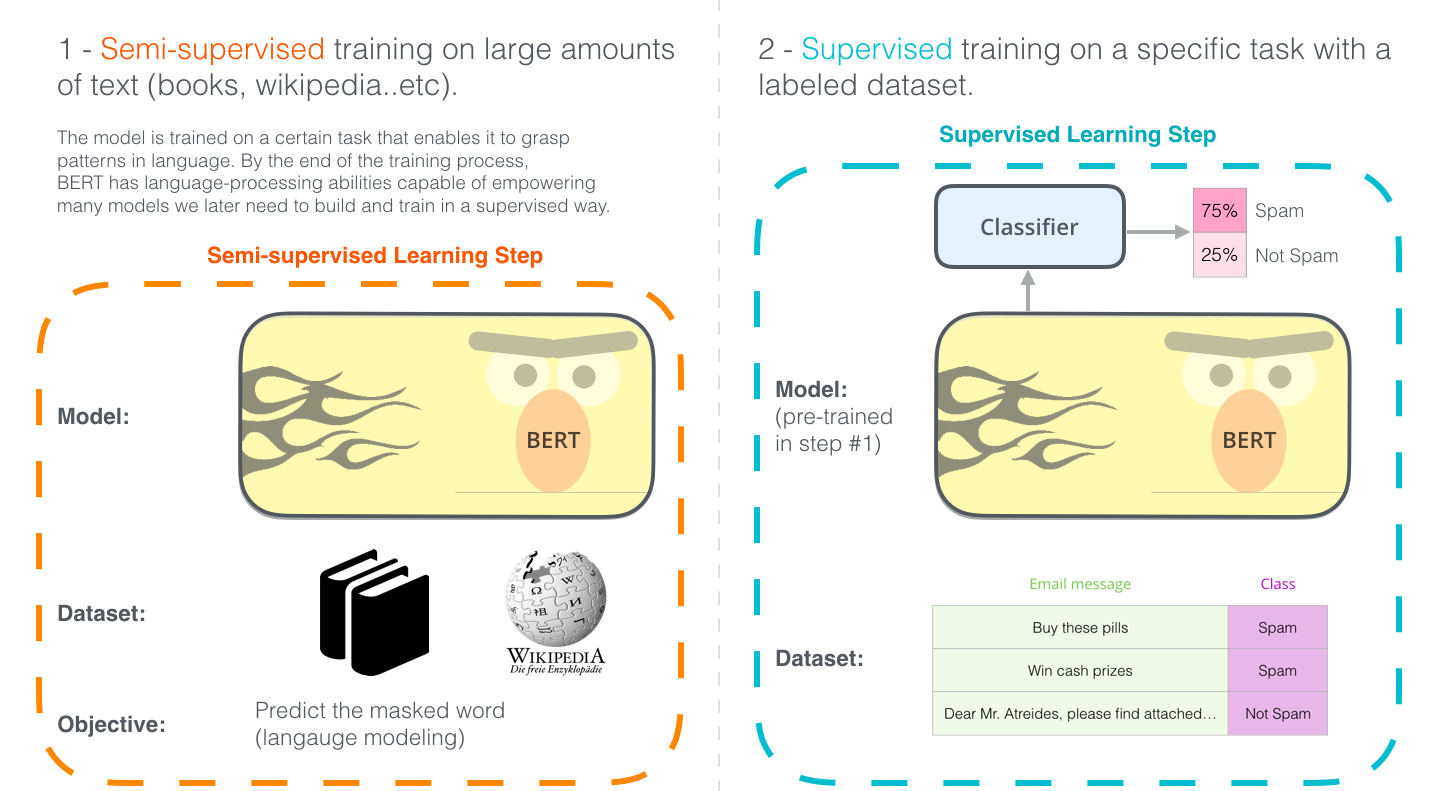
- Pre-training: A large model like BERT (Bidirectional Encoder Representations from Transformers) is first trained on a massive, unlabeled text corpus (like Wikipedia and the BooksCorpus). It isn't trained on a specific task, but rather on general "language understanding" objectives. These objectives, like predicting masked words in a sentence, force the model to learn grammar, semantics, context, and world knowledge. This phase produces the powerful, pre-trained model.
- Fine-tuning: This is where you come in. You take the pre-trained model, which is already rich with linguistic knowledge, and continue training it on your own smaller, labeled dataset (e.g., your parent complaints with "violation" or "no violation" labels). This second phase adapts the model's general knowledge to your specific classification task.
The video below gives an excellent overview of this two-phase process.
BERT Neural Network - EXPLAINED!
This video from CodeEmporium clearly separates the pre-training and fine-tuning stages and explains the objectives of each.
Watch the initial segment from the beginning to understand how BERT is derived from the Transformer's encoder and how its training is split into two phases. Then, watch the explanation of the two pre-training tasks, Masked Language Modeling and Next Sentence Prediction. This will clarify what kind of knowledge BERT learns before we even touch our own data.
The following image provides a great visual summary of this entire transfer learning workflow.
2. Adapting the Architecture: Adding a Task-Specific "Head"
How do we take a model designed for general language understanding and make it predict complaint categories? The adaptation starts at the architectural level. A pre-trained BERT model is essentially a sophisticated feature extractor. Our goal is to attach a simple classifier to it.
Here's how it works:
-
Input Formatting: We feed our text complaint into BERT. As we learned in the previous lesson on Transformers, the input is tokenized. For BERT, a special token,
[CLS](for "classification"), is added to the beginning of every input sequence. -
Processing through BERT: The entire sequence, including the
[CLS]token, is processed through the multiple layers of the Transformer encoder that make up BERT. At each layer, self-attention helps create increasingly context-aware representations for each token. -
The
[CLS]Token's Role: The final hidden-state vector corresponding to the[CLS]token is unique. By design, the model learns to aggregate the meaning of the entire sequence into this single vector. Think of it as a rich numerical summary of the input complaint. Its dimensionality is typically 768 for the base BERT model. -
Adding a Classification Head: This 768-dimension
[CLS]vector is then fed into a new, small neural network that we add on top of BERT. For most classification tasks, this "head" is just a single, untrained linear layer with a softmax activation function. The linear layer's job is to map the 768-dimension summary vector to a vector withNdimensions, whereNis the number of classes you have (e.g., for "Good," "Adequate," and "Poor,"Nwould be 3). The softmax function then converts these raw output values (logits) into a probability distribution, giving you the likelihood for each class.
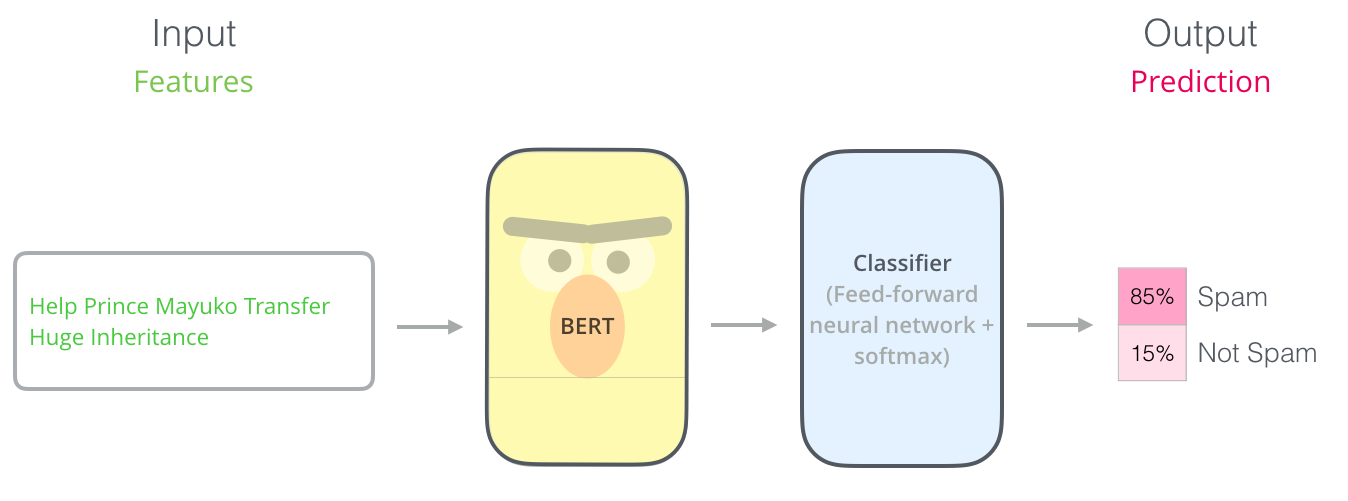
The following video provides a fantastic, step-by-step walkthrough of this entire process, from tokenization to the final prediction.
FineTuning BERT for Multi-Class Classification on custom Dataset | Transformer for NLP
This video from Rohan-Paul-AI offers a detailed mechanical explanation of how raw text flows through the BERT model during fine-tuning for classification. It clarifies the exact role of the [CLS] token and the classification head.
Watch the section from understanding the flow. This part meticulously breaks down how the [CLS] token is used, how its final hidden state becomes the sequence representation, and how it is passed through the linear and softmax layers to get a class prediction.
3. The "Tuning" Process: Updating the Model's Weights
Once the new classification head is attached, the model is ready for fine-tuning. This is a supervised training process where the model's predictions are compared against the true labels from your dataset, a loss is calculated, and the model's weights are updated via backpropagation. But which weights are updated?
This is the most crucial part of fine-tuning:
- The Classifier Head: The weights of the new linear layer are initialized randomly. They have no knowledge of your task, so they must be trained from scratch on your labeled data.
- The Pre-trained BERT Body: The weights of the main BERT model are not random. They contain all the rich language knowledge from the pre-training phase. We don't want to erase this knowledge. Therefore, we update these weights as well, but with a very small learning rate.
This strategy allows us to gently "nudge" the powerful, pre-existing representations to become slightly more specialized for our complaint classification task, while the new classifier head learns to map these specialized representations to our desired output labels. Because we are only making small adjustments to a very good starting point, fine-tuning is far more efficient and effective than training from scratch.
BERT Neural Network - EXPLAINED!
This segment from CodeEmporium clearly explains the concept of fine-tuning the model's weights.
Watch the section from the fine-tuning phase. It emphasizes that only the output layer parameters are learned from scratch, which is why the process is fast and efficient.
For even more detail on how the weights are updated, refer back to the previous video resource.
FineTuning BERT for Multi-Class Classification on custom Dataset | Transformer for NLP
This section of the video from Rohan-Paul-AI addresses a common question about what weights get modified during fine-tuning.
Please watch the segment from do all weights get modified?. It confirms that all weights are potentially modified, but explains why a smaller learning rate is used to preserve the general language knowledge acquired during pre-training.
Fine-Tuning vs. Feature Extraction
It's worth noting an alternative approach called feature extraction. In this method, you would "freeze" all of BERT's layers, preventing any of its weights from being updated. You would use BERT purely to convert your text into [CLS] vectors and then train a separate classifier on these vectors.
For your project, fine-tuning is the recommended approach. It generally yields higher performance because it allows the entire model to adapt to the nuances of your specific data. However, knowing about freezing layers is useful, as it's a technique sometimes used to speed up training, especially with smaller datasets.
Fine-Tuning BERT for Classification: A Practical Guide
This article provides practical advice on fine-tuning and introduces the concept of freezing layers.
Read the section titled Freezing Layers. This will give you a clear rule of thumb for when you might consider freezing parts of the model versus fine-tuning everything.
Conclusion
In this lesson, you've learned the conceptual framework for adapting a general-purpose language model like BERT to a specific task. This process, fine-tuning, is what makes state-of-the-art NLP accessible and practical for projects like yours.
Here are the key takeaways:
- Transfer learning in NLP involves a two-step process: pre-training on a massive, general corpus, followed by fine-tuning on a smaller, task-specific labeled dataset.
- Adapting BERT for classification involves adding a simple classification head (typically a linear layer + softmax) on top of the pre-trained model.
- The final hidden state of the special
[CLS]token is used as the input to this classification head, as it serves as an aggregated representation of the entire input sentence. - During fine-tuning, the new classification head is trained from scratch, while the body of the pre-trained BERT model is updated with a small learning rate to gently specialize its knowledge without losing its powerful general language understanding.
You now understand the "what" and "why" behind fine-tuning. In our next lesson, we will dive into the "how." You'll use the Hugging Face transformers library in Python to load a pre-trained BERT model, tokenize your complaint data, and execute the fine-tuning process to build your text classification baseline.