Hello! Welcome back to our lessons on English pronunciation.
In our last session, you did an excellent job learning the first set of diphthongs: /eɪ/, /aɪ/, and /ɔɪ/. We established that a diphthong is a single syllable vowel sound that glides from one mouth position to another.
Today, we will complete our foundation in English diphthongs by focusing on the final two common ones. Your goal for this lesson is to distinguish and produce the diphthongs /aʊ/ (as in 'now') and /əʊ/ (as in 'go').
Mastering these two sounds is crucial because they are very common in English and are often a point of confusion. As before, we will focus on the specific mechanics of producing them—the movement of your tongue, lips, and jaw—to suit your preferred learning style.
1. Introducing Two New Diphthongs
Like the sounds we studied last time, /əʊ/ and /aʊ/ are "closing diphthongs," which means your mouth becomes more closed as you finish the sound. They both end with the same rounded-lip position, but they start very differently.
This infographic provides a great overview of both sounds, showing their movement on the vowel chart and their common spellings. We will refer back to it.

Let's begin by watching a short introduction to both sounds.
How to Pronounce Diphthongs - Learn British English RP Accent - /əʊ/ + /aʊ/
We'll continue with the 'English with Liz' channel. This clip introduces the /əʊ/ and /aʊ/ diphthongs and reinforces the idea of a vowel glide.
Watch from the beginning to 01:09. Focus on the definition of a diphthong and hear the target sounds in the example words 'no' and 'mouth'.
2. The /əʊ/ Sound (as in go, boat)
The first sound, /əʊ/, is very common in words like go, no, show, and boat. It's the sound many people think of as the "long O".
The Glide: This sound glides from the schwa sound /ə/ to the /ʊ/ sound (as in 'put').
Physical Mechanics:
- Starting Position (/ə/): Start with your mouth completely relaxed. Your jaw, lips, and tongue are in a neutral, central position. This is the schwa sound we've discussed before.
- Ending Position (/ʊ/): From the neutral start, your lips come together into a small, rounded shape. The back of your tongue tenses and rises slightly.
Let's see this in action. The key is the lip rounding at the end.
How to Pronounce Diphthongs - Learn British English RP Accent - /əʊ/ + /aʊ/
This segment of the video breaks down the production of the /əʊ/ sound. Pay close attention to the instruction about making the first sound longer and the second sound shorter and unstressed.
Watch from 01:09 to 02:40. Try to imitate the correct sound ('no') and the incorrect sound ('no-oh') to feel the difference.
Practice Words: Say these words aloud. Focus on starting relaxed and finishing with rounded lips.
- go
- open
- boat
- slow
- though
- phone
3. The /aʊ/ Sound (as in now, house)
Our second sound, /aʊ/, is found in words like now, how, out, and down.
The Glide: This sound glides from an open vowel /a/ to the same /ʊ/ sound.
Physical Mechanics:
- Starting Position (/a/): Begin by dropping your jaw to create a lot of space in your mouth. Your tongue should be low. It's a very open sound.
- Ending Position (/ʊ/): From the open start, your jaw rises and your lips come together into that same small, rounded shape as the /əʊ/ sound.
The movement for /aʊ/ is much larger than for /əʊ/. This diagram clearly shows the open starting position and the rounded ending position.
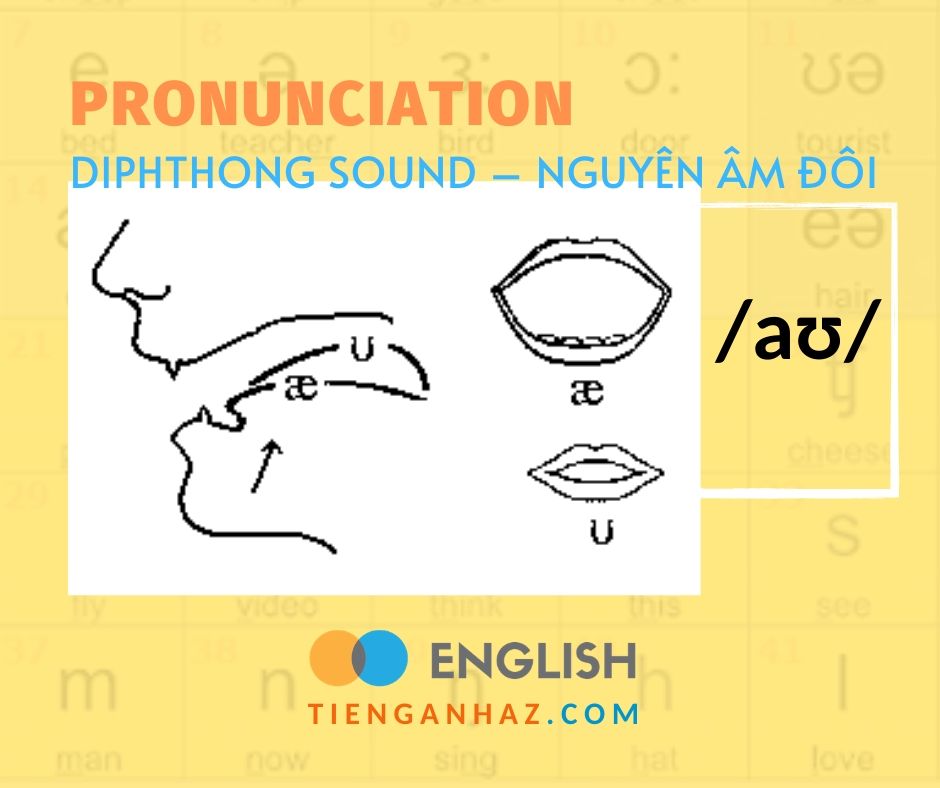
Let's watch two videos to master this movement. The first gives an overview, and the second provides a detailed, slow-motion look at the mechanics.
How to Pronounce Diphthongs - Learn British English RP Accent - /əʊ/ + /aʊ/
First, let's return to the 'English with Liz' video to get an initial explanation of the /aʊ/ sound.
Watch from 03:35 to 04:00. The instructor explains the starting 'ah' sound and the glide to the final sound.
English Sounds - OW [aʊ] Diphthong - How to make the OW as in NOW Diphthong
Now, for a more detailed look, this video from 'Rachel's English' is excellent. It provides a slow-motion close-up, which is perfect for seeing the jaw drop and lip rounding in detail. Remember to allow for comfortable movement, especially with your braces.
Watch from 00:22 to 01:36. Pay close attention to the jaw drop for the first sound and how the lips round to finish the sound.
Practice Words: Say these words aloud. Exaggerate the jaw drop at the beginning.
- now
- house
- sound
- down
- about
- loud
4. Distinguishing /əʊ/ vs. /aʊ/
The most important part of this lesson is learning to clearly distinguish between these two sounds. The ending position is the same (rounded lips), so the difference is entirely in the starting position.
- /əʊ/: Starts relaxed and central. Small jaw movement.
- /aʊ/: Starts wide open. Large jaw movement.
Using a mirror is the best way to check this. When you say a word with /aʊ/, you should see your jaw drop significantly more than for a word with /əʊ/.
Minimal Pair Practice
Minimal pairs are words that differ by only one sound. Practicing them is a powerful way to train your ear and mouth.
How to Pronounce Diphthongs - Learn British English RP Accent - /əʊ/ + /aʊ/
Let's watch the minimal pairs from the 'English with Liz' video one more time. Listen carefully to the contrast.
Watch from 04:00 to 04:45. After watching, say the pairs yourself while looking in a mirror. Watch your jaw.
Now, practice these pairs on your own. Say both words in each pair and focus on the different starting positions.
- no / now
- load / loud
- found / phoned
- doubt / d**on'**t
Conclusion
Excellent work today! You have now learned the mechanics of all the major English diphthongs. This is a huge step forward in making your speech sound clearer and more natural.
Key Takeaways:
- Diphthongs are vowel glides that happen within one syllable.
- The /əʊ/ sound starts from a relaxed, central position and ends with rounded lips (e.g., go).
- The /aʊ/ sound starts from a wide-open jaw position and ends with rounded lips (e.g., now).
- The key difference is the starting position: a small movement for /əʊ/ and a large jaw-drop for /aʊ/.
Preview of Next Lesson:
In our next lesson, we will shift our focus from vowels to consonants. We'll begin by learning a very useful technique called minimal pairs to help distinguish between similar-sounding consonants like /p/ and /b/. This will build directly on the minimal pair practice we did today.
Keep practicing these diphthongs, especially using a mirror to check your jaw movement. A few minutes of practice each day will make a big difference.