Hello! Welcome to your next lesson.
In our last session, we worked on distinguishing between the short vowels /ʌ/ (as in 'cup') and /ɒ/ (as in 'cot'), focusing on how lip rounding creates the difference. We will continue with this theme of contrasting vowel pairs and focusing on the physical aspects of sound production.
Today's lesson addresses a pair of sounds that are often confused: /ʊ/ as in 'put' and /uː/ as in 'pool'. Your goal is to learn to distinguish and produce these two sounds accurately. This is a common challenge because the main differences are subtle changes in sound length, tongue position, and lip tension. For many learners, including native Hindi speakers, these English sounds may be pronounced similarly to sounds in their own language, but the specific mouth posture is unique. Getting this right is a big step toward clearer pronunciation.
1. The Relaxed Vowel: The /ʊ/ Sound (as in 'put')
First, let's focus on the /ʊ/ sound. This is a short, relaxed vowel. In the International Phonetic Alphabet (IPA), it's often called the "near-close near-back rounded vowel."
How to produce the /ʊ/ sound:
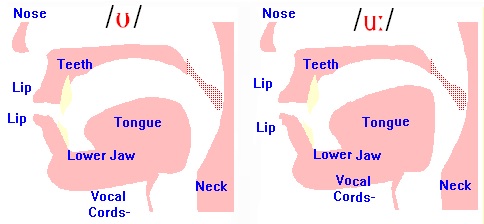
- Jaw: Your jaw is fairly high, so your mouth is not very open.
- Lips: Your lips are slightly rounded, but they are relaxed, not tight or pushed forward.
- Tongue: The back of your tongue is raised, but it's in a relaxed, lower position compared to the /uː/ sound we will learn next.
Let's watch a video that explains this in detail. The instructor uses a helpful analogy to get the feeling right.
How to pronounce pool vs. pull | Tense UW vs. Lax U in American English
In this video from Accent's Way English, Hadar will explain how to produce the relaxed /ʊ/ sound. Pay close attention to her description of the jaw, lips, and her 'hot potato' analogy for tongue position.
Please watch from 03:00 to 04:19. Notice how the jaw drops slightly and the lips are only a little rounded. Try to imitate the sound and the example words: 'pull', 'foot', 'cook', 'look', 'book'.
Common spellings for /ʊ/:
- u: put, push, full
- oo: good, foot, look, cook
- ou: could, should, would
2. The Tense Vowel: The /uː/ Sound (as in 'pool')
Now, let's look at its counterpart, the /uː/ sound. This is a long, tense vowel. The two dots (:) in the IPA symbol /uː/ signify that it is a long sound.
How to produce the /uː/ sound:
- Jaw: Your jaw is high, and your mouth is nearly closed.
- Lips: Your lips are tightly rounded and pushed forward, as if you were about to whistle or say "eww."
- Tongue: The back of your tongue is very high and tense.
This tension and forward lip position are the key physical differences from the /ʊ/ sound. Since you have braces, focus on the feeling of pushing your lips forward rather than stretching them wide.
Let's return to the same video for an explanation of this sound.
How to pronounce pool vs. pull | Tense UW vs. Lax U in American English
Hadar will now explain the tense /uː/ sound. Her analogies of sound coming through a 'straw' and making the 'ew' sound are excellent for feeling the correct mouth position.
Please watch from 01:05 to 03:00. Focus on the instructions to push your lips forward and pull the tongue up. Practice the examples: 'pool', 'food', 'who'.
Common spellings for /uː/:
- oo: food, pool, soon
- ew: new, few
- ue: blue, glue
- o_e: move, whose
3. The Contrast: /ʊ/ vs. /uː/
The best way to master these sounds is to contrast them directly. Let's summarize the differences:
| Feature | /ʊ/ (as in put) | /uː/ (as in pool) |
|---|---|---|
| Length | Short | Long |
| Lips | Relaxed, slightly round | Tense, tightly rounded, pushed forward |
| Tongue | Lower and relaxed | Higher and tense |
| Jaw | Slightly more open | Nearly closed |
This image shows the tongue position for both sounds. You can see how the tongue is much higher and further back for /uː/. This is exactly the kind of physical detail you find helpful.
Minimal Pair Practice
Now, let's practice telling them apart and saying them in pairs. This will train both your ear and your mouth muscles.
How to pronounce pool vs. pull | Tense UW vs. Lax U in American English
Let's watch the final section of Hadar's video, where she directly compares the two sounds using minimal pairs.
Watch from 04:19 to 05:25. Listen carefully to the pairs and then repeat them aloud. Try to feel the difference in your lips and tongue. pool vs. pull coo vs. cook Luke vs. look
Here are more pairs to practice. Say them aloud, exaggerating the difference at first.
- food /fuːd/ vs. foot /fʊt/
- full /fʊl/ vs. fool /fuːl/
- wood /wʊd/ vs. wooed /wuːd/
- should /ʃʊd/ vs. shoed /ʃuːd/
4. The Spelling Puzzle: The <oo> Trap
As you've seen, the spelling <oo> is particularly tricky because it can be pronounced as /ʊ/ or /uː/. There is no perfect rule, so you often have to learn the pronunciation of individual words.
Let's do a quick exercise to test your ear.
[PDF] The Sound of English - Pronunciation Studio
The following exercise is based on a fantastic resource from Pronunciation Studio. We'll use it to practice sorting words with the '' spelling.
I want you to look at the list of words below. Try to say each one aloud and decide if it has the /ʊ/ sound (like 'good') or the /uː/ sound (like 'food'). Categorize them into two groups. You can check the Pronunciation Studio PDF on page 68 ('< oo > | Spelling & Sound') for the answers if you are stuck. Word list: book, wood, stood, food, soon, fool, cool, look, good, roof, tooth, hook, room.
Group 1: /ʊ/ (like 'good')
- ...
Group 2: /uː/ (like 'food')
- ...
(Take your time to sort the words before checking your answers.)
Answer Key:
- Group 1 /ʊ/: book, wood, stood, look, good, hook
- Group 2 /uː/: food, soon, fool, cool, roof, tooth, room
Conclusion
Great job today! You have tackled one of the most common vowel contrasts in English. By focusing on the physical sensations of tongue tension, lip rounding, and sound length, you can reliably produce and distinguish between /ʊ/ and /uː/.
Key Takeaways:
- The /uː/ sound (as in 'pool') is long and tense. Your lips are tight and pushed forward, and your tongue is high in your mouth.
- The /ʊ/ sound (as in 'put') is short and relaxed. Your lips are looser, and your tongue is lower.
- The spelling
<oo>is not a reliable guide and can represent either sound, so it's important to learn the pronunciation of individual words. - Practicing with minimal pairs like
full/foolis the best way to solidify your understanding.
In our next lesson, we will continue to expand your vowel repertoire by tackling four more long vowel sounds: /iː/ (as in 'seat'), /ɑː/ (as in 'car'), /ɔː/ (as in 'fork'), and /ɜː/ (as in 'bird'). Keep up the excellent work