Introduction
Hello! In our last module, we explored the "melody" of English by mastering intonation to convey different emotions and attitudes. We learned how the rise and fall of your voice can change the entire meaning of a sentence.
Now, we move from the melody to the flow of English. This module is about Connected Speech—the techniques native speakers use to make their words flow together smoothly and naturally, rather than sounding like a series of separate words. For your goal of succeeding in job interviews and working internationally, mastering this flow is just as important as pronouncing individual sounds correctly.
In today's lesson, you will learn the most fundamental rule of connected speech: linking words that end in a consonant sound to words that begin with a vowel sound. By the end of this 30-minute lesson, you will be able to apply this technique to make your own speech sound much more fluent and natural.
1. What is Linking and Why is it Important?
In written English, we see spaces between words. In spoken English, those spaces often disappear. Linking is the bridge that connects words, creating a smooth, uninterrupted stream of speech.
Let's begin with a video that explains this concept and highlights why it's so beneficial for your pronunciation.
How to connect English words to sound like a native speaker | Accurate English
This video from AccurateEnglish provides an excellent introduction to linking. It demonstrates the difference between choppy, disconnected speech and smooth, linked speech.
Watch the first two minutes of this video (from 00:00 to 02:05). Pay attention to: The examples of disconnected vs. connected speech (e.g., 'I live in an apartment'). The key idea that linking creates smoother speech, not necessarily faster speech. The main rule: connect a final consonant sound to the next word's starting vowel sound.
As the video explained, learning to link has three major benefits:
- You will sound more natural and fluent.
- It forces you to pay more attention to sentence stress, which we covered in a previous module.
- It can actually make pronouncing difficult final consonants easier, because you move them to the beginning of the next syllable where they are often easier to say.
2. The Rule: Consonant Sound → Vowel Sound
The rule is straightforward: when one word ends in a consonant sound and the next word begins with a vowel sound, you pronounce them as if they are one long word. The consonant sound effectively "jumps over" to start the next word.
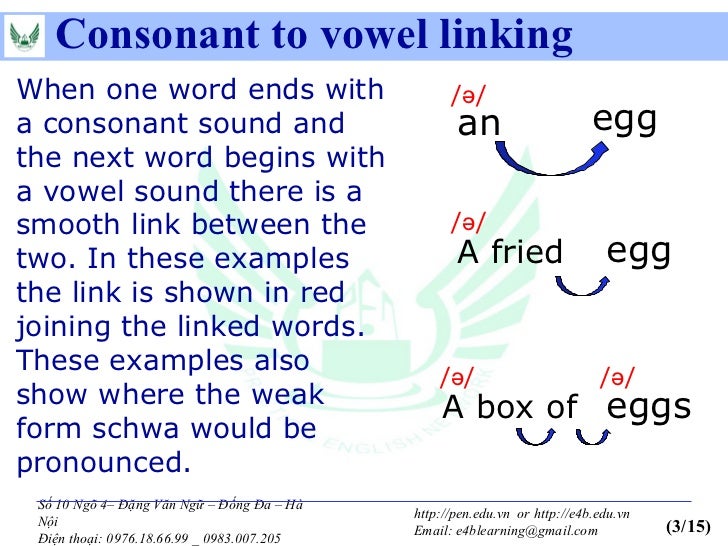
A crucial point to remember, which is especially important given your interest in the mechanics of speech, is that this rule applies to sounds, not letters.
A perfect example is the phrase "an hour".
- The word 'an' ends with an /n/ sound.
- The word 'hour' is spelled with an 'h', but it begins with an /aʊ/ vowel sound (the 'h' is silent).
- Therefore, we link them: a-nour.
3. Seeing and Hearing it in Action
Let's watch a couple of clear, slow-motion examples. This will help you see and hear exactly how the sounds connect.
English Pronunciation - Linking: Consonant to Vowel -- American Accent
This video from Rachel's English is excellent for breaking down the mechanics of linking. We'll look at two very common examples.
Watch these two short clips: 'his anniversary' (02:34 - 03:00): Notice how the final 's' in 'his' is pronounced like a /z/ sound. This /z/ sound moves to the start of 'anniversary', so the phrase sounds like 'hi-zanniversary'. 'what is it' (02:02 - 02:34): This is a very useful phrase. The 't' in 'what' and 'it' are both between vowel sounds, so they change to a light 'd' sound (a 'flap t'). Everything links together to sound like 'wha-di-zit'.
The "flap t" you heard in "what is it" is a very common feature of American English. When a /t/ sound appears between two vowel sounds, it softens to sound like a quick /d/. This happens frequently because of linking.
4. Practice Time
Now it's your turn to practice. The best way to master linking is to say the phrases out loud and feel the smooth connection.
This PDF provides focused practice on linking with three of the most common final consonants: /n/, /r/, and /t/.
Consonant to Vowel Linking with N, R, and T
Let's work through some targeted exercises. This document gives clear examples to help you practice.
Please read through this short document. As you read the example phrases in the tables, say them out loud. Your goal is to make the transition from the consonant to the vowel completely smooth, with no pause. For example: can of should sound like ca-nof sure is should sound like su-ris put it should sound like pu-dit (using that soft 'd' sound) Try the tip mentioned in the text: put your hand on your throat to feel the vibration of your vocal cords. You should feel a continuous vibration as you move from one word to the next.
Putting it into Sentences
Now, let's try linking within full sentences. Record yourself saying these sentences and listen back. Can you hear the smooth connections?
- I need to pick it up. (sounds like: pick-i-tup)
- He works in an office. (sounds like: i-na-noffice)
- This is a great idea. (sounds like: thi-si-za)
- Let's talk about it. (sounds like: tal-ka-bou-tit)
Conclusion
Great work today! You have just learned the most common and important feature of connected speech in English. Making this one change will have a huge impact on how fluent and natural you sound.
Key Takeaways:
- The Rule: Link words that end in a consonant sound to words that begin with a vowel sound.
- The Technique: Imagine the final consonant sound moves to the beginning of the next word, creating one long, smooth word.
- The Goal: Not to speak faster, but to speak smoother and eliminate the choppy breaks between words.
- Remember: Always focus on sounds, not spelling (e.g., 'an hour').
Preview of Next Lesson:
Now that you know how to connect words, we will next look at a related topic: elision. This is when native speakers drop sounds in common phrases to speak even more efficiently, like saying 'next door' as 'nex door'. This is another key piece of the puzzle to understanding and sounding like a native speaker.