Hello! Welcome to the next lesson in your English pronunciation course.
In our last session, we focused on producing the labiodental fricative /v/, emphasizing the friction created by the lower lip touching the upper teeth. We noted that this is different from the sound commonly used in Hindi.
Today, we will build directly on that knowledge. Our goal is to distinguish and produce the /v/ and /w/ sounds correctly, a common challenge for Hindi speakers. This lesson is crucial for clear communication, as mixing these sounds can change the meaning of words entirely (e.g., 'vest' vs. 'west'). We will break down the precise physical movements for each sound, which will help you master the distinction.
1. Understanding the Source of Confusion
The main reason Hindi speakers often confuse /v/ and /w/ is that Hindi has a sound, phonetically written as /ʋ/, that sits between the two English sounds. You may recall from the document we reviewed in the last lesson, "A Contrastive Study of English & Hindi Speech Sounds," that this sound is a labiodental approximant.
Let's quickly break down what this means, as understanding the theory will help you in practice:
- English /v/: A labiodental fricative. You bring your top teeth and bottom lip together (labiodental) and create friction (fricative).
- English /w/: A voiced labio-velar approximant. You round your lips (labio-) and pull the back of your tongue up (velar), letting the sound glide out without friction (approximant).
- Hindi /ʋ/: A labiodental approximant. You bring your teeth and lip close (labiodental), but you don't create the friction needed for the English /v/. It's an approximant, like the English /w/.
Your goal is to learn to separate this middle-ground Hindi sound into two distinct English sounds: one with clear friction (/v/) and one with rounded lips and no friction (/w/).
2. How to Produce the /v/ and /w/ Sounds
Let's watch a video that explains the physical production of each sound in detail. Pay close attention to the instructor's description of lip and teeth placement.
How to pronounce the V and W (and how NOT to confuse them when speaking)
This video from Accent's Way English provides an excellent breakdown of the mechanics for both the /v/ and /w/ sounds.
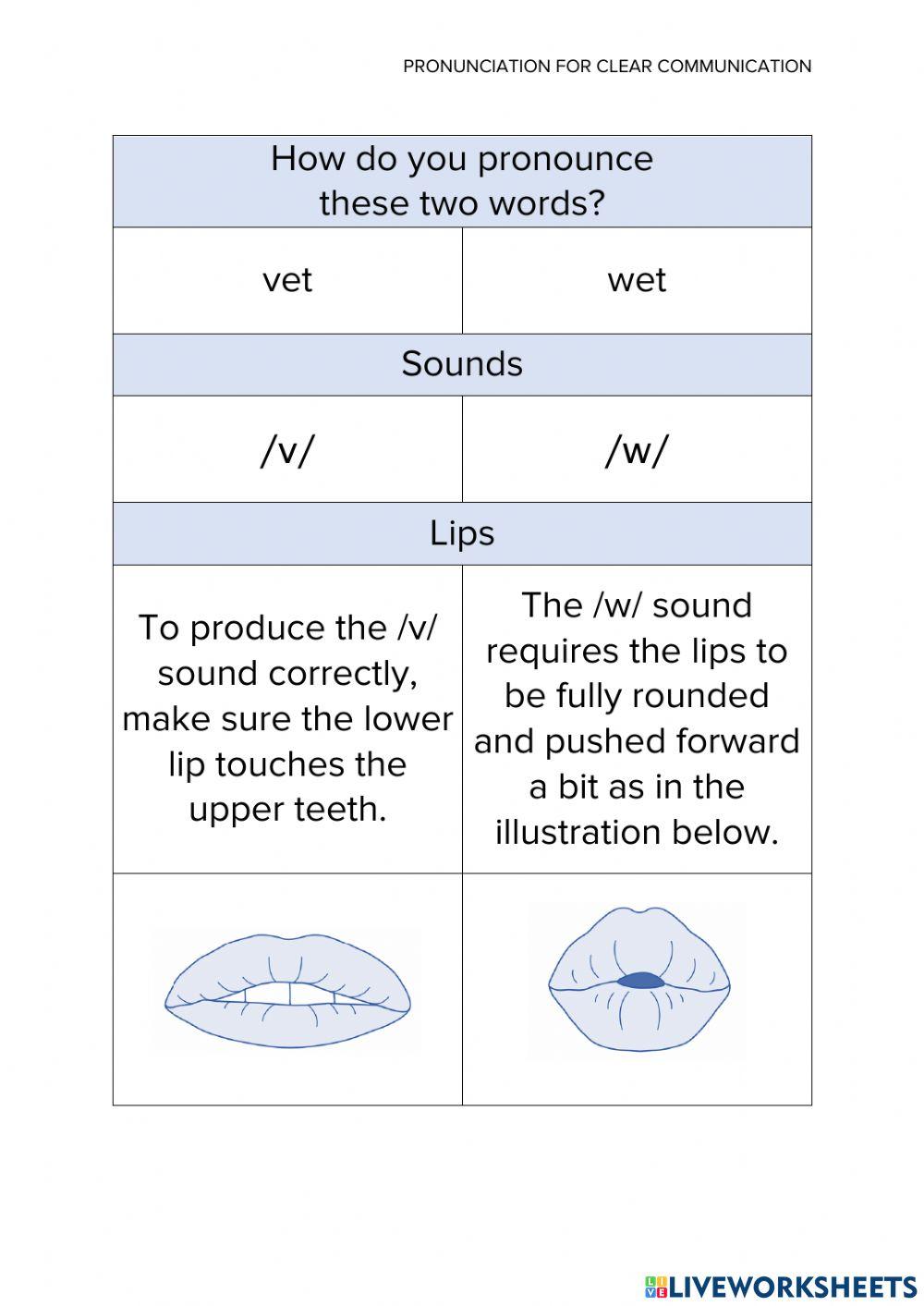
Watch the video from 00:42 to 02:25. Focus on these two key differences: For the /v/ sound: The bottom lip makes contact with the top teeth. You should feel a vibration or buzzing from the friction. For the /w/ sound: The lips are rounded and pushed forward. Nothing touches the lips. The sound is smooth.
To reinforce this, look at the image below. It clearly shows the difference in mouth shape. Try making these shapes in front of a mirror.
3. Practice with Minimal Pairs
Minimal pairs are words that differ by only one sound. Practicing them is one of the most effective ways to train your mouth and ears to distinguish between similar sounds.
Let's start by watching a demonstration of a few minimal pairs. This video explains the difference in meaning as well, which helps connect the sound to the word.
Pronunciation - V & W sound - English Accent Lesson
This video from Learn English | Let's Talk demonstrates several useful minimal pairs.
Watch from 02:13 to 04:25. Repeat each pair of words aloud after the speaker: vent / went very / wary vet / wet Focus on exaggerating the mouth movements at first: bite your lip gently for the /v/ words and round your lips for the /w/ words.
Now that you have the basic idea, you can use a more extensive list for practice. The following resource provides a table of minimal pairs.
Minimal Pairs Practice: /v/ vs. /w/ Sounds
This webpage from 7ESL offers a great summary and a comprehensive list of minimal pairs for /v/ and /w/.
First, review the section 'Minimal Pair /v/ vs. /w/ with Example Sentences' to see the words in context. Then, go to the 'Minimal Pair /v/ vs. /w/ List'. Spend a few minutes reading these pairs aloud. Pick 3-4 pairs that you find challenging and repeat them several times.
4. Practice in Sentences and Phrases
Producing the sounds correctly in isolated words is the first step. The real challenge is maintaining that accuracy in connected speech, especially when both sounds appear close together.
Let's practice some phrases designed to highlight this challenge.
How to pronounce the V and W (and how NOT to confuse them when speaking)
We'll return to the first video to practice phrases that contain both sounds. The instructor gives excellent advice on how to approach this.
Watch from 02:25 to 05:32. Say the phrases along with the instructor. Go slowly at first. very well: Feel the /v/ (teeth on lip) then the /w/ (rounded lips). vicious wedding: Again, consciously switch your mouth position between the two words. Viking warriors: Practice the transition from /v/ to /w/. Don't be discouraged if it feels difficult. This is an advanced exercise that builds muscle memory.
Finally, let's practice with full sentences that mix the sounds. This will help you prepare for using them in real conversation.
Pronunciation - V & W sound - English Accent Lesson
The second video we watched has a great section with full practice sentences.
Watch from 05:42 to 07:54. Read the sentences aloud with the speaker. 'Victor and Walter wear white vests.' 'It is windy in West Virginia.' Record yourself saying these sentences and listen back. Can you hear a clear difference between your /v/ and /w/ sounds?
Conclusion
Excellent work today. You have tackled one of the most common pronunciation hurdles for Hindi speakers and have learned the precise physical adjustments needed to master the /v/ and /w/ sounds.
Key Takeaways:
- The English /v/ is a fricative: Your top teeth must make gentle contact with your bottom lip to create audible friction or buzzing.
- The English /w/ is an approximant: Your lips must be rounded, with no contact from your teeth. The airflow is smooth and without friction.
- The key is to consciously separate the single Hindi /ʋ/ sound into these two distinct English sounds.
- Practicing with minimal pairs and sentences containing both sounds is the best way to build muscle memory and confidence.
Preview of Next Lesson:
In our next lesson, we will continue exploring fricatives. We will focus on producing the palato-alveolar sounds /ʃ/ (as in 'she') and /ʒ/ (as in 'vision'), and the glottal fricative /h/ (as in 'he'). These sounds will add more refinement and clarity to your English speech.