Hello! Welcome to the next lesson in your journey to improve your English pronunciation.
In our last session, we focused on producing the voiced 'th' sound /ð/ and distinguishing it from the /d/ and /z/ sounds. You practiced this in words like this, they, and mother, which is a major step in sounding clearer and more natural.
Today, we shift our focus to a new and important challenge: producing consonant clusters at the beginning of words. A consonant cluster is a sequence of two or more consonant sounds with no vowel sound between them. Our goal is for you to confidently pronounce words that start with clusters like 'str' (as in street), 'spr' (as in spring), and 'scr' (as in screen).
1. What are Consonant Clusters and Why Are They a Challenge?
As a native Hindi speaker, you might find that your mouth automatically wants to add a small vowel sound, like a schwa /ə/, between consonants. This is because consonant clusters are less common in Hindi than in English. For example, a word like "street" might come out sounding like "suh-treet" or "is-treet." The key to mastering these clusters is to become aware of this tendency and to practice moving smoothly from one consonant sound to the next without any breaks.
Let's watch a short video that explains this specific challenge for Hindi and Urdu speakers.
10 pronunciation challenges for Hindi & Urdu Speakers | हिंदी भाषी के लिए अंग्रेजी उच्चारण
This clip from Accent's Way English with Hadar clearly explains why consonant clusters can be difficult and what happens when they are 'broken'.
Please watch from 09:33 to 11:10. Pay close attention to the examples given, such as 'sleep' being pronounced 'suh-leep'. The main point is that the challenge isn't the individual sounds, but the transition between them.
The secret, as the video mentions, is awareness and slow, deliberate practice.
2. The Building Blocks: Two-Consonant Clusters
Before we tackle the more complex three-consonant clusters, let's look at some common two-consonant clusters. These are the fundamental building blocks. The image below shows a table of common clusters that start with plosive sounds like /p/, /t/, and /k/.
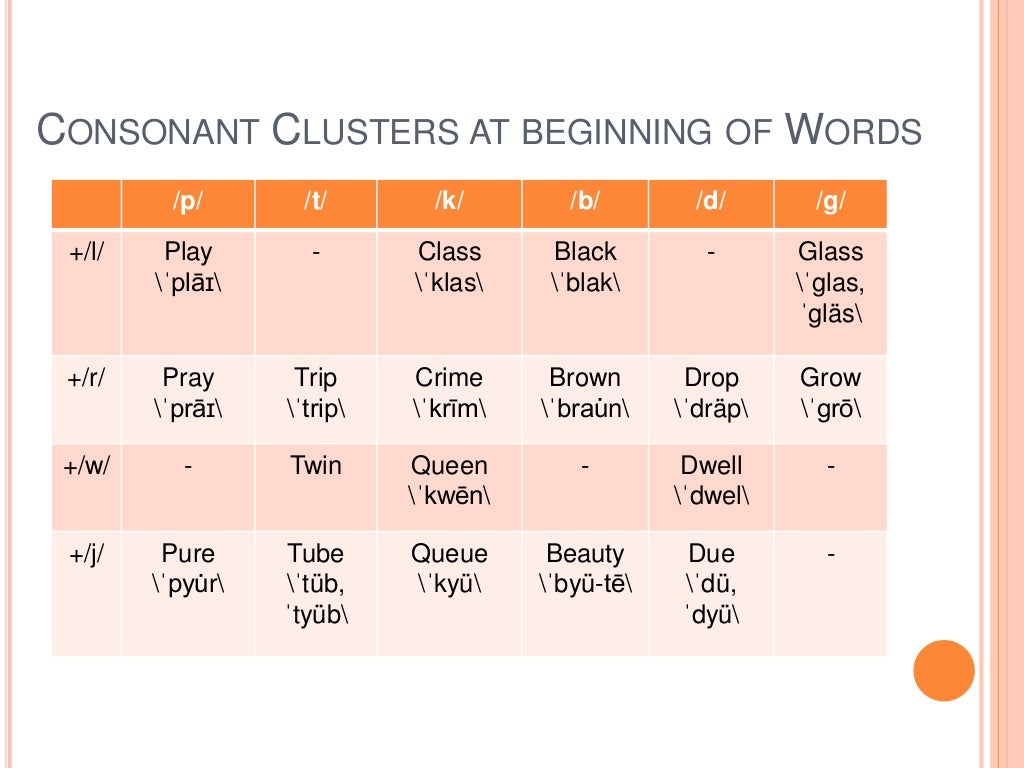
The most common initial clusters involve the letter 's', such as:
- sp- (speak, sport)
- st- (stop, start)
- sk- (sky, school)
Let's quickly review how to approach these. The key is to produce the long /s/ sound and immediately move your lips or tongue into position for the next consonant without releasing any air in between.
The 22 Most Common Consonant Clusters in English
The article 'The 22 Most Common Consonant Clusters in English' from the BoldVoice Blog gives simple instructions for many of these. We'll look at two foundational 's' clusters.
Please find and read the short sections for 15. SP /sp/ and 16. ST /st/. Notice the instruction is to pronounce the hissing /s/ sound and then transition immediately into the next sound (/p/ or /t/). Practice the example words provided for each.
3. Mastering Three-Consonant Clusters
Now you're ready to tackle the three-consonant clusters from our learning goal: /spr/, /str/, and /scr/. These can feel like a mouthful, but we can break them down. The trick is to think of them as the two-consonant clusters you just practiced ('sp-', 'st-', 'sk-') with an /r/ or /l/ sound added on the end.
The following video provides excellent, detailed instructions on the physical movements required for each cluster. Since you prefer to know the theory of sound production, pay close attention to the instructor's directions about tongue and lip positioning.
Pronunciation and fluency practice with consonant clusters spr,spl,stj,str,skr,skw - British English
This video from 'English with Liz' is a fantastic guide for practicing three-consonant clusters. We will work through it section by section.
Watch the following segments and repeat the words after the instructor. Try to mimic her mouth movements exactly. 'spr' cluster (00:16 - 01:55): Notice how she builds the sound from /s/ -> /sp/ -> /spr/. Focus on rounding your lips for the /r/ as you finish the /p/ sound. 'str' cluster (04:19 - 04:53): Here, you combine the 'st' cluster with an 'r'. Get your tongue ready for the /r/ sound right after you produce the /t/. 'scr' cluster (04:53 - 05:37): This combines 'sk' with 'r'. The back of your tongue makes the /k/ sound, and then the tip of your tongue curls for the /r/. Try to say the example words slowly at first, ensuring no vowel sound sneaks in between the consonants. For example, for 'street', it should be /s-t-r-iːt/, not /s-ə-t-ə-riːt/.
4. Practice and Consolidation
Let's put your knowledge to the test. Look at the image below. On the left is a list of words that all start with 'scr', 'str', or 'spr'. Your task is to mentally sort each word into its correct category on the right. This will help you quickly recognize and categorize these clusters.

Take a minute to go through a few words. For example:
- "strong" -> starts with 'str'
- "scratch" -> starts with 'scr'
- "spring" -> starts with 'spr'
This kind of rapid recognition is a great way to train your brain to see these clusters as single units.
Conclusion
Great work today! You have tackled a very common but tricky aspect of English pronunciation for Hindi speakers. By understanding why you might be tempted to break up consonant clusters and practicing how to blend the sounds together smoothly, you are making your speech much more fluid and natural.
Key Takeaways:
- A consonant cluster is a series of consonants with no vowel sound between them.
- The main goal is to avoid inserting a vowel sound (like /ə/) between the consonants.
- To pronounce clusters, focus on a smooth, quick transition from one consonant's mouth position to the next.
- For three-consonant clusters like 'str-', 'spr-', and 'scr-', practice building the sound from two consonants ('st-', 'sp-', 'sk-') and then adding the final consonant.
Preview of Next Lesson:
We've focused on clusters at the beginning of words. In the next lesson, we will continue this topic by learning how to produce two-consonant clusters at the end of words, such as in past (-st), hand (-nd), and left (-ft).