Introduction
Hello! In our last lesson, we focused on answering introductory interview questions with clear rhythm and pronunciation. You practiced the valuable technique of recording yourself to identify areas for improvement, which is a fantastic foundation for what we'll cover today.
This lesson moves on to a more advanced interview skill: answering behavioral questions. Your learning goal is to use appropriate intonation and sentence stress to structure your answers effectively. These questions often start with "Tell me about a time when..." and require you to tell a story about your past experiences. How you use the "music" of your voice—your stress and intonation—is just as important as the words you choose. Mastering this will help you tell compelling stories that showcase your skills and make a strong impression on your future employer.
1. Structuring Your Story: The STAR Method
Before we talk about how to say your answer, let's establish what to say. The most effective way to answer behavioral questions is by using the STAR method. This framework ensures your story is clear, concise, and complete.
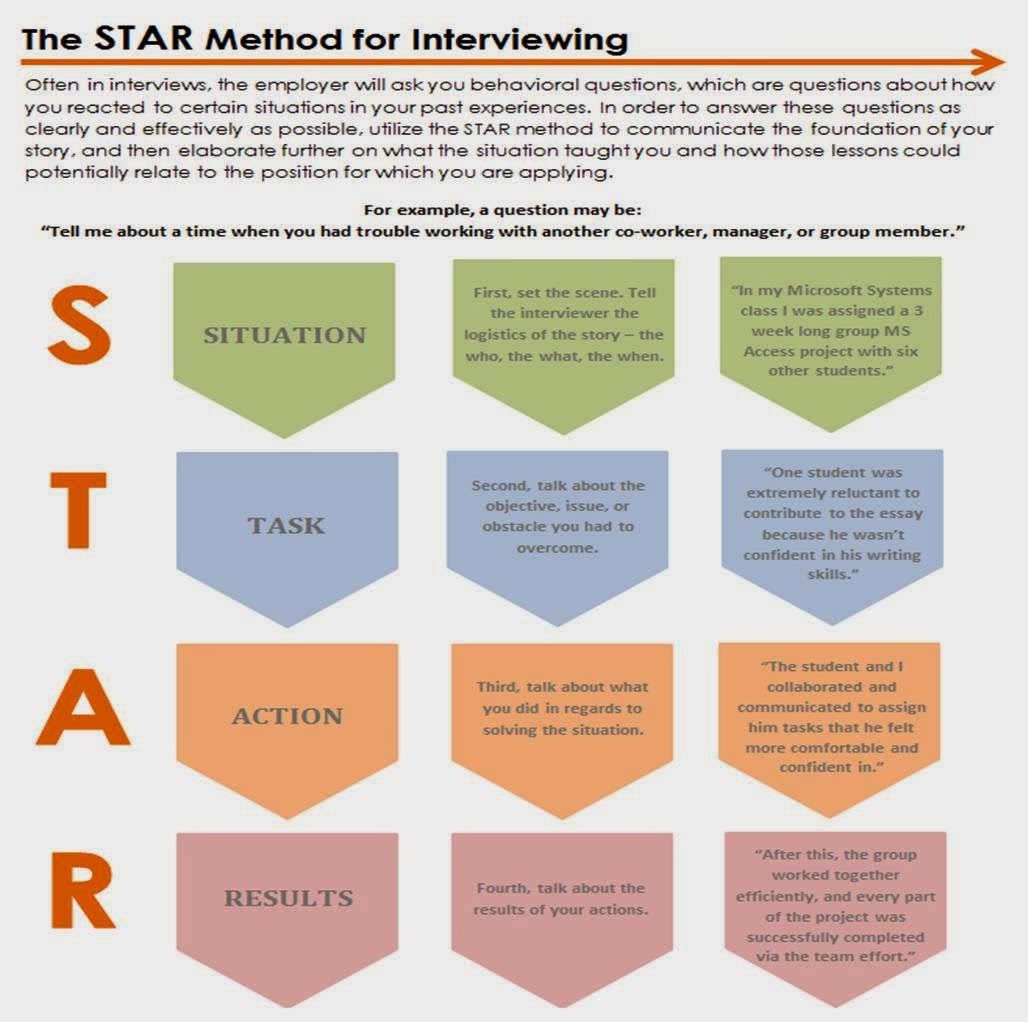
Using STAR prevents you from rambling and helps the interviewer easily follow your experience. It provides a logical structure that we can now bring to life with pronunciation.
2. Guiding the Listener with Sentence Stress
In previous lessons, we learned that sentence stress is about emphasizing content words (nouns, main verbs, adjectives) and reducing function words (prepositions, articles). Now, we'll take that a step further. When telling a story, you can use stress flexibly to highlight the most important idea in each part of your STAR answer.
This is not about stressing every content word, but about choosing the key word that carries the main point of that sentence.
Sentence Stress in English Pronunciation
Let's watch a video from Oxford Online English that explains how stress can be used flexibly to change meaning and add emphasis. This is the exact technique you will use in your STAR answers.
Please watch the section from 08:43 to 12:48. Pay close attention to how adding 'extra' stress to a specific word (like 'ARGENTINA' or 'FOUR') changes the focus of the sentence. This is how you will guide your interviewer's attention through your story.
Think of this "extra" stress as a spotlight. In each part of your STAR answer, you'll shine a spotlight on the most crucial information:
- Situation: Stress the key details of the context. (e.g., "We had a TIGHT deadline for the project.")
- Task: Stress the main challenge or goal. (e.g., "My task was to organize the entire event.")
- Action: Stress the specific verbs that show what you did. (e.g., "So, I created a shared schedule and delegated the tasks.")
- Result: Stress the positive outcome, especially numbers or key achievements. (e.g., "As a result, we finished two days early and received excellent feedback.")
3. Sounding Confident and Clear: Intonation and Pausing
Once you know which words to stress, the next step is to deliver them with confident intonation. This involves using pitch changes and strategic pauses to make your story engaging and easy to follow.
How to Stop Sounding Robotic: Use Stress and Intonation to Sound Natural in English
The following video from ETJ English demonstrates how to use intonation and pausing to sound more natural and confident. The concepts here are directly applicable to delivering a powerful STAR answer.
First, watch from 00:57 to 02:36. Notice how the speaker uses a falling tone on the final word ('project') to show completion and sound confident. You will do this at the end of your final 'Result' statement. Next, watch from 03:35 to 05:39. This section highlights the power of pausing. A short pause between the 'S', 'T', 'A', and 'R' sections of your story acts like a paragraph break, giving the listener time to process the information and showing that you are in control of your narrative.
Here's how to apply this:
- Falling Tone: Use a decisive falling tone at the very end of your answer to signal completion and confidence.
- Pausing: Take a slight pause after you explain the Situation, the Task, and the Action. This separates the parts of your story and makes it much easier to understand.
- Pacing: As the video mentions, speaking slowly and deliberately conveys confidence. Avoid rushing, especially since you are also focusing on articulation with braces.
A Note for Hindi Speakers
When applying these stress and intonation patterns, it's helpful to be aware of how they might differ from your native language.
English for Urdu and Hindi Speakers: 10 Pronunciation Challenges
As a native Hindi speaker, you might have a natural tendency to use pitch differently than in American English. This short article from Hadar Shemesh explains a key difference that is very useful to know.
Please read the section on 'applying the intonation patterns of Hindi-Urdu onto English'. The key insight is that in Hindi, many words are stressed with a rising pitch. In English, stressing too many words can confuse the listener. Your goal is to stress only one or two key words per phrase to make your main point clear.
This is why identifying the single most important word to stress in each sentence of your STAR answer is so powerful. It's a direct and effective way to practice the rhythm of English.
4. Your Practice Task: Telling a Story
Now, let's put this all together. Your task is to prepare and practice answering a behavioral question using the STAR method, focusing on stress and intonation.
Your Task (30 minutes):
-
Choose a Question: Select one of these common behavioral questions:
- Tell me about a time you had to work with a difficult team member.
- Describe a situation where you had to learn a new skill quickly.
- Give an example of a goal you reached and tell me how you achieved it.
-
Outline Your STAR Answer (5 mins): On a piece of paper, write 1-2 bullet points for each section. Do not write full sentences.
- S (Situation):
- T (Task):
- A (Action):
- R (Result):
-
Mark Your Stress and Pauses (5 mins):
- Read through your bullet points. In each point, underline the one or two key words you will give extra stress.
- Place a slash mark ( / ) where you plan to take a short, deliberate pause (e.g., between S, T, A, and R).
-
Record and Critique (20 mins):
- Set up your phone or computer to record yourself.
- Deliver your answer, using your notes as a guide. Focus on hitting the stressed words and honoring your pauses.
- Listen back. Ask yourself:
- Stress: Did I clearly emphasize the words I underlined? Or did I stress too many words?
- Pausing: Were my pauses deliberate? Did they help structure the story?
- Intonation: Did I use a confident, falling tone at the very end of my answer?
- Re-record at least once, trying to improve on one specific aspect (e.g., "This time, I will make my pauses longer," or "This time, I will really emphasize the verbs in my 'Action' section").
Conclusion
Excellent work today. You have learned how to combine a logical structure (STAR) with the musical elements of English (stress, intonation, and pausing) to answer complex behavioral interview questions effectively. This skill is fundamental to coming across as a clear, confident, and compelling candidate.
Key Takeaways:
- Behavioral questions are best answered using the STAR method (Situation, Task, Action, Result).
- Use flexible sentence stress to spotlight the most important information in each part of your STAR story.
- Employ strategic pauses between the STAR sections to structure your narrative and give the listener time to think.
- End your answer with a falling intonation to signal confidence and completion.
- For Hindi speakers, focusing on stressing fewer words more strongly is a key strategy for clarity in English.
Preview of Next Lesson:
An interview is a two-way conversation. Now that you've practiced answering questions, our next lesson will focus on the other side: how to formulate and ask questions about the role and company using polite intonation. This will help you sound engaged, thoughtful, and professional as you gather the information you need.